
Engineers Australia Competency Assessment is covered in this guide for Engineers Australia applicants.
What is the Engineers Australia Competency Assessment and who is it for?
Anyone who wants to work as an engineer in Australia has to go through the Engineers Australia Competency Assessment. This test checks their skills, knowledge, and experience. It’s for engineers who got their degrees somewhere other than Australia and want to be honoured in their home country.
Introduction
An important goal for engineers is to become a member of Engineers Australia. This opens up a lot of opportunities in the field. But not all engineering credentials meet the standards right away to become a member. For those whose credentials don't meet the needs you will have to take a competency assessment
which is another name for an entry to practice test.
This is the first thing you need to do to join and get an Australian Skilled Migration visa. In this article we will cover what this assessment involves including the assessment routes for those with an ASQA-recognised Australian associate degree or advanced diploma in engineering and those looking for a job as an engineering associate.
The Washington Accord the Sydney Accord and the Dublin Accord all respect certain skills.
We will also talk about how important it is to have those skills. These are important parts of the process that Engineers Australia uses to check your skills for the engineering job you want. The Engineering Australia acceptance letter needs to be sent with your visa application to the Department of Home Affairs.
We will talk about how important this is. As an engineer you should be able to work without being supervised.
This letter will show that you have the professional values and understanding to do so.
- What is the Engineers Australia Competency Assessment and who is it for?
- Introduction
- When Do You Need a Competency Assessment?
- What Does the Assessment Involve?
- How to Apply
- Assessment Requirements: Prepare the following documentation:
- Assessment Outcome
- Fees
- Conclusion
- FAQs for Engineers Australia Competency Assessment
- 1. What is a professional engineer?
- 2. What is a skills assessment?
- 3. What is a Stage 1 Competency Assessment?
- 4. How does Engineers Australia conduct skills assessment?
- 5. What is a Stage 2 Competency Assessment?
- 6. What is a Career Episode?
- 7. What is an Engineering Competency Claim?
- 8. What is a Migration Skills Assessment?
- 9. What is Relevant Skilled Employment Assessment?
- 10. What is a CDR writer?
- 11. What is a Chartered Member?
- 12. What is a Engineering Competency Report?
- 13. What is the National Engineering Register?
- 14. What is Continuing Professional Development (CPD)?
- 15. What is an Accredited Qualification?
- 16. What is a Skilled Migration Visa?
When Do You Need a Competency Assessment?
When the following things happen, Engineers Australia may need to do a competency test for you:
Skills in Australia that aren’t recognised: If you learned engineering skills in Australia but they aren’t accredited or accepted by Engineers Australia, you will need to get them evaluated.
The engineering skills you get outside of Australia are not recognised by Engineers Australia. If you already have engineering credentials from another country, you will have to go through the same process.
Fields that are similar for people with graduate engineering degrees: A lot of the time, Engineers Australia won’t accept your credentials if they fall outside of engineering. You might still be able to get another chance if you have a master’s degree in engineering and a lot of experience as an engineer.
What Does the Assessment Involve?
The goal of the competency test is to really show you what skills and abilities you have. There are three important areas where Engineers Australia checks your skills:
This part tests your knowledge of basic engineering ideas to see how much you know.
This part tests your engineering skills by seeing how well you can use what you know to solve problems and handle situations that are unique to your job.
Professional Attributes: This part of the test checks to see if you have the professional traits that you are supposed to have as an engineer.
How to Apply
These are the steps you need to take to begin the ability test:
Sign up: First, sign up for an account on the Engineers Australia member page.
Get your papers together: Get the files you need in a format that can be shared with your test application.
One color-scanned copy of your main form of ID like a passport driver's licence or birth certificate; one passport-sized photo; proof that you can speak and write English (if needed); copies of all your credentials; and full instructions on how to fill out your migration skills assessment application including how much the assessment costs.
You can download a document that goes over all of the requirements for the test in great depth.
Assessment Requirements: Prepare the following documentation:
CV or Resume: Please send a recent CV or resume that shows all of your engineering jobs from when you were an undergrad to now. Not more than three pages long, and make sure it lists any work experience you had while you were in school.
job Episodes: You need to write about three things that happen at work that show off your tech skills. You should also add a summary line that ties these events together.
Assessment Outcome
Assessors from Engineers Australia will look over your report after you send it in. This test takes four weeks most of the time, but it can take longer. Your gateway account will let you know when the test is over.
For those who do well on the test, your gateway account can be used to apply to become a member of Engineers Australia. With three months, you can ask for a review, and with six months, you can file an appeal if you do not pass. It costs extra to do either of these things..
Fees
You can become a lawyer by taking a test that costs $810. It’s also important to know that if you get in, you will have to pay extra to become a member.
Conclusion
This is a very important step for people whose engineering skills don’t directly meet the requirements to become a member of Engineers Australia. If you do what it takes and send in the right paperwork, you can get your engineering skills and experience recognised. Once that happens, you can join Engineers Australia and enjoy its benefits.
FAQs for Engineers Australia Competency Assessment
1. What is a professional engineer?
A professional engineer is someone who has met the requirements and standards set by Engineers Australia. They have shown that they are skilled in their engineering area through education, experience, and testing.
2. What is a skills assessment?
A skills assessment is a process conducted by Engineers Australia to evaluate the qualifications, experience, and competency of engineers seeking migration or professional recognition in Australia.
3. What is a Stage 1 Competency Assessment?
Stage 1 Competency Assessment is the initial assessment phase conducted by Engineers Australia to determine if an applicant’s qualifications and experience meet the requirements for entry into the engineering profession in Australia.
4. How does Engineers Australia conduct skills assessment?
Engineers Australia conducts skills assessment through a thorough evaluation of an applicant’s educational qualifications, work experience, and engineering competency claims.
5. What is a Stage 2 Competency Assessment?
Stage 2 Competency Assessment is the second phase of assessment conducted by Engineers Australia for those seeking professional registration as a Chartered Professional Engineer or Chartered Engineering Technologist.
6. What is a Career Episode?
A Career Episode is a detailed account of an engineer’s specific engineering work experience, submitted as part of the Competency Demonstration Report (CDR) required for Engineers Australia assessment.
7. What is an Engineering Competency Claim?
An Engineering Competency Claim is a statement made by an engineer detailing how their education, training, and experience align with the competency standards set by Engineers Australia.
8. What is a Migration Skills Assessment?
A Migration Skills Assessment is an assessment conducted by Engineers Australia to determine an engineer’s eligibility for skilled migration to Australia based on their qualifications and experience.
9. What is Relevant Skilled Employment Assessment?
Relevant Skilled Employment Assessment is an evaluation conducted by Engineers Australia to assess an engineer’s work experience against Australian standards for skilled migration purposes.
10. What is a CDR writer?
A CDR writer is a professional who assists engineers in preparing their Competency Demonstration Reports (CDRs) for submission to Engineers Australia.
11. What is a Chartered Member?
A Chartered Member is an engineer who has been granted chartered status by Engineers Australia, indicating a high level of professionalism and competency in their field.
12. What is a Engineering Competency Report?
An Engineering Competency Report is a document submitted to Engineers Australia as part of the assessment process, detailing an engineer’s qualifications, experience, and competency.
13. What is the National Engineering Register?
The National Engineering Register is a database maintained by Engineers Australia containing information on registered and chartered engineers in Australia.
14. What is Continuing Professional Development (CPD)?
Continuing Professional Development (CPD) refers to the ongoing process of maintaining and improving professional knowledge and skills through activities such as training, seminars, and workshops.
15. What is an Accredited Qualification?
An Accredited Qualification is a degree or certification recognized by Engineers Australia as meeting the standards for entry into the engineering profession.
16. What is a Skilled Migration Visa?
A Skilled Migration Visa is a visa category that allows individuals with skills and qualifications needed in Australia to migrate to the country for employment purposes.
These FAQs aim to provide clarity on various aspects of the Engineers Australia Competency Assessment process. For further information and specific inquiries, individuals are encouraged to refer to Engineers Australia’s official website or contact their customer service representatives.
Engineers Australia competency assessment checklist for Engineers Australia
A strong application should make the assessor’s job easy. Keep the discussion specific to your nominated occupation, explain your personal engineering contribution, and connect each claim with evidence from your projects, employment documents, CPD records, and career episodes.
- Use the same occupation wording consistently across the CV, CDR, career episodes, and summary statement.
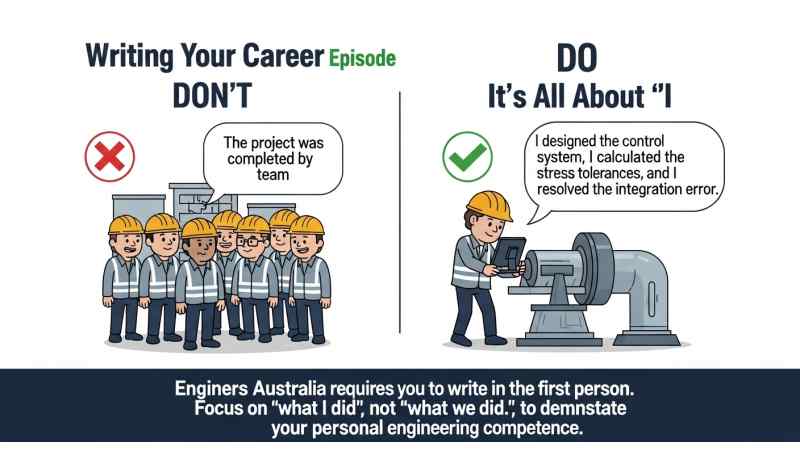
- Explain what you personally designed, calculated, tested, supervised, improved, or solved.
- Support technical claims with project context, tools, standards, constraints, and measurable outcomes.
- Check that the final report follows Engineers Australia guidance before submission.
For related support, see our CDR writing services, sample CDRs for Engineers Australia, and Engineers Australia Skill Assessment guide.
FAQs about Engineers Australia competency assessment
Why does Engineers Australia competency assessment matter for a CDR?
It helps align your report with the occupation and assessment pathway you are presenting to Engineers Australia. Clear alignment can reduce confusion and make your competency evidence easier to review.
What should I prepare before writing?
Prepare your CV, academic records, employment evidence, CPD list, project notes, calculations, drawings, and any documents that prove your personal engineering role.
Can I use a sample before writing?
Yes. A sample can help you understand structure and tone, but your final report should be written around your own work, decisions, and engineering responsibility.
Engineers Australia Competency Assessment supporting resources

Engineers Australia Competency Assessment complete preparation guide
Engineers Australia Competency Assessment also needs a clear document trail. Applicants should keep transcripts, employment records, project evidence, CPD details, and identity documents ready before starting the final review. This makes the Engineers Australia assessment easier to follow and reduces avoidable gaps in the application.
When preparing Engineers Australia Competency Assessment, the applicant should describe engineering tasks in plain English and then support each claim with technical detail. Good examples include calculations, drawings, standards, safety checks, design choices, testing methods, site coordination, and measurable project outcomes.
A strong Engineers Australia Competency Assessment draft should not read like a job description. It should explain the problem, the applicant’s personal role, the action taken, and the result. This gives the assessor enough context to understand the level of responsibility and engineering judgement shown in the project.
Before submitting Engineers Australia Competency Assessment, review every section for consistency. Names, dates, project titles, employment periods, and competency references should match across the career episodes, summary statement, CPD list, and supporting evidence. Small mismatches can slow down the assessment.
The best Engineers Australia Competency Assessment preparation balances accuracy and readability. Engineers Australia assessors need technical evidence, but they also need a document that is organised, concise, and easy to verify. Short paragraphs, descriptive headings, and careful proofreading help make the application stronger.
Applicants should also check whether their nominated occupation, ANZSCO code, and engineering category match the evidence in the report. If Engineers Australia Competency Assessment is prepared around the wrong occupation, even a well written document may fail to support the intended migration pathway.
For final quality control, compare Engineers Australia Competency Assessment against the current Engineers Australia guidance and remove unsupported claims. The final version should be original, factual, and written around real engineering work rather than copied samples or broad template language.
Engineers Australia Competency Assessment also needs a clear document trail. Applicants should keep transcripts, employment records, project evidence, CPD details, and identity documents ready before starting the final review. This makes the Engineers Australia assessment easier to follow and reduces avoidable gaps in the application.
When preparing Engineers Australia Competency Assessment, the applicant should describe engineering tasks in plain English and then support each claim with technical detail. Good examples include calculations, drawings, standards, safety checks, design choices, testing methods, site coordination, and measurable project outcomes.
A strong Engineers Australia Competency Assessment draft should not read like a job description. It should explain the problem, the applicant’s personal role, the action taken, and the result. This gives the assessor enough context to understand the level of responsibility and engineering judgement shown in the project.
Before submitting Engineers Australia Competency Assessment, review every section for consistency. Names, dates, project titles, employment periods, and competency references should match across the career episodes, summary statement, CPD list, and supporting evidence. Small mismatches can slow down the assessment.
The best Engineers Australia Competency Assessment preparation balances accuracy and readability. Engineers Australia assessors need technical evidence, but they also need a document that is organised, concise, and easy to verify. Short paragraphs, descriptive headings, and careful proofreading help make the application stronger.
Related reading
- Start with how the EA skills assessment works from start to finish.
- See also the Engineers Australia skill assessment process.
- Background: the complete Engineers Australia CDR guide.
- Next step: our CDR review, edit and plagiarism check service.
- Next step: CDR samples by engineering discipline.
- Also useful: the Mechanical Engineering Draftsperson pathway (ANZSCO 312511).
- See also: how many points you would score for PR.