
CDR Writing: A Full Guide for Engineers Australia Skill Test
CDR Writing is covered in this guide for Engineers Australia applicants.
Introduction
Migrating to Australia as a professional engineer requires passing a skills assessment by Engineers Australia, the designated authority for evaluating engineering qualifications. For many international engineers, this process includes preparing a Competency Demonstration Report (CDR) – a comprehensive document that showcases your engineering education and work experience, proving that your skills meet Australian standards.
Writing a CDR for Engineers Australia can seem daunting, especially if you’re unfamiliar with the requirements and format. This friendly guide will break down everything you need to know about writing CDR Engineers Australia assessments, from understanding what a CDR entails to step-by-step tips for crafting a successful report. By the end, you’ll have a clear roadmap to create an impressive CDR that boosts your chances of a positive skills assessment outcome.
Who Needs a CDR?
Not every engineer migrating to Australia needs to write a CDR – it depends on your qualifications. Engineers Australia recognizes certain accredited qualifications (for example, degrees from Washington Accord universities) which may exempt applicants from the CDR requirement.
However, if your engineering degree is not accredited or you’re from a country without a recognized agreement, you will likely need to undergo the CDR pathway as part of the migration skills assessment.
In simple terms, the CDR is your opportunity to demonstrate your competency as an engineer in lieu of formal recognition. It’s often referred to as the “Engineers Australia skill assessment test” for non-accredited engineers, though in reality it’s not a written exam but a compilation of documents about your engineering journey.
If you are an engineer seeking migration to Australia, chances are you’ll be preparing a CDR to prove that your skills and knowledge are equivalent to Australian-trained engineers.
Why is the CDR Important?
Engineers Australia uses the CDR to assess whether you have the engineering competencies needed for the Australian workforce. A well-prepared CDR can lead to a positive skills assessment, which is crucial for your visa application. On the other hand, a poorly written CDR could result in rejection or delay your migration plans.
Essentially, the CDR is your chance to present your engineering story in the best possible light – highlighting your technical expertise, problem-solving abilities, and contributions to projects. It’s not just a formality; it’s a personal marketing document that can make or break your Australian engineering dreams.
Therefore, understanding what Engineers Australia expects in a CDR is the first step to success. In this guide, we’ll walk you through the CDR’s key components, how to write them effectively, and common mistakes to avoid, all in a friendly, step-by-step manner.
What is a CDR (Competency Demonstration Report)?
A Competency Demonstration Report (CDR) is a collection of documents that demonstrate your engineering competencies to Engineers Australia. Think of it as a comprehensive portfolio of your engineering career. The CDR typically consists of three main parts:
-
Continuing Professional Development (CPD) List – A record of how you keep your engineering knowledge up-to-date.
-
Three Career Episodes – Three essays or reports each describing a specific engineering project or experience you’ve been involved in.
-
Summary Statement – A cross-referenced summary showing how your Career Episodes prove the competency elements required by Engineers Australia.
In essence, the CDR contains your educational and professional history in your own words. Engineers Australia assesses this report to verify that you have the skills, knowledge, and experience equivalent to an Australian-qualified engineer in your occupational category.
According to Engineers Australia, the CDR’s main purpose is to identify “your knowledge of technical engineering concepts, how you have applied your engineering skills, and your competency level in the engineering occupation you chose”.
Each component of the CDR plays a unique role in showcasing your qualifications:
-
CPD shows your commitment to lifelong learning as an engineer.
-
Career Episodes demonstrate your hands-on engineering experience and problem-solving in real projects.
-
Summary Statement maps your experiences to the specific competency standards Engineers Australia is looking for.
By requiring a CDR, Engineers Australia ensures that incoming migrants have proven their abilities in a detailed manner, beyond just academic transcripts or resumes. It’s a way to maintain professional standards within the Australian engineering industry. If you prepare your CDR thoroughly and thoughtfully, it not only helps the assessor approve your skills assessment, but also gives you confidence in your own professional journey.
Key Components of a CDR for Engineers Australia
Let’s dive deeper into each part of the CDR. A successful CDR application will include all three components described below, prepared according to Engineers Australia’s guidelines.
Continuing Professional Development (CPD)
Continuing Professional Development is a list of activities that show how you have kept your engineering knowledge and skills current after graduation. Engineers Australia wants to see that you are actively engaged in learning and improving in your field.
Your CPD can include a variety of formal and informal learning activities, such as:
-
Postgraduate courses or advanced degrees you’ve pursued.
-
Conferences or seminars you attended or presented at.
-
Workshops, technical training, or short courses completed.
-
Training programs or webinars in your engineering domain.
-
Memberships of professional bodies, committee work, or volunteering in engineering organizations.
-
Self-study like reading technical journals, manuals, or online courses.
When listing CPD in your CDR, you should present it in a simple list or table format, usually in chronological order. Each entry should mention the activity name, date, duration, venue, and organizer (if applicable). For example, an entry might be “Advanced Project Management Workshop – 15/03/2023 – 2 days – Sydney – Organized by IEEE.” The idea is to provide enough detail to show what the activity was and when you did it.
Keep your CPD list concise – Engineers Australia specifies that the CPD listing must not exceed one A4 page in length. You do not need to attach certificates or proof for every course; the list itself is sufficient evidence of your professional development (though you should be truthful, as they can request verification if needed).
The CPD section might seem less significant compared to the Career Episodes, but it’s still important. It demonstrates your commitment to staying up-to-date in your field, which is a key professional attribute.
Tip: When preparing your CPD list, include all relevant activities since graduation that added to your engineering skills. Even things like self-study (reading technical books or journals) can be listed. But make sure the CPD items are relevant to your engineering profession – focus on quality and relevance over quantity. And remember to keep it to one page.
Career Episodes
The Career Episodes are the heart of your CDR. These are three narrative essays (typically 1,000–2,500 words each) that describe separate instances in your engineering experience. Each Career Episode focuses on a different project or period of work in your career (or academic study) and highlights how you applied your engineering knowledge and skills in that context.
Think of a Career Episode as telling a story of an engineering task or project you were involved in. You might choose examples such as:
-
A significant project you worked on at your job (e.g., designing a component, solving a technical problem, leading a team in a project).
-
An engineering project from your university final year or during your post-graduate study.
-
A research project or thesis work (if it has a practical engineering aspect).
-
A specific engineering problem you solved or a unique design you contributed to.
Each episode should be distinct – do not use the same project twice or overlap too much. Engineers Australia expects three different episodes to show the breadth of your experience. For example, you might write one episode about a design project at work, another about a troubleshooting task or innovation you implemented, and a third about a university project or research experience. This variety helps cover a range of competency elements.
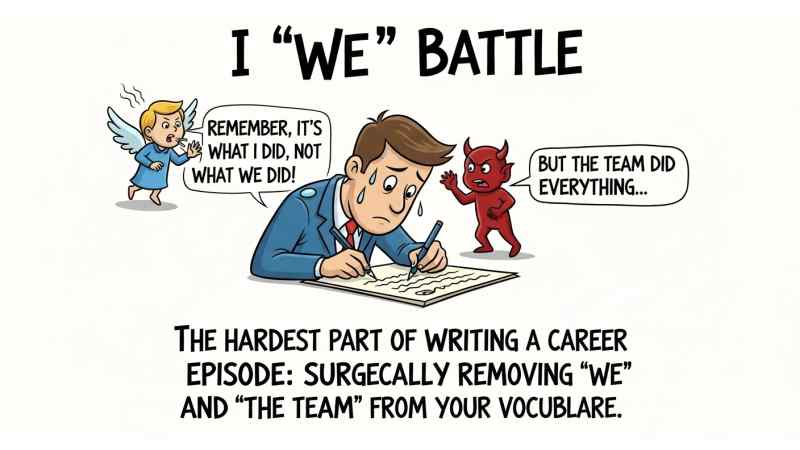
Writing style and focus: Write your Career Episodes in the first person (“I did this”), because they need to clearly highlight your personal role and contributions. The assessor wants to know what you specifically did – not just what the team or project achieved. Even if the project was a group effort, focus on your individual tasks and responsibilities. For instance, instead of saying “We installed and tested the new control system,” say “I designed the control system layout and personally supervised its installation and testing.” Be concrete and detailed about your own work.
Each Career Episode is written as a formal report or essay (not a bullet-point list or a table) describing:
-
What the project or task was, and what were its objectives?
-
Where and when it happened, and who you were working for (if applicable)?
-
What your role was and what you did – specifically your engineering tasks, techniques, and solutions.
-
What was the outcome and what did you learn or achieve?
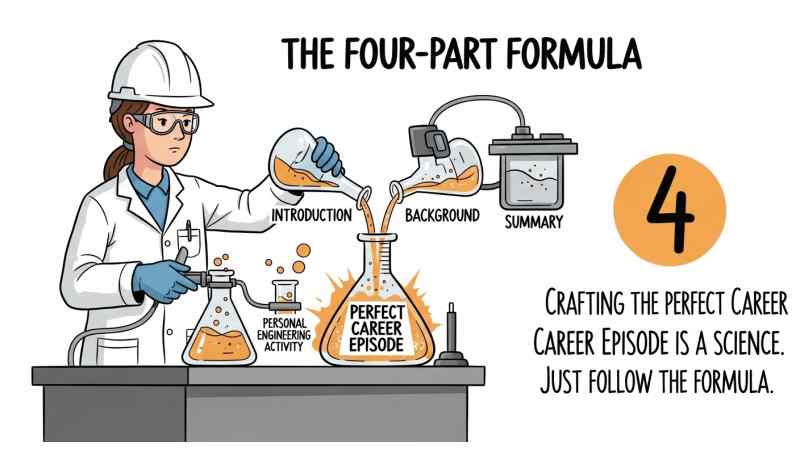
To give your Career Episodes a clear structure, Engineers Australia recommends dividing each episode into sections: Introduction, Background, Personal Engineering Activity, and Summary. Here’s what each part typically includes:
-
Introduction (about 100–150 words): Provide the basics – the chronology (dates and duration of the project/experience), the location, the organization or institution involved, and your job title or position at the time. Think of it as the who/what/when/where of the story. For example: “This episode describes my experience as a Civil Engineer at XYZ Construction from June 2019 to Jan 2020, during which I worked on the ABC Bridge Design Project in Melbourne.”
-
Background (200–500 words): Set the context for your work. You should describe the overall project objective and nature (what was the project about?), the organizational structure or team context (who were you working with, what was the project environment?), and your duties or responsibilities in that project. This section is like the scene-setting part of your story – it helps the reader understand why the project was undertaken and where you fit in.
You can include an organizational chart or a brief description of the team to show your position. If you have an official duty statement for your role, you can summarize it here.
-
Personal Engineering Activity (500–1500 words): This is the core part of the episode – the detailed narrative of what you did, how you applied your engineering knowledge, and how you solved problems. Describe your actions and thinking in first person (use “I” throughout). Key points to cover here include:
-
The technical tasks you undertook and how you carried them out (e.g., calculations, design process, analysis techniques, coding, testing, etc.).
-
Any engineering problems or challenges that arose and how you approached solving them. For example, did you encounter design constraints, errors, or unforeseen issues? Explain your problem-solving process.
-
Any creative or innovative solutions or strategies you devised. This could include new design ideas, improvements to existing processes, or optimizations you implemented.
-
How you worked with others on the project – but remember to keep the focus on your role. Mention collaboration or team coordination if relevant (e.g., “I coordinated with the electrical team to ensure my design integrated well with their system”), but avoid saying “we did X” without clarifying your part.
-
-
Use technical evidence and details to support your story. If possible, include figures like diagrams, schematics, or tables of results (these can be referenced in the text or included as images). Don’t overload with unnecessary theory or complex math, but do show that you undertook substantive engineering work.
-
This section should essentially showcase your engineering competency in action. Imagine you are proving to the assessor that you can perform as a qualified engineer – every paragraph should contribute to that proof. Also, number each paragraph of your Career Episodes (e.g., 1.1, 1.2, 1.3 for Episode 1; 2.1, 2.2 for Episode 2, etc.). Numbering is crucial because you will need these references for the Summary Statement later.
-
Summary (50–150 words): Conclude the episode with a short recap of the outcome of the project and your personal contribution. This is where you can reflect on the project – did it meet its goals? What was the final result or status? – and summarize how your involvement was important. You can also mention any lessons learned or how the experience helped you grow as an engineer. Keep this brief and positive, essentially wrapping up the story.
Illustration: The structure of a Career Episode in a CDR (Introduction, Background, Personal Engineering Activity, Summary). Each Career Episode should follow this format to cover all necessary details.
When writing your Career Episodes, always link back to the Engineers Australia competency elements where possible. Engineers Australia requires that across your three episodes, you demonstrate all the competency elements for your occupational category at least once. For instance, Professional Engineers have 16 elements of competency (covering things like knowledge base, problem-solving, ethics, communication, etc.), and you must show evidence of each of those somewhere in your episodes.
It’s a good idea to familiarize yourself with these elements (listed in the Migration Skills Assessment booklet or Engineers Australia website) so you can target your writing to cover them. For example, if one element is “Effective communication,” be sure to mention times you communicated ideas or led meetings; if another is “Identifies, assesses and manages risks,” describe how you handled a risk or safety issue in a project. A well-rounded set of Career Episodes will collectively touch on all required competencies.
Remember: Each Career Episode must be your own work and written in your own words. Engineers Australia has strict rules against plagiarism or misrepresentation. You cannot copy someone else’s CDR or use generic text from the internet. Not only would that fail to show your unique experience, but it’s also considered unethical.
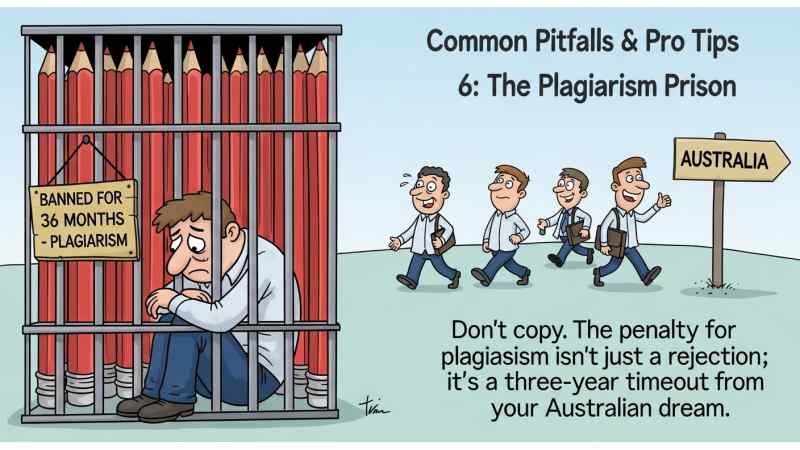
In fact, plagiarism or paying someone to write your CDR can lead to severe penalties – Engineers Australia may reject your application, impose a ban of up to 36 months, and even report you to immigration authorities. We’ll talk more about avoiding plagiarism in the tips section, but keep this in mind from the start: the Career Episodes must reflect your personal engineering journey.
Summary Statement
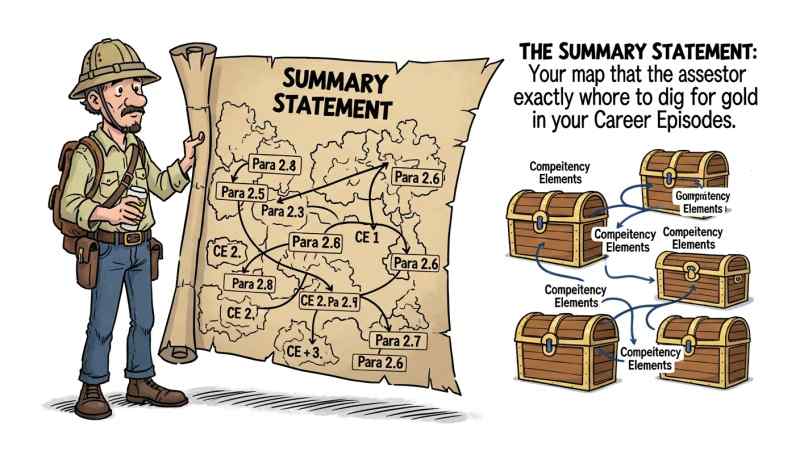
The Summary Statement is a single document (usually one or two pages) that comes after your three Career Episodes. In this section, you provide a concise table or list of how each competency element was demonstrated in your Career Episodes. Think of it as a map or index linking the requirements to your evidence.
Engineers Australia provides a template for the Summary Statement for each occupational category (Professional Engineer, Engineering Technologist, Engineering Associate, or Engineering Manager). These templates list out all the competency elements you need to address for your category.
Your job is to fill in the template with references to the paragraphs in your episodes where each element is showcased. For example, a portion of a summary statement for a Professional Engineer might look like:
1.4 – Discernsment of engineering techniques: Career Episode 1 – Paragraphs 1.5, 1.6; Career Episode 2 – Paragraph 2.3
2.1 – Application of established engineering methods: Career Episode 2 – Paragraphs 2.6, 2.7
(Note: This is just an illustrative example; refer to the actual template for the exact competency wording and numbering.)
When writing the Summary Statement, you do not re-write entire examples. You simply list the competency element and pinpoint where in your episodes you have demonstrated it. Because you numbered your paragraphs in the episodes, this cross-referencing becomes easier. Essentially, the Summary Statement is an overview of competencies: it shows the assessor that you have covered all the required skills and attributes, and it directs them to the exact parts of your narrative where you did so.
Some tips for the Summary Statement:
-
Use the correct template: Make sure you download the latest summary statement template for your engineering category from the Engineers Australia website. The competency elements differ for Professional Engineers vs. Engineering Technologists, etc. Using the wrong template could cause you to miss elements.
-
Be thorough: Ensure that every required competency element appears at least once in your summary statement (and thus, in your episodes). It’s fine (even common) for one episode to cover multiple elements, or for one element to be demonstrated in multiple episodes. Just make sure no element is left out. Engineers Australia explicitly states that all elements must be addressed at least once across the three episodes.
-
Keep it concise: The summary statement is typically a brief section. You do not need to elaborate on the stories again. Bullet points or a table format as given in the template is perfect. In fact, many applicants fit the summary statement on one page for clarity.
-
Double-check references: After you finish, double-check that the paragraph numbers you cite in the summary statement indeed correspond to the right competency and cover what you claim they do. Inconsistencies here can confuse the assessor. For instance, if you claim you demonstrated “ethical conduct (element 3.x)” in paragraph 2.4 of Career Episode 2, make sure paragraph 2.4 actually discusses an ethical decision or scenario.
The Summary Statement might be challenging because it requires analysis of your own writing. A good approach is to write your Career Episodes first, then study them while looking at the competency elements, and mark up which paragraph addresses which element. As you complete the summary, you’ll essentially create a checklist that proves you’ve met all the requirements.
Engineers Australia calls the Summary Statement an “overview of the competencies you have demonstrated in each of your career episodes” – it’s your executive summary of how you meet the standards.
Step-by-Step Guide to Writing Your CDR
Now that you know the what of a CDR, let’s focus on how to write it. Preparing a CDR can be broken down into manageable steps. Following a logical process will make the task less overwhelming and help ensure you don’t miss anything. Here’s a step-by-step approach:
1. Confirm the Need for a CDR and Identify Your Category
Before diving into writing, verify that you indeed need to submit a CDR. If you have an engineering degree from a country or university under an accredited agreement (like the Washington Accord), you might be eligible for a faster qualification recognition and not need a CDR.
Assuming you do need a CDR (which is the case for most international engineers from non-accredited programs), identify your occupational category for assessment – e.g., Professional Engineer, Engineering Technologist, Engineering Associate, or Engineering Manager. This is important because it determines which competency standards and summary statement template you will use. Most degree-qualified engineers fall under Professional Engineer, but if you have a 3-year engineering degree or diploma, you might be in the Technologist or Associate category. Knowing your category will guide your writing focus.
2. Gather and Review the Official Guidelines
Successful CDR preparation starts with understanding Engineers Australia’s rules. Download the latest Migration Skills Assessment (MSA) Booklet from the Engineers Australia website and read the sections on CDR preparation. Also, review any CDR writing guides or examples provided by Engineers Australia (such as the document on writing career episodes and summary statements).
These official materials outline exactly what the assessors expect. Pay special attention to details like required formats, word counts, and the competency elements. It might help to make a checklist of requirements (e.g., “Paragraphs must be numbered,” “Each episode 1000–2500 words,” “Write in first person,” etc.) so you can tick them off as you write. Being thoroughly familiar with the guidelines will save you from costly mistakes.
Remember, Engineers Australia ensures applicants stick to all instructions given in the MSA booklet, so let those instructions be your ultimate reference.
3. Choose Your Career Episode Topics Strategically
Selecting the right experiences to write about is crucial. Take some time to brainstorm and outline which three projects or work experiences you will use for your Career Episodes. Consider the following when choosing:
-
Relevance: Pick episodes that are closely related to the engineering discipline of your nominated occupation (e.g., if you’re applying as a Mechanical Engineer, your stories should revolve around mechanical engineering tasks).
-
Significance: The projects should be substantial enough to showcase real engineering work – ideally projects where you had to solve problems, design or analyze something, make decisions, and contribute to outcomes. A minor task or a very basic project might not allow you to demonstrate many competencies.
-
Variety: Use three different episodes to cover different facets of your experience. For example, one could be design-focused, another could be about research and analysis, and another about project management or implementation. Variety helps cover more competencies and also shows your versatility as an engineer. Avoid using three episodes all from the exact same project or same role; it’s better to show breadth. (Also, as a rule, do not split one project into two episodes. Each episode should stand on its own, covering a distinct scope.)
-
Personal Involvement: Most importantly, choose scenarios where you had a meaningful role. You need to have enough personal material to write about. If a project was team-based, ensure you can isolate and describe your contributions. If the project’s success wasn’t something you significantly influenced, it might not be a good episode choice. You want to be the “hero” of each story to a reasonable extent.
Once you’ve identified potential stories, it’s a good idea to jot down a brief outline for each – what was the project, what was your role, what key competencies could it demonstrate? This will also reveal if any competency elements seem hard to cover; you can then adjust your choices. For example, if none of your chosen stories involves any managerial or leadership aspect and you need to demonstrate that, perhaps one episode could be about when you led a small team or took initiative.
4. Collect Evidence and Information
Gather all details and documents related to your chosen episodes. This includes dates, project details, figures, drawings, reports, calculations, emails – anything that can help you remember and substantiate the story. While you won’t submit most of this raw documentation (except perhaps some drawings or diagrams as part of the report if relevant), having them on hand ensures your narrative is accurate and detailed.
If the episode is based on work experience, ensure you have (or can get) an employment reference letter for that job, as Engineers Australia asks for proof of employment for episodes based on work. The letter should be on company letterhead stating your position and duration of employment – this will be uploaded separately in the application, but it’s linked to your CDR evidence.
For academic projects, have any thesis or project report handy, plus maybe a reference from your professor if available. Collate the technical details – like specific numbers (budget, team size, results achieved), technical specs, or methodologies – because including these in your story can make it more convincing and concrete. Being prepared with all info will also help you write faster and more convincingly.
5. Write the CPD List
Writing the CPD list is usually straightforward once you have all your professional development activities listed out. Follow the format – a simple list or table. Start with the most recent activities and go backwards in time (reverse chronological order) or group them by type (if that makes sense), but chronological is often clearer.
Include all those workshops, courses, seminars, etc., with dates and details as discussed in the CPD section above. Ensure it fits on one page. Since this is largely factual listing, it might not take too long. Still, double-check that you included everything relevant (better to have a slightly long list you later trim down, than to forget something important like a major certification course you did).
Also, make sure the CPD entries align with any claims in your Career Episodes. For instance, if you talk in an episode about learning a new software tool via a training program, make sure that training is listed in CPD. Consistency adds credibility.
6. Draft Your Career Episodes (One by One)
Now comes the main writing effort – drafting the three Career Episodes. It’s often easiest to tackle them one at a time. Here’s a strategy:
-
Start with an outline: For each episode, outline the four sections – Introduction, Background, Personal Activity, Summary. Under each, list the points you plan to cover. For example, under Personal Activity, list the key tasks or problems you want to describe. An outline keeps your writing focused and ensures you don’t forget important details.
-
Write in a narrative, first-person style: Tell the story as if you are explaining to a colleague how you solved a problem or executed a project. Be clear, factual, and keep the tone professional (avoid too much casual language), but also make it personal – it should reflect your thoughts and actions. For instance: “I was responsible for selecting the appropriate HVAC system. I began by calculating the building’s cooling load using standard formulas.
After identifying a suitable system, I encountered a challenge with the available space for installation, so I collaborated with the structural team to modify the layout…” and so on. This reads much better than a dry list of duties.
-
Highlight competencies as you go: Subtly weave in references to the competency elements. You don’t need to explicitly label them in the text (the summary statement will do that), but use language that aligns with them. If one competency is about problem analysis, make sure to include a paragraph in the episode about a problem you analyzed and solved.
If another is about ethical practice, mention any instance where you had to consider safety, standards or ethics. By doing this in each episode, you’re essentially writing content that you know will tick off boxes in the Summary Statement later.
-
Mind the details: Include quantitative details where possible (e.g., “The project budget was $2 million,” or “The design had to handle a load of 5 kN/m²”). Also mention standards or codes if you followed any (e.g., “designed according to Eurocode 2” or “complied with IEEE standards”). This shows you work to professional standards.
However, avoid overly technical jargon or long theoretical digressions – remember, the assessor reading your CDR is likely an engineer in your field, but they have limited time and are more interested in what you did rather than lengthy textbook content. Keep the technical discussion focused and relevant to the story.
-
Watch the length: Each episode should be between 1,000 and 2,500 words. Aim for somewhere in the middle of that range (around 1,500–1,800 words) which is usually enough to cover everything without being too verbose. If an episode draft is running too long, trim repetitive or less important parts – you don’t want to bore the assessor or violate the word limit.
If it’s too short, you likely haven’t given enough detail; think of where you can elaborate on what you did or add more context.
-
Use correct formatting: Write each episode as a continuous narrative (essay style), not as bullet points or tables. Make sure to number the paragraphs as mentioned earlier (this can be done after writing, but it’s easier to number as you create each paragraph). A recommended approach is to number them like X.Y, where X is the episode number and Y is the paragraph.
For example, the first paragraph of Episode 1 is 1.1, and the tenth paragraph of Episode 3 would be 3.10. This numbering is very important for the Summary Statement, so do it carefully.
-
Revise within each episode: After writing a draft, take a short break then re-read it with a critical eye. Does each episode clearly show your role? Would someone unfamiliar with the project understand what problem was tackled and what solution was implemented? Edit to improve clarity.
Check that you’ve written in first person throughout – no slipping into “we did this” or passive voice like “the design was carried out…” without attributing it to yourself. It’s okay to mention team or mentor involvement, but the focus should remain on you.
Take each Career Episode through this drafting process. It might help to finish one completely (including a round of self-review) before moving to the next, so that you can apply any lessons learned to the subsequent episodes.
7. Write the Summary Statement
Once you have three solid Career Episodes written and numbered, you’re ready to tackle the Summary Statement (SS). This step is more analytical than creative. Do the following:
-
Download the Summary Statement template for your category from Engineers Australia (if you haven’t already). It will list the competency elements grouped under headings like “Knowledge and Skill Base,” “Engineering Application Ability,” and “Professional and Personal Attributes” (for Professional Engineers), or the corresponding sets for other categories.
-
Carefully read through each competency element and understand what it’s asking for. Then, for each element, figure out which part of your Career Episodes demonstrates that element. This can be a bit like solving a puzzle or doing a treasure hunt in your own text.
For example, an element might be “2.4 – Application of systematic engineering synthesis and design processes.” You recall that in Career Episode 2 you described designing a solution – that’s a match. You might identify that paragraphs 2.5 to 2.8 in Episode 2 cover that. So in the summary statement, next to 2.4, you will write something like: “CE2: 2.5 – 2.8”. Do this for each element.
-
Some elements might have been covered in more than one episode – you can cite multiple references (e.g., “CE1: 1.7; CE3: 3.3, 3.4” if, say, both Episode 1 and 3 had instances of that competency). Other elements might only appear once – that’s fine as long as each is addressed at least once overall.
-
Be honest and accurate. Don’t force an episode to fit an element it didn’t actually cover – if you find a gap (uh oh, I didn’t show any instance of, say, “ethical responsibility”), you might need to adjust one of your episodes to include a mention of that or, in worst case, draft a new short example to cover it. Ideally, you already planned for broad coverage, so this shouldn’t happen.
-
Format the summary statement neatly as per the template – usually a table with three columns (Competency Element | Brief descriptor | Paragraph reference). Some people also use bullet points under each element. Just make sure it’s clear and tidy. The assessor should be able to see at a glance that every competency is accounted for.
-
Keep the wording short in the summary statement. You don’t re-tell the story here; you just say that you have demonstrated X competency in these paragraphs of that episode. The heavy lifting of explanation was done in the Career Episodes themselves.
-
After filling in the summary statement, proofread it carefully against the episodes. This is critical – any discrepancy (like a wrong paragraph number, or claiming something that’s not actually in the text) can confuse the assessor and possibly cause doubt. It might help to have someone else read your summary statement and spot-check the episodes to ensure it all lines up correctly.
8. Proofread and Polish Your CDR
At this point, you have all sections written: CPD list, three Career Episodes, and Summary Statement. Congratulations – the bulk of the work is done! Now, invest time in proofreading and refining the entire CDR document:
-
Check language and grammar: The CDR also reflects your communication skills, so it must be well-written and clear. Look for grammar mistakes, typos, and awkward phrasing. Ensure consistent use of tense (past tense is usually appropriate when describing past projects, but maintain first person). If English isn’t your first language, consider using tools (like Grammarly) or seeking help from a proficient friend or editor to polish the language. A grammatically correct and well-structured report creates a good impression.
-
Ensure clarity and flow: Each Career Episode should read like a coherent story. Check that one idea flows to the next. Sometimes when we write in pieces, the narrative can jump – add transitional sentences if needed. Also verify that acronyms or technical terms are explained (at least at first mention) so the assessor can follow along. Remember, they might not be intimately familiar with your specific company or project, so give enough context.
-
Verify formatting and presentation: Make sure the document is neatly formatted. Typically, CDRs are submitted as PDF files, so ensure your final document converts to PDF cleanly. Use headings for each Career Episode (e.g., “Career Episode 1: Project ABC”) to clearly separate them. Ensure paragraph numbering is correct and consistent throughout. The CPD list might be in a table – see if it fits well on a page.
Check that any diagrams or images you included are clear and have captions (if needed). All text should be readable (avoid very small fonts or images of text). Also, do not present the Career Episodes in tables or dot points – it must be essay format as required.
-
Length check: Verify the word counts for each episode and the overall document length. If an episode is slightly over 2500 words, trim it down. If an episode is too short, see where you can add detail. Ensure CPD is one page. Summary Statement usually shouldn’t exceed one page either. The overall CDR document often ends up around 30–40 pages including all sections (depending on formatting and length of episodes), which is normal. Just avoid any single part being out of spec.
-
Consistency and accuracy: Cross-check facts if you mentioned them (dates, figures, project names) for consistency across episodes or with your CV. Little inconsistencies (like a project date being 2018 in one episode and 2019 in another mention) can raise questions. Also, ensure the content in your CDR aligns with your resume or application forms (Engineers Australia often asks for a CV and details in the application).
For example, if you wrote about a project under a certain job, make sure that job and project are listed correctly in your CV with the same date range.
-
Plagiarism self-check: Run your text through a plagiarism checker tool if possible, especially if you referred to any external materials while writing. Ensure nothing is copied verbatim from somewhere (except maybe standard technical terms). Engineers Australia uses powerful plagiarism detection (like Turnitin) and even checks against previously submitted CDRs. So you want to be absolutely sure your text is original.
If you did quote or reference any sources (maybe a standard or theory), cite it properly even within your narrative (though CDRs typically don’t need a lot of external references, it’s mostly about your work).
9. Avoid Plagiarism and Unethical Practices
This step is more about a mindset throughout your writing, but it’s worth emphasizing as a checklist item before finalizing. Do not copy content from sample CDRs or online sources. Engineers Australia has made it clear that plagiarism can lead to immediate rejection and even bans. Even copying templates or large phrases is risky.
It’s okay to get inspiration by reading CDR examples Engineers Australia for learning purposes, but use them only to understand format or level of detail – never to lift text.
Similarly, write the CDR yourself. It might be tempting to hire someone to write it for you, but Engineers Australia considers having your CDR written by a third party as unethical behavior that can result in serious consequences. They have ways to detect inconsistencies in writing and will investigate if they suspect the work isn’t your own. The safest path is to be authentic and honest in your writing.
Not only will this keep you out of trouble, but it generally results in a better personal document. After all, who can tell your engineering stories better than you?
10. Submit Your CDR with Your Application
With a polished CDR in hand, follow the Engineers Australia process for submission. As of writing, applications are done through Engineers Australia’s online portal. You will need to fill out personal details, attach your documents (passport, degree certificates, academic transcripts, CV, English test results, etc.) and upload your CDR components.
Typically, you combine the CPD, Career Episodes, and Summary Statement into one PDF file labeled “Competency Demonstration Report” and upload that. Ensure all scanned documents (like your identification and credentials) are clear and certified if required. Double-check the document checklist in the MSA booklet or Engineers Australia website to make sure you haven’t missed anything. Pay the required fee and submit your application.
After submission, be prepared to wait a few weeks (or even months, depending on processing times) for the outcome. Engineers Australia might contact you if they need additional information or if an interview is required (interviews are not common for CDR, but can happen in certain assessments). While waiting, it’s a good time to keep copies of everything and maybe prepare for next steps in migration if the assessment is positive.
Tips for a Successful CDR (Do’s and Don’ts)
Writing a CDR is a significant effort, but following these tips can increase your chances of success:
-
Do adhere to Engineers Australia guidelines: This sounds obvious, but many applicants get rejected for not following instructions. Use the correct format for each section, respect the word limits, and cover all required competency elements. Engineers Australia’s assessors have a checklist, and if you miss something like numbering paragraphs or including a summary statement, it’s an easy reason to delay or reject your application.
-
Do focus on your role and contributions: The CDR is all about what you did. Make sure every Career Episode clearly highlights your personal actions. If you found yourself writing “we designed” or “the team accomplished,” stop and rephrase it to “I designed” or “I accomplished (with the team’s input)…”. It’s not bragging – it’s providing evidence of your skills.
The assessors know large projects require teams, but they need to assess your competency. As one official guideline emphasizes: “Remember, it is what I did, not what we did”.
-
Do provide sufficient detail and depth: Give enough technical detail to show your competency. Vague statements like “I completed the project successfully” don’t tell the reader anything. Instead, explain how you completed it: What challenges did you overcome? What calculations or decisions did you make? Provide specifics. However, balance is key – avoid overly lengthy theoretical explanations. Include detail that demonstrates skill, but don’t overload with unnecessary technical jargon that doesn’t add value.
-
Do illustrate a range of competencies: Across your three episodes, try to showcase a broad range of engineering skills – technical design, analysis, project management, teamwork, communication, leadership, safety, sustainability, etc. The more well-rounded your competencies appear, the stronger your case. Of course, stay relevant to your field and experiences (don’t force something unrelated), but often even one project can yield multiple insights (technical and interpersonal). Use all three episodes together to paint a full picture of you as a competent engineer.
-
Do get a second opinion: If possible, have someone (a colleague, mentor, or friend in engineering) read your Career Episodes and give feedback. A fresh pair of eyes can catch unclear explanations or point out if you’re not showcasing yourself enough. Just ensure the person is someone you trust to respect the confidentiality of your work. You can also engage professional review services (some companies offer CDR review or critique, as opposed to writing it for you). They can provide expert feedback on improvements while you still maintain authorship.
-
Don’t plagiarize or copy content: This is worth repeating – plagiarism is one of the most common reasons for CDR rejection. Engineers Australia uses advanced plagiarism detection, and they are very experienced at spotting copied material or generic text. Never copy sample CDRs you find online, and do not reuse your friend’s CDR, even if you worked on similar projects. The risk is simply not worth it.
Use CDR examples Engineers Australia only as learning tools, not as templates to steal wording from. If any part of your CDR is found to be plagiarized, your application will likely be refused and you could face a ban from reapplying for up to 3 years – a setback that could derail your migration plans.
-
Don’t lie or exaggerate your experience: It might be tempting to invent a project or inflate your role, but dishonesty can backfire. Assessors sometimes ask for interview or additional evidence if something in the CDR is unclear or too “good to be true.” If you’re caught with false information, it’s a serious offense. Stick to the truth. It’s okay if your real projects seem small – what matters is how you present your real contributions and learnings. Authenticity comes through in writing.
-
Don’t ignore English proficiency: Remember that Engineers Australia is also quietly judging your communication ability through the CDR. Even if you passed an English test (IELTS/TOEFL), a poorly written CDR could raise concerns. Make sure the writing is yours but do take the time to polish the language. Avoid slang, and ensure professional tone. Also, be consistent in using either UK/Australian English or US English spelling – Australian usage tends to favour British spelling (like “analyse” vs “analyze”), but consistency is more important than which you choose.
-
Don’t use bullet points or charts as a substitute for narrative: Each Career Episode must be an essay-style narrative. It’s fine to include a small table or figure for a design calculation or project schedule if it adds value, but the majority of the episode should be paragraph text. Don’t list duties or technologies in bullet form – elaborate on them in sentences.
Also, don’t write it like a diary or log. It should be a reflective technical story, not just “Day 1 I did this, Day 2 I did that.”
-
Don’t neglect the Summary Statement: Some applicants make the mistake of treating the Summary Statement as a rushed formality. In fact, it’s crucial and requires careful thought. If your Summary Statement is poorly done (e.g., wrong mappings, or missing elements), even a great set of Career Episodes might not save you because the assessor may think you didn’t understand or cover some competencies. Dedicate time to it and triple-check it aligns with the episodes.
-
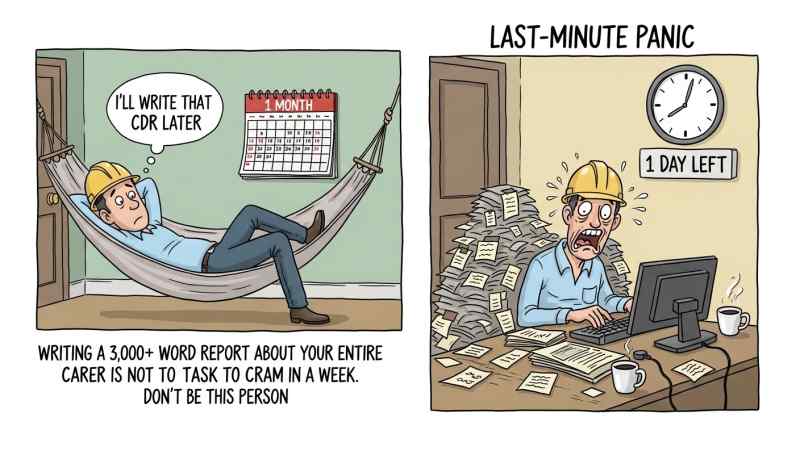
Don’t wait until the last minute: Writing a 3,000+ word report about your professional life – and doing it in a second language for many – is not a task to cram in a week. Give yourself plenty of time, perhaps a couple of months, to go through all these steps comfortably. This also gives you buffer in case you realize you need to swap out an episode or get additional documents.
By following these do’s and don’ts, you’ll avoid the common pitfalls that have led many CDR applications to be rejected. Remember, many engineers have successfully passed the Engineers Australia skills assessment with a well-crafted CDR – you can too, by being diligent and thorough.
Final Thoughts
Writing a CDR for Engineers Australia’s skill assessment is indeed a challenging project, but it’s also a valuable reflection on your engineering journey. By breaking down the process into steps – understanding requirements, choosing the right examples, and carefully writing and reviewing each part – you can produce a CDR that truly represents your competencies and strengths.
Approach it like an engineering problem: understand the criteria, plan a solution (your report structure and content), execute it diligently, and check your results (proofread!).
A well-written CDR not only helps satisfy the migration requirements, but also gives you confidence in presenting your professional achievements. It’s your narrative – your chance to show the assessors how you’ve made a difference in your projects and how you are prepared to contribute to the Australian engineering field.
Good luck with your CDR writing journey! With careful effort and attention to detail, you’ll be well on your way to obtaining a positive Engineers Australia skills assessment and moving closer to your goal of working as an engineer in Australia. Safe travels on your professional path, and welcome to the community of global engineers aspiring to make it in Australia!
CDR Writing: Best Guide 2026
CDR Writing should start with the applicant selecting real engineering evidence instead of generic duties. A strong CDR Writing page explains the project context, personal engineering actions, and measurable outcomes. Use CDR Writing to connect career episode examples with Engineers Australia competency elements. The best CDR Writing preparation keeps claims specific, factual, and supported by documents.
For migration applicants, CDR Writing is most useful when it avoids copied samples and focuses on individual work. CDR Writing can improve review quality when each project paragraph answers what, why, and how. Before submission, CDR Writing should be checked for structure, evidence, language clarity, and consistency. Applicants using CDR Writing should keep CPD, summary statement, and career episode details aligned.
A practical CDR Writing checklist helps reduce avoidable Engineers Australia assessment delays. Professional CDR Writing support should protect accuracy while improving readability and presentation. The CDR Writing process also helps applicants identify missing technical details before final review. Every CDR Writing draft should show the engineer’s own decisions, calculations, coordination, and problem solving.
CDR Writing is strongest when the final document is clear enough for an assessor to follow quickly. A final CDR Writing review should confirm that the report supports the nominated occupation. Using CDR Writing carefully helps keep the application focused on evidence rather than broad claims. Well planned CDR Writing content can make the complete CDR package easier to assess.
A reliable CDR Writing workflow includes topic selection, drafting, checking, and final compliance review. The main purpose of CDR Writing is to present engineering competency in a clear migration assessment format. For overseas engineers, CDR Writing should balance technical depth with simple, direct English. The best result from CDR Writing is a report that is accurate, original, and easy to verify.
When using CDR Writing, applicants should match each claim with real project evidence. A strong CDR Writing draft avoids vague teamwork claims and explains personal contribution. Good CDR Writing preparation also checks grammar, formatting, and cross references before upload. Complete CDR Writing support should improve confidence without changing the facts of the engineering project.
CDR Writing works best when the applicant records dates, tools, standards, and responsibilities clearly. A careful CDR Writing review can reveal gaps in project evidence before Engineers Australia assessment. The final CDR Writing document should be original, structured, and consistent with the applicant’s background. CDR Writing is easier to assess when each paragraph has one clear purpose and concise wording.
Applicants should use CDR Writing to show engineering judgement, not only task descriptions. A complete CDR Writing package should align the career episodes, summary statement, and supporting documents. CDR Writing should include enough technical detail to prove the applicant worked at the required level. The most useful CDR Writing review checks evidence, formatting, language, and competency coverage together.
For skilled migration, CDR Writing should present the applicant’s role in a direct first-person style. A focused CDR Writing plan helps applicants avoid repeated information across career episodes. Successful CDR Writing preparation keeps the assessor’s questions in mind from the first draft. A clear CDR Writing structure can make complex engineering projects easier to understand.
The final CDR Writing check should remove vague claims and keep only evidence-based statements. Useful CDR Writing support explains calculations, design choices, testing, safety, and project outcomes. Applicants can strengthen CDR Writing by linking each achievement to a real engineering problem. Accurate CDR Writing preparation reduces the chance of confusion during document review.
A polished CDR Writing draft should be easy to read without losing technical substance. Each CDR Writing section should support the migration skills assessment goal clearly. The best CDR Writing outcome is a complete, honest, and well organised application file. Before uploading, CDR Writing should be reviewed against the latest Engineers Australia expectations.
CDR Writing checklist for Engineers Australia
- Confirm the nominated occupation and ANZSCO code before drafting.
- Use project evidence that shows your own engineering decisions.
- Keep paragraphs short, specific, and easy for an assessor to scan.
- Review the latest Engineers Australia guidance before submission.