
Writing CDR Engineers Australia is covered in this guide for Engineers Australia applicants. If you are an engineer aiming to migrate to Australia one crucial requirement is preparing a Competency Demonstration Report (CDR) for Engineers Australia (EA) .
The CDR is a technical document through which EA assesses your engineering qualifications and competencies to determine if they meet Australian standards.
Many engineers find the CDR preparation process challenging – it demands strong technical writing skills, a clear structure, and strict adherence to EA’s Migration Skills Assessment (MSA) guidelines. In this comprehensive CDR writing guide, we will cover everything you need to know about writing CDR Engineers Australia requires for skilled migration. This includes:
-
What a CDR report is and why it’s important for Engineers Australia.
-
Who needs to submit a CDR (eligibility and requirements for the CDR pathway).
-
How to put together your CDR report – the format and each component (CPD, Career Episodes, Summary Statement, CV).
-
Step-by-step tips for writing a successful CDR.
-
Common mistakes to avoid during CDR preparation.
-
Options for professional help if you need assistance with your CDR.
By the end of this guide, you will have a clear understanding of how to prepare a high-quality CDR that maximizes your chances of a positive skills assessment from Engineers Australia.
What is a CDR (Competency Demonstration Report)?
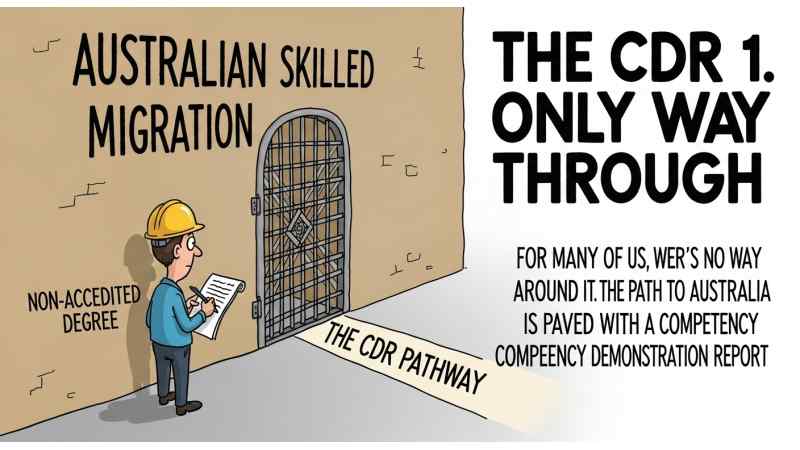
A Competency Demonstration Report (CDR) is a detailed technical report required by Engineers Australia for certain applicants undergoing the Migration Skills Assessment. It showcases an engineer’s education experience and competencies in engineering allowing EA to evaluate whether the applicant meets the Australian engineering standards for their occupation. In essence
the CDR is your opportunity to demonstrate your engineering knowledge and skills in a formal report format.
Who needs to submit a CDR?
The CDR pathway is generally required if you do not have an accredited engineering qualification. For example, engineers whose degrees are not recognized under the Washington Accord, Sydney Accord, or Dublin Accord (international agreements for accredited engineering programs) must submit a CDR for assessment. According to Engineers Australia, you should apply via the CDR pathway if:
-
Your engineering degree is not accredited (e.g. not from a recognized Accord country or program).
-
You have a provisionally-accredited qualification or a combination of qualifications that are not directly recognized.
-
You seek assessment in an occupational category different from your qualification (for instance, if your degree is in a different engineering discipline than the occupation you nominate).
In practical terms this means most engineers migrating from countries or universities not covered by the international accords will need to prepare a CDR. It is also required for those changing engineering disciplines in their assessment. Engineers migrating to Australia on a skilled visa (such as subclass 189 190
or 491) often fall under this category if their qualifications aren’t automatically recognized.
Why Is the CDR Important for Engineers Australia?
The CDR is extremely important for your Australian skilled migration process because it is the basis of your skills assessment by Engineers Australia. A positive skills assessment is mandatory to proceed with many engineering-related visa applications. Here’s why the CDR holds so much significance:
-
Required for Non-Accredited Engineers: If you aren’t covered by an international accord, the CDR is the only way to prove your engineering credentials to Australia’s assessing authority. Without an approved CDR, you cannot get the skilled migration points for your engineering occupation.
-
Demonstrates Your Competency: The CDR is how you demonstrate your engineering knowledge and experience in detail. Engineers Australia uses it to verify that your skills match the Australian Stage 1 competency standards for your engineering category (Professional Engineer, Engineering Technologist, etc.) – essentially ensuring you have the baseline competencies of an Australian graduate engineer.
-
Ensures Alignment with Australian Standards: Through the CDR EA checks that you meet Australian engineering practice standards and ethics. It evaluates your ability to identify and solve engineering problems apply technical knowledge and communicate effectively in English.
A well-written CDR that clearly shows these competencies will prove that you can work safely and effectively in the Australian engineering environment.
-
Key to Visa Approval: A CDR-based skills assessment outcome is an integral part of obtaining a skilled migration visa. In fact it’s often a prerequisite for lodging your visa application. A positive outcome on your CDR from Engineers Australia significantly improves your chance of securing Permanent Residency (PR) in Australia as an engineer. Conversely
a poorly written CDR could lead to a rejection or unfavorable assessment derailing your migration plans.
Bottom line: Engineers Australia will only issue you a favorable skills assessment if your CDR report is well-prepared and convincing. The effort you invest in writing a quality CDR can directly impact your migration success. Now, let’s look at how to put together the CDR and what it must contain.
CDR Report Format and Components
A complete CDR report to Engineers Australia is composed of four main parts:
-
Continuing Professional Development (CPD) List – a record of how you have kept your skills up-to-date.
-
Three Career Episodes – narrative essays each describing a specific period or project in your engineering career.
-
Summary Statement – a table or matrix that maps the competency elements demonstrated in your Career Episodes to Engineers Australia’s requirements.
-
Curriculum Vitae (CV) – a professional résumé outlining your engineering education and work history.
Each of these components serves a distinct purpose and must be prepared according to EA’s guidelines. All documents must be written in clear, formal English and adhere to the format specified by Engineers Australia. Below, we break down each component in detail.
Continuing Professional Development (CPD)
Continuing Professional Development is the first section of your CDR. CPD is essentially a list of all the professional development activities you have undertaken to maintain and improve your engineering knowledge after your undergraduate qualification. Engineers Australia uses this to verify that you are actively engaged in learning and staying current in your field.
What to include in your CPD: You should include all relevant training and development activities you’ve completed. This can include:
-
Formal courses and workshops: Technical courses, training programs, or workshops (e.g. an Advanced AutoCAD training course, a seminar on power system analysis).
-
Conferences and seminars: Engineering conferences attended, seminars, or any events where you learned about new technologies or practices.
-
Research papers and presentations: Any papers you have published or presentations given in your field.
-
Self-study and online learning: Webinars, online courses (e.g. MOOCs), or self-directed study of engineering journals and books.
-
Professional memberships or volunteer activities: Participation in engineering organizations, committees, or volunteer projects that contributed to your skills (if applicable).
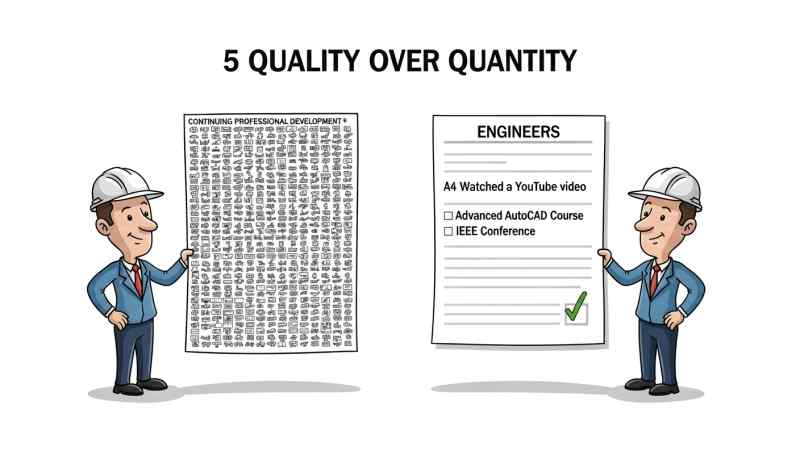
Engineers Australia expects the CPD to be presented in a table or list format, and it should ideally include the date, name of the activity, duration (hours or days), venue or platform, and organizing body. Keep the entries concise and focus on recent and relevant activities that genuinely contributed to your professional growth.
For example, your CPD record might look like:
Tip: There is no strict word count for CPD but try to keep it succinct and relevant. Include enough entries to show you maintain your skills (covering at least the last 3 years if possible) but avoid listing trivial or unrelated activities. Also
ensure the CPD list is formatted clearly (as a neat table or bullet list) so that assessors can easily review it.
Career Episodes
The Career Episodes are the most critical part of your CDR. You are required to write three career episodes each of which is an essay that describes a specific instance in your engineering experience where you applied your skills and knowledge.
The purpose of the career episodes is to provide evidence of your engineering competency through real examples from your work or study.
Each career episode should focus on a distinct project or time period in your engineering career. It could be based on:
-
A project you worked on as a professional engineer (either current or past job).
-
A significant engineering project or assignment you completed during your undergraduate or postgraduate studies (especially useful for recent graduates with limited work experience).
-
Any engineering research or internship experience, or even a noteworthy technical hobby project, as long as it’s relevant.
If you use an academic project (for example, your final year university project), you should mention the academic details (project title, course name, supervisor, etc.) and ensure you focus on your personal contribution to the project.
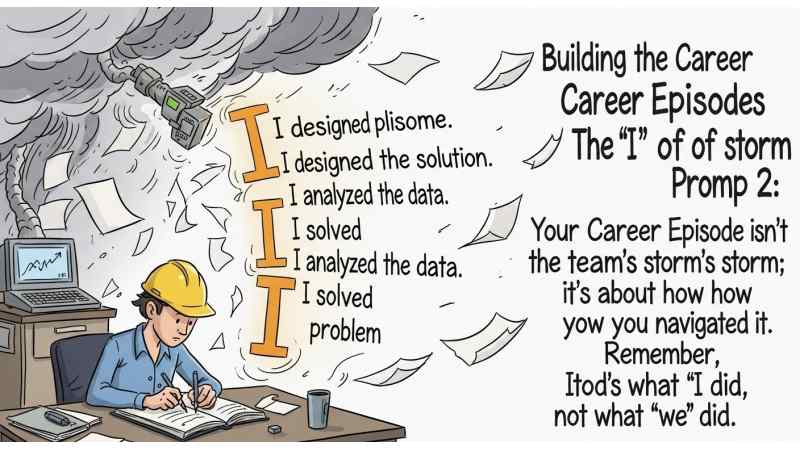
Length and format: Each career episode must be written as a narrative in essay format using the first person (“I” statements) and should be between 1,000 to 2,500 words in length. It’s important to stick within these word limits. The narrative should be written entirely by you in your own words with no plagiarized content
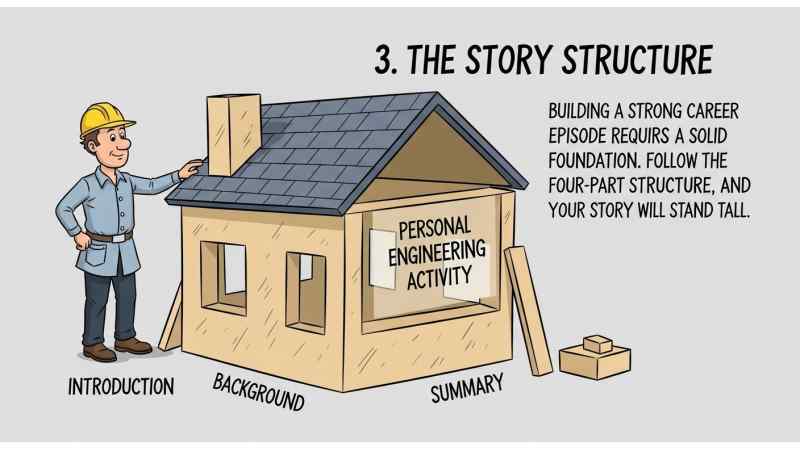
since it also serves as proof of your communication skills and originality. Engineers Australia recommends structuring each Career Episode into four sections:
-
Introduction ( ~100 words ): Provide the context of the episode. Include the time frame (dates and duration of the project) the location where the experience took place the name of the organization or institution and your job title/position during that period. The introduction is like an executive summary of the episode
so keep it brief and to the point outlining what the project was.
-
Background ( 200–500 words ): Describe the context and objectives of the project or work. This section should answer questions like: What was the overall project about and what were its goals? What was the organizational structure or team hierarchy
and where did you fit within it (you can mention the team size or attach an org chart highlighting your role)? What duties and responsibilities were assigned to you in this project?
The background sets the stage for the story – it should provide enough detail for the reader to understand why the project was undertaken and your role in it.
-
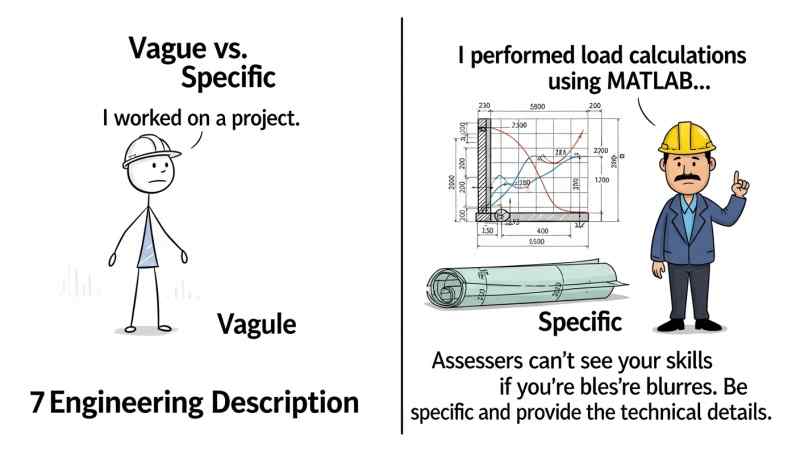
Personal Engineering Activity (600–1500 words): This is the core part of the episode – detail the actual work you personally did and the engineering tasks you accomplished. Describe your role and actions: How did you apply your engineering knowledge during the project? What specific tasks were you responsible for, and how did you carry them out? Discuss any technical problems or challenges you encountered and, importantly, how you solved them. Be sure to include technical details: for example, calculations you performed, design methodologies or tools/software used, standards followed, or any innovative approaches you implemented. If you made design decisions or developed solutions, explain your thought process and rationale. This section should highlight your problem-solving skills and technical competency. Remember to keep the focus on what you did – your individual contribution is what matters, not the team’s work. Use first-person language (“I designed…”, “I analyzed…”, “I led…”) consistently. EA explicitly notes that it is not sufficient to describe the team’s work or use vague language like “we did X” –
 you must clearly state your own personal role in achieving the project outcomes.
 -
Summary ( 50–100 words ): Conclude the episode by summarizing the outcome of the project and your contributions. Did the project meet its objectives? What did you personally achieve or learn through this experience? You can mention key results (for example
“The design I developed reduced system outages by 15%” or “The project was delivered on time and within budget and I gained expertise in XYZ as a result”).
This final part should wrap up how your involvement was important in the project’s success and maybe how it helped your professional development. Keep it brief but insightful.
When writing Career Episodes make sure to number the paragraphs in each episode because these numbers will be used in your summary statement later. A common numbering scheme is: Career Episode 1: paragraphs 1.1 1.2 1.3 …; Career Episode 2: paragraphs 2.1 2.2 …; Career Episode 3: 3.1 3.2 ….
Numbering helps the assessor see which paragraph relates to which competency in your summary statement (we will explain this soon).
Example Career Episode Topics: The content of your episodes will depend on your personal experience, but here are a few examples of suitable topics for inspiration:
-
Designing and Implementing an Industrial Automation System: For instance, you could describe how you developed a PLC-based automation solution for a manufacturing line, including programming, testing, and commissioning of the system.
-
Improving the Energy Efficiency of HVAC Systems: You might write about a project where you analyzed and optimized an HVAC system for a building to reduce energy consumption, detailing calculations and control strategies used.
-
Developing a Smart Grid for Sustainable Power Distribution: This could involve explaining how you planned and worked on a smart grid project, integrating renewable energy sources and using smart meters, and what challenges you overcame in the process.
These are just illustrative examples – your episodes should be based on your own real experiences. The key is to choose projects that allow you to showcase a range of competencies (problem solving, design, teamwork, project management, etc.) relevant to your engineering discipline.
Tip: ✍️ Write your Career Episodes in a clear narrative style. Imagine you are telling a story of your engineering experience but keep it professional and focused. Use active voice and first person (“I”) to highlight your role.
Don’t shy away from technical details – specifics make your competencies evident – but explain them in a way that a reader (the assessor) can follow.
It’s a good idea to have someone review your episodes for clarity and grammar. Finally, absolutely avoid any plagiarism – do not copy text from any source or from someone else’s CDR. Engineers Australia uses sophisticated plagiarism detection tools, and any copied content can lead to rejection and a ban.
Summary Statement
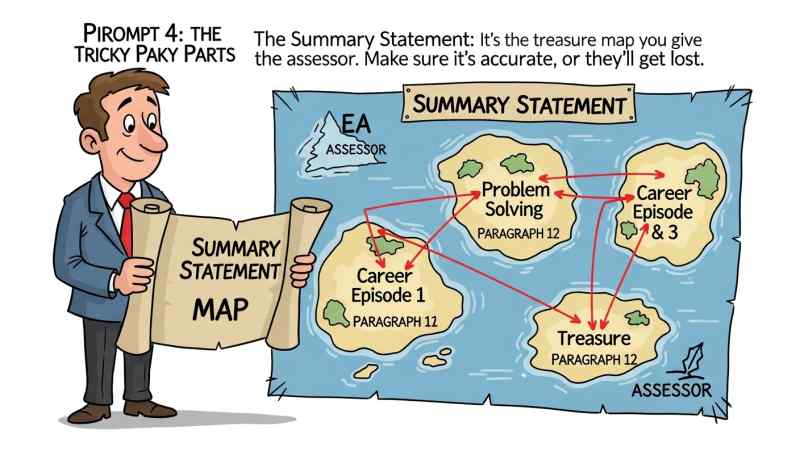
The Summary Statement is a unique and crucial part of the CDR. In this section you must summarize how each of your Career Episodes demonstrates specific competencies that Engineers Australia expects of a qualified engineer. Think of the summary statement as a mapping table:
it links the content of your three episodes to the competency elements in EA’s accreditation framework.
Engineers Australia provides a list of competency elements (based on the Stage 1 Competency Standards) for each engineering category (Professional Engineer Engineering Technologist Engineering Associate or Engineering Manager). For example Professional Engineers have competencies in three units: Knowledge and Skill Base Engineering Application Ability
and Professional and Personal Attributes – each unit contains several elements (there are 16 elements in total for Professional Engineers). Your summary statement must show where in your episodes you have addressed each of these competency elements.
How to prepare the Summary Statement: You will create a table or list that has the competency elements on one side and references to your Career Episodes on the other. For each relevant competency element, indicate which Career Episode and paragraph number evidences that competency. For instance, your summary statement entry might look like:
-
Competency 1.1: Knowledge of engineering principles and theories – Demonstrated in Career Episode 1, Paragraphs 1.3 to 1.6 (where you might have discussed the theoretical analysis you performed).
-
Competency 2.2: Application of systematic engineering synthesis and design processes – See Career Episode 2, Paragraphs 2.10 – 2.14 (where you described designing a solution to a problem).
-
Competency 3.3: Creative, innovative and pro-active demeanour – Demonstrated in Career Episode 3, Paragraph 3.5 (where you introduced an innovative approach or improvement in a project).
In the actual summary statement document this is often formatted as a table with columns for the competency element a brief description of how you’ve addressed it and references to the episodes/paragraphs.
Engineers Australia notes that the Summary Statement cross-references the competency elements with the specific paragraphs in your career episodes where each element is demonstrated. You do not need to write long explanations here; just a concise reference is enough since the detailed evidence is in the episodes.
A simplified example of a Summary Statement entry (for a Professional Engineer) could be:
In this example, “CE1 – 1.4, 1.5” means Career Episode 1, paragraphs 1.4 and 1.5 contain evidence for that competency. Ensure every required competency element is covered at least once across your three episodes. Some elements might appear in multiple episodes; you can choose the best example to reference.
Important points for the Summary Statement:
-
You only need to submit one Summary Statement covering all three episodes, not separate statements for each. Make sure it’s the correct template for your occupational category (EA provides template guidelines for Professional Engineer, Engineering Technologist, etc., which list the competency elements for that category).
-
Be precise and accurate in your referencing. Double-check that the paragraph numbers you cite actually correlate to the competency element claimed. The assessor will verify each reference, so any mismatched or incorrect reference could raise doubts.
-
Do not copy text into the summary statement from your episodes or from EA’s competency descriptions. Use your own words briefly if explaining how the element was demonstrated. Many applicants simply reference the episodes without additional explanation, since the explanation is in the episode itself.
-
The Summary Statement is typically presented in a tabular form and there is no strict length (it can span more than one page if needed). Engineers Australia has templates available on their website as a guide but you should not feel constrained to make it fit on one page.
Clarity is more important than brevity here – ensure the layout is clear and easy to follow.
Tip: Preparing the summary statement is often easier after writing your Career Episodes. Once your episodes are done read through the competency elements and mark which paragraphs in your stories align with each element. It might help to label the margins of your draft episodes with the element codes as you identify them. This way
when you create the summary table you already know where each competency is demonstrated.
This process also serves as a cross-check to ensure you haven’t missed any competency in your narratives – if you find one is not covered, you can go back and address it in a Career Episode before finalizing the CDR.
Curriculum Vitae (CV)
The Curriculum Vitae (CV), or résumé, is the final document in your CDR application. While the Career Episodes and Summary Statement demonstrate your technical competencies, the CV provides a chronological overview of your professional history and qualifications. Engineers Australia uses the CV to get a succinct summary of your education and work experience background.
Your CV for the CDR should be professional clear and well-organized. According to EA’s guidelines it should be a complete record of your activities including any periods of employment or unemployment – typically up to the present day. The CV is not the place for project details (those belong in career episodes); instead
it’s a listing of positions and responsibilities.
Key details to include in your CV:
-
Educational Qualifications: List your degrees and diplomas in engineering (and related fields), including the institution name, location, graduation year, and any honors or awards. If you have multiple degrees, list them all (for example, Bachelor’s and Master’s).
-
Professional Work Experience: For each job position you’ve held, provide the job title, the employer’s name and location, and dates of employment (start and end). Under each position, include a brief description of your role and responsibilities – ideally in a few bullet points or a short paragraph. Focus on responsibilities that highlight your engineering skills.
If available, you may also mention a reference or contact (though it’s not always necessary for the CDR). Ensure the job titles and dates here match what you describe in your Career Episodes if there’s overlap, to maintain consistency.
-
Key Achievements or Projects: You might include one-liners about notable projects or achievements under each role (just the highlights). However, avoid going into excessive detail – save the detailed narratives for the career episodes.
-
Professional Certifications or Training: Mention any engineering licenses, registrations, or certifications you hold (e.g. Professional Engineer licensure, specific technical certifications), as well as major professional training courses (if not already listed in CPD).
-
Publications or Awards (if any): If you have published papers or received awards/recognition relevant to your career, you can list them briefly.
A neat way to format the work experience section is a table or simply headings for each job. For example:
XYZ Engineering Ltd – Melbourne, Australia Electrical Engineer (June 2021 – Present)
-
Design and analysis of power distribution systems for commercial projects.
-
Perform load calculations, prepare single-line diagrams, and oversee installation of electrical equipment.
-
Lead a team of 3 junior engineers, assigning tasks and reviewing designs for compliance with standards.
ABC Infrastructure – Mumbai, India Graduate Trainee Engineer (July 2018 – May 2021)
-
Assisted in the maintenance of industrial plant equipment, troubleshooting electrical faults, and planning preventive maintenance schedules.
-
Contributed to a project on improving energy efficiency in the plant, collecting data and analyzing results which led to a 10% reduction in energy consumption.
This format clearly shows the timeline and gives the assessor a snapshot of your roles. Engineers Australia suggests keeping the CV to around 3 pages maximum (concise and relevant). Make sure the CV is up-to-date as of your application date.
Tip: Treat your CV as you would for a job application – it should be honest factual and well-presented. Avoid any unexplained gaps in time; if you took a year off you can mention it (e.g. 2019 – 2020: Career break or self-study period).
And double-check that everything in your CV aligns with your other documents (for example the dates and roles mentioned in your Career Episodes should match the CV entries). Inconsistencies could raise questions during assessment.
Step-by-Step Guide to Writing a CDR for Engineers Australia
Preparing a CDR can be a complex task, but breaking it down into clear steps will make it more manageable. Here is a step-by-step guide to help you write a successful CDR:
Step 1: Understand Engineers Australia’s Requirements
Before you start writing thoroughly read the official Migration Skills Assessment (MSA) booklet provided by Engineers Australia. This booklet contains all the rules and guidelines for CDR format the competency standards and the assessment process. It’s essential to familiarize yourself with these requirements upfront.
Pay special attention to sections that describe how to write career episodes and the summary statement as well as the eligibility criteria for the CDR pathway. Having a clear understanding of what EA expects will save you from rework later.
Step 2: Choose the Right Projects for Your Career Episodes
Select three projects or work experiences that best showcase your engineering skills and achievements. Ideally pick diverse experiences that cover different aspects of your competency – for example one academic project one design project from work and one project where you solved a significant problem or demonstrated leadership.
Ensure you were personally involved enough in these projects to write in detail.
It’s important that for each episode, you have plenty of material about what you did. If a project was a team effort, but you can highlight your individual tasks, it’s suitable. Jot down key points for each chosen project (objectives, your tasks, challenges overcome, outcomes) – this will help when you start writing.
Step 3: Use the Correct Structure and Format
When writing each part of the CDR follow the prescribed structure. For Career Episodes stick to the introduction → background → personal activity → summary format and keep within the word limits for each section. Number the paragraphs in your episodes as required. Present your CPD in a proper list or table form.
Use the summary statement template for your category to ensure you’re addressing all competencies.
Adhering to the format not only makes a good impression but also ensures you don’t accidentally omit a required part. Remember that clarity and organization are key – the assessor should be able to easily navigate through your documents.
Step 4: Write in Clear and Professional English
Your CDR is also an assessment of your communication skills. Write your report in clear concise English. Avoid overly complex sentences or too much technical jargon without explanation – the assessor may not be an expert in your specific niche so clarity is crucial. At the same time
do maintain a professional tone (this is not a casual essay or a personal diary).
Proofread your writing for grammar and spelling errors; poor language can leave a negative impression and make your content hard to understand. If English isn’t your first language it might be worth having a proficient English speaker review your drafts. Also
avoid writing in bullet points in the career episodes – EA expects a narrative format (bullet points can be used in CPD or CV but the episodes should be paragraphs).
Good formatting (consistent font, headings, paragraph spacing) will make your CDR look professional and easy to read.
Step 5: Provide Sufficient Technical Detail and Evidence
One common mistake is staying too vague or high-level in the career episodes. Make sure you include specific technical details and quantitative data where appropriate. For example if you designed something mention key design parameters or calculations; if you improved a process mention by what percentage or value. If possible include supporting evidence such as diagrams tables
or equations within your narrative (or as appendices) to strengthen your claims.
However, ensure any figure or diagram is directly relevant and referenced in the text. The idea is to convince the assessor that you genuinely possess the engineering competency by showing how you applied it. That said, balance the detail – avoid overly lengthy theoretical explanations or copying textbook content. The focus should remain on your work and its results.
Step 6: Avoid Plagiarism and Write Original Content
This cannot be emphasized enough: do not plagiarize any part of your CDR. Engineers Australia will check your submission against a database of previous submissions and internet sources using plagiarism detection software. If they find copied text (even something you might have copied from a friend’s CDR sample or a template from the web)
your application can be immediately rejected and you could face a ban period.
Write everything from scratch in your own words. It’s fine to refer to CDR examples for Engineers Australia to understand the format or level of detail but never copy phrases or sentences from them. Even self-plagiarism (reusing text from your own earlier CDR if you are re-applying) can be an issue
so treat each application as a fresh document.
If you need to include some identical content (say, describing the company background that appears in two episodes), try to rephrase it. Always err on the side of originality.
Step 7: Review, Edit, and Refine Your CDR
Once you have drafted all sections of your CDR (CPD, Career Episodes, Summary Statement, CV), take the time to carefully review and revise. Check for any inconsistencies between sections (do the dates in your CV match the timeline in your episodes? Does the summary statement correctly point to the right paragraphs?).
Ensure the language is consistent (for example if you refer to yourself as an Electrical Engineer in one place don’t call it Power Engineer elsewhere – keep terminology consistent). Look out for typos or formatting issues. It’s often helpful to take a short break after writing and then re-read your CDR with fresh eyes
or ask a trusted friend/colleague to provide feedback.
A well-polished CDR free of errors demonstrates your attention to detail and professionalism. Remember, this report is representing you in front of the assessors – you want it to be as impeccable as possible.
Step 8: Submit and Be Patient (Know the Timeline)
When you’re fully satisfied with your CDR you will submit it through Engineers Australia’s online portal as part of your Migration Skills Assessment application. After submission be prepared to wait for the outcome.
Engineers Australia’s processing time for a standard CDR assessment is typically around 8 to 12 weeks from the date they receive a complete application.
It can vary depending on the volume of applications and the quality of your documents – incomplete or problematic submissions can take longer because EA might ask for additional information which pauses the clock. If you’re in a hurry EA offers a fast-track service for an extra fee
which can reduce the processing to about 20 working days (roughly 4 weeks).
However, even fast-track won’t guarantee an approval; it just speeds up the review. During the waiting period, you can check the status on the EA portal, but generally it’s a matter of patience. Use this time to ensure you have other documents (like your English test results, etc.) ready for your visa process.
By following these steps diligently, you’ll greatly improve the quality of your CDR and your chances of success. It is indeed a lot of work, but thousands of engineers have successfully been assessed by EA – with careful preparation, you can be one of them!
Common Mistakes to Avoid in CDR Writing
Writing a CDR is a high-stakes task, and mistakes can be costly (in terms of time and outcome). Here are some common mistakes that you should be careful to avoid:
-
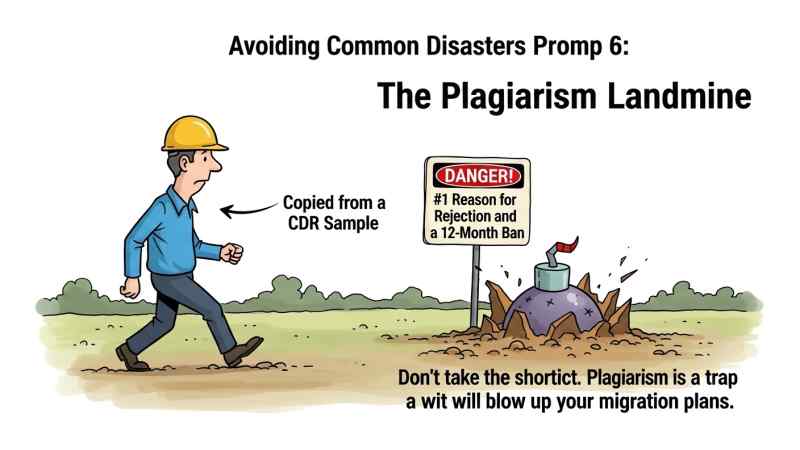
❌ Plagiarism: As mentioned plagiarism is the number one reason for CDR rejection. Never copy content from any source. Even using large chunks of text from your own company’s project reports can be problematic if not rewritten. Engineers Australia uses advanced plagiarism detection tools and any flagged content can lead to your application being rejected without refund
plus a 12-month ban before you can reapply. Always write original descriptions of your work.
If you use any external material (like a theory or diagram), cite or reference it properly and ensure the majority of the writing is yours. Before submission, it’s wise to run your text through a plagiarism checker to be safe.
-
❌ Focusing on Team Achievements Over Individual Role: It’s a mistake to write your career episodes like a company report or a team report. The assessors don’t want to know what the team did; they want to know what you did. Avoid language like “we designed” or “the team accomplished” – even if it was teamwork
single out your personal contributions (“I designed the circuit for…” “I was responsible for testing…”).
If your write-up is too heavy on collective description, EA may conclude that you haven’t demonstrated your own competency clearly enough.
-
❌ Insufficient Technical Detail: Some applicants stay too generic, perhaps out of fear of revealing company data or thinking the assessor won’t understand. However, lack of concrete technical detail is a red flag. Vague statements like “I completed the project successfully” without explaining how you did it or what engineering methods were used will make your CDR weak.
Always include specifics – e.g., mention the calculations, the standards (AS/NZS codes, IEEE, etc.) you followed, the tools or software (AutoCAD, MATLAB, etc.) you utilized, and the quantitative outcomes of your work. This demonstrates real engineering work. If your CDR is too shallow or high-level, it may be assessed as not meeting the competencies.
-
❌ Weak or Incorrect Summary Statement: The summary statement can trip up many candidates. A common mistake is incorrect mapping – referencing wrong paragraph numbers or putting entries under wrong competency elements. Another mistake is leaving some competency elements unaddressed. A poorly done summary statement may confuse the assessor or force them to hunt through your episodes
which could result in a negative assessment.
Double-check that each competency required for your category is referenced at least once. Use the correct competency codes/numbers as per EA’s template. If the summary statement is unclear or has errors, it gives a bad impression and can undermine the excellent work you might have described in the episodes.
-
❌ Poor Writing and Presentation: Grammatical errors spelling mistakes and disorganized structure can hurt your CDR. Remember communication ability is one of the competencies too. Reviewers expect a professional standard of writing. Ensure your document is well-formatted – use headings (as we outlined: Introduction Background etc.) consistent fonts and a clear layout.
Number pages and sections if it’s a long document. Avoid walls of text; break up paragraphs logically.
If the assessor finds your CDR hard to read or full of mistakes, it could affect their judgment of your attention to detail. Before submitting, do a thorough proofread (or have someone do it for you).
-
❌ Ignoring EA’s Instructions: Sometimes applicants overlook specific instructions in the MSA booklet. For example not providing certified translations for documents not in English or exceeding the page limit for the CV or not signing the self-declaration. These might seem minor but failure to follow the official instructions can lead to delays or rejection on administrative grounds.
Always cross-check your final submission package against the checklist in the MSA guidelines to ensure every required document and detail is included correctly.
Tip: It’s a good practice to put yourself in the shoes of the assessor once your draft is ready. Go through each part of your CDR critically asking: “Is this authentically my work? Does this clearly show my competency? Is it well-structured and easy to follow? Are all requirements met?” By self-auditing your CDR
you can catch and fix many mistakes before the assessor sees them.
Also, consider using a CDR review service (if not a full writing service) or getting feedback from someone experienced with EA assessments – they might spot weaknesses that you missed.
Getting Help with CDR Preparation in Australia
Writing a CDR for Engineers Australia can be a daunting task – not everyone is confident in their technical writing abilities especially in a second language. If you find yourself struggling with any part of the CDR professional help is available. There are consultancy and writing services that specialize in CDR preparation for Engineers Australia.
While you must ensure the content ultimately remains original and truthful to your experience experts can guide you in presenting it effectively.
How can professional CDR writers assist you?
-
They can help you choose the right projects and frame your career episodes strategically to cover the required competencies. Sometimes, an external perspective helps in identifying which aspects of your work to highlight.
-
They ensure your career episodes are 100% plagiarism-free and properly written. Reputable CDR writing services will not simply write it for you without input; instead, they will usually gather detailed information from you and help craft it into a well-structured narrative in line with EA’s expectations (thus avoiding the plagiarism issue).
-
Professionals are familiar with EA’s formatting and writing style. They can help with proper document formatting, paragraph numbering, and correcting language or grammar issues. Essentially, they act as skilled editors for your report.
-
They can assist in writing a clear Summary Statement, doing the competency mapping accurately – a part that many engineers find confusing.
-
Some services also offer pre-assessment reviews, checking your complete CDR for any deficiencies or compliance issues and using tools to check for plagiarism similarity, so you can revise before the official submission.
If you decide to seek help make sure you use ethical and reputable services. You should be involved in the process because ultimately you might be asked questions on your CDR content. Avoid any service that promises to fake projects or provide fraudulent data – integrity is crucial and EA may ask for verification or interviews in suspicious
cases.
The best approach is to work with a consultant who guides you while ensuring you remain the author of your CDR content.
✔️ Career Episode Guidance: Professionals can guide you to write compelling episodes that emphasize your personal role and technical skills (and ensure you’re not focusing too much on team achievements). The result will be episodes that stand out and meet EA’s competency requirements.
✔️ Well-Organized Summary Statement: Expert help can result in a neatly prepared summary statement table that correctly links all your competencies to the right parts of your episodes saving you a lot of headache in understanding the mapping process. ✔️ Complete Error-Free Documents: With professional editing your CDR report can be polished to be free of grammatical mistakes
typos or formatting issues. This gives your submission a professional edge.
Consultants also ensure that your CPD CV and all sections align with each other and nothing is missing. ✔️ Understanding EA Standards: Perhaps most importantly a good CDR consultant will ensure that your content consistently reflects Engineers Australia’s Stage 1 competencies and code of ethics standards. They know what keywords or themes assessors look for
and can help you integrate those naturally into your writing.
That said, remember that using a CDR writing service doesn’t mean you have zero work – you will need to provide all the raw information and collaborate closely, since only you know your work in depth. Think of them as an aid to present your story in the best possible manner.
Need help from a professional? If writing your CDR for Engineers Australia feels overwhelming you might consider reaching out to a professional CDR writing service for guidance. Many engineers have successfully obtained positive assessments by using such expert help in drafting and reviewing their CDR.
Contact us today for expert assistance in writing CDR Engineers Australia – our team can help ensure your CDR is well-structured completely original and aligned with EA’s standards greatly improving your chances of success.
(Please note: Always maintain honesty and transparency in your CDR. Professional assistance should be used for improvement and guidance, not for falsification of any information.)
Last Words on Writing CDR for Engineers Australia
Preparing a Competency Demonstration Report is a critical step for engineers aspiring to work in Australia. It requires a significant investment of time and effort but getting it right is absolutely worth it. A well-crafted CDR that follows Engineers Australia’s guidelines can make the difference in earning a positive skills assessment
which in turn is key to achieving your skilled migration goals.
To recap, focus on the following when writing your CDR:
-
Use the correct CDR format and include all four components (CPD, three Career Episodes, Summary Statement, CV). Each part has its role – don’t neglect any of them.
-
Select strong examples for your Career Episodes and write them in a way that clearly highlights your personal engineering contributions. Show your technical depth and problem-solving abilities through concrete examples and data.
-
Ensure originality and authenticity in every section. Not only should the work be yours, but the way you describe it should be in your own voice. Engineers Australia’s assessors are experienced – they can usually tell when something doesn’t sound genuine or if it’s copied.
-
Align with EA’s competency standards: Keep the EA competency elements in mind as you write, and make sure by the end that your Summary Statement evidences all of them. Essentially, you want to convince the assessor that you already perform at the level of an Australian engineer in your category.
-
Review, revise, and refine: Treat your CDR as a professional document. Edit it carefully, get feedback if possible, and double-check all details (dates, technical units, project names, etc.) for accuracy.
If you follow these guidelines, you will greatly improve your chances of passing Engineers Australia’s assessment. Many applicants who initially feel intimidated by the CDR process find that by systematically breaking it down and perhaps getting a bit of guidance, they are able to produce a successful report.
Finally don’t hesitate to seek help if needed. It’s better to ask questions or get advice than to submit an incorrect or subpar report. Engineers Australia even allows you to request a review or appeal if you’re not satisfied with an outcome but ideally
you won’t need to if you get it right the first time.
Good luck with your CDR preparation! With careful effort, your CDR will showcase your engineering capabilities effectively and bring you one step closer to your Australian dream.
Need professional help with writing your CDR for Engineers Australia? We’re here to assist. Get in touch now to improve your CDR and ensure it meets all the requirements – expert support is just a click away.
Frequently Asked Questions (FAQs) about CDR Writing
Q1: How long should a Career Episode be?
Each Career Episode should be between 1,000 and 2,500 words in length. This is the range specified by Engineers Australia to ensure sufficient detail without being too lengthy. Aim for a narrative that fully covers the project and your contributions; many successful episodes tend to be 1,500–2,000 words long
but it’s fine as long as you stay within the limits.
Remember that quality matters more than just word count – don’t add fluff just to hit a higher word count, and conversely, don’t omit important details to stay on the lower side.
Q2: May I use free CDR report examples for Engineers Australia as a reference?
You can refer to CDR examples to understand the format and level of detail but do not copy anything from them. Your CDR must be entirely original and based on your own work. Engineers Australia explicitly warns against using any generic templates or examples in a way that leads to plagiarism. If you find free CDR samples online
use them only to guide you in structure or to see how others have presented their stories.
Never use wording from those samples – even unintentional similarity can be flagged. In short, CDR examples can be learning tools, but your writing and content must be uniquely yours. It’s fine to get inspiration, but not okay to imitate.
Q3: How long does it take for Engineers Australia to assess a CDR?
The standard processing time for a CDR-based Migration Skills Assessment is about 8 to 12 weeks from the date of submission (assuming all documents are correct). However, this can vary. If Engineers Australia has a high volume of applications or if they request additional information from you, it could take longer (sometimes 3+ months).
On the other hand EA offers a Fast Track service for an additional fee which can reduce the processing time to roughly 20 business days (around 4 weeks). Keep in mind that Fast Track simply queues your application for quicker allocation to an assessor;
you still need to have a well-prepared CDR because a rushed submission that is incomplete or poor in quality could face delays or a negative outcome.
It’s always best to submit your application well in advance of any visa deadlines. While waiting you can check the status online but typically you will get an email once the outcome is decided. Patience is key – use the waiting period to prepare other aspects of your migration (like gathering documents for visas
improving English test scores if needed etc.).
Q4: What if my CDR is rejected by Engineers Australia? Can I reapply?
If your CDR assessment is not successful Engineers Australia usually provides a reason for the rejection. Common reasons can include insufficient evidence of certain competencies plagiarism issues or not following guidelines. Depending on the reason you may need to wait for a certain period (often 12 months) before reapplying if it’s a plagiarism or ethics-related rejection.
For other cases you could potentially reapply sooner or request a review/appeal of the decision.
If you do face a rejection, it’s crucial to learn from the feedback. You should prepare a stronger application addressing the shortcomings. It may be very helpful to seek professional guidance for a reapplication to avoid repeat mistakes. Always ensure to update and improve your content rather than just resubmitting the same documents.
Also, note that there are fees for reviews or re-assessments, so it’s best to aim for success on the first try by being thorough in your initial CDR preparation.
Writing CDR Engineers Australia: Best Guide 2026
Writing CDR Engineers Australia should start with the applicant selecting real engineering evidence instead of generic duties. A strong Writing CDR Engineers Australia page explains the project context personal engineering actions and measurable outcomes. Use Writing CDR Engineers Australia to connect career episode examples with Engineers Australia competency elements.
The best Writing CDR Engineers Australia preparation keeps claims specific factual and supported by documents.
For migration applicants Writing CDR Engineers Australia is most useful when it avoids copied samples and focuses on individual work. Writing CDR Engineers Australia can improve review quality when each project paragraph answers what why and how. Before submission Writing CDR Engineers Australia should be checked for structure evidence language clarity and consistency.
Applicants using Writing CDR Engineers Australia should keep CPD summary statement and career episode details aligned.
A practical Writing CDR Engineers Australia checklist helps reduce avoidable Engineers Australia assessment delays. Professional Writing CDR Engineers Australia support should protect accuracy while improving readability and presentation. The Writing CDR Engineers Australia process also helps applicants identify missing technical details before final review. Every Writing CDR Engineers Australia draft should show the engineer's own decisions calculations
coordination and problem solving.
Writing CDR Engineers Australia is strongest when the final document is clear enough for an assessor to follow quickly. A final Writing CDR Engineers Australia review should confirm that the report supports the nominated occupation. Using Writing CDR Engineers Australia carefully helps keep the application focused on evidence rather than broad claims.
Well planned Writing CDR Engineers Australia content can make the complete CDR package easier to assess.
A reliable Writing CDR Engineers Australia workflow includes topic selection drafting checking and final compliance review. The main purpose of Writing CDR Engineers Australia is to present engineering competency in a clear migration assessment format. For overseas engineers Writing CDR Engineers Australia should balance technical depth with simple direct English.
The best result from Writing CDR Engineers Australia is a report that is accurate original and easy to verify.
When using Writing CDR Engineers Australia applicants should match each claim with real project evidence. A strong Writing CDR Engineers Australia draft avoids vague teamwork claims and explains personal contribution. Good Writing CDR Engineers Australia preparation also checks grammar formatting and cross references before upload.
Complete Writing CDR Engineers Australia support should improve confidence without changing the facts of the engineering project.
Writing CDR Engineers Australia works best when the applicant records dates tools standards and responsibilities clearly. A careful Writing CDR Engineers Australia review can reveal gaps in project evidence before Engineers Australia assessment. The final Writing CDR Engineers Australia document should be original structured and consistent with the applicant's background.
Writing CDR Engineers Australia is easier to assess when each paragraph has one clear purpose and concise wording.
Applicants should use Writing CDR Engineers Australia to show engineering judgement not only task descriptions. A complete Writing CDR Engineers Australia package should align the career episodes summary statement and supporting documents. Writing CDR Engineers Australia should include enough technical detail to prove the applicant worked at the required level.
The most useful Writing CDR Engineers Australia review checks evidence formatting language and competency coverage together.
For skilled migration Writing CDR Engineers Australia should present the applicant's role in a direct first-person style. A focused Writing CDR Engineers Australia plan helps applicants avoid repeated information across career episodes. Successful Writing CDR Engineers Australia preparation keeps the assessor's questions in mind from the first draft.
A clear Writing CDR Engineers Australia structure can make complex engineering projects easier to understand.
The final Writing CDR Engineers Australia check should remove vague claims and keep only evidence-based statements. Useful Writing CDR Engineers Australia support explains calculations design choices testing safety and project outcomes. Applicants can strengthen Writing CDR Engineers Australia by linking each achievement to a real engineering problem.
Accurate Writing CDR Engineers Australia preparation reduces the chance of confusion during document review.
A polished Writing CDR Engineers Australia draft should be easy to read without losing technical substance. Each Writing CDR Engineers Australia section should support the migration skills assessment goal clearly. The best Writing CDR Engineers Australia outcome is a complete honest and well organised application file. Before uploading
Writing CDR Engineers Australia should be reviewed against the latest Engineers Australia expectations.
Writing CDR Engineers Australia checklist for Engineers Australia
- Confirm the nominated occupation and ANZSCO code before drafting.
- Use project evidence that shows your own engineering decisions.
- Keep paragraphs short, specific, and easy for an assessor to scan.
- Review the latest Engineers Australia guidance before submission.
Writing CDR Engineers Australia review checklist for 2026
Writing CDR Engineers Australia should be checked against the latest Engineers Australia assessment expectations. A practical Writing CDR Engineers Australia review confirms that the applicant has used real engineering evidence. The final Writing CDR Engineers Australia draft should explain personal responsibility, technical decisions, and project outcomes. Applicants preparing Writing CDR Engineers Australia should avoid vague claims and keep the report evidence based. A clear Writing CDR Engineers Australia structure helps the assessor follow the project from problem to result.
Before upload, Writing CDR Engineers Australia should be reviewed for grammar, formatting, originality, and consistency. Strong Writing CDR Engineers Australia preparation connects project evidence with the nominated engineering occupation. Professional Writing CDR Engineers Australia support should improve clarity without changing the applicant’s facts. Every Writing CDR Engineers Australia section should support the migration skills assessment pathway clearly. A complete Writing CDR Engineers Australia review can reduce delays caused by missing or unclear information.
Writing CDR Engineers Australia should be checked against the latest Engineers Australia assessment expectations. A practical Writing CDR Engineers Australia review confirms that the applicant has used real engineering evidence. The final Writing CDR Engineers Australia draft should explain personal responsibility, technical decisions, and project outcomes. Applicants preparing Writing CDR Engineers Australia should avoid vague claims and keep the report evidence based. A clear Writing CDR Engineers Australia structure helps the assessor follow the project from problem to result.
Before upload, Writing CDR Engineers Australia should be reviewed for grammar, formatting, originality, and consistency. Strong Writing CDR Engineers Australia preparation connects project evidence with the nominated engineering occupation. Professional Writing CDR Engineers Australia support should improve clarity without changing the applicant’s facts. Every Writing CDR Engineers Australia section should support the migration skills assessment pathway clearly. A complete Writing CDR Engineers Australia review can reduce delays caused by missing or unclear information.
Writing CDR Engineers Australia should be checked against the latest Engineers Australia assessment expectations. A practical Writing CDR Engineers Australia review confirms that the applicant has used real engineering evidence. The final Writing CDR Engineers Australia draft should explain personal responsibility, technical decisions, and project outcomes. Applicants preparing Writing CDR Engineers Australia should avoid vague claims and keep the report evidence based. A clear Writing CDR Engineers Australia structure helps the assessor follow the project from problem to result.
Before upload, Writing CDR Engineers Australia should be reviewed for grammar, formatting, originality, and consistency. Strong Writing CDR Engineers Australia preparation connects project evidence with the nominated engineering occupation. Professional Writing CDR Engineers Australia support should improve clarity without changing the applicant’s facts. Every Writing CDR Engineers Australia section should support the migration skills assessment pathway clearly. A complete Writing CDR Engineers Australia review can reduce delays caused by missing or unclear information.
Writing CDR Engineers Australia should be checked against the latest Engineers Australia assessment expectations. A practical Writing CDR Engineers Australia review confirms that the applicant has used real engineering evidence. The final Writing CDR Engineers Australia draft should explain personal responsibility, technical decisions, and project outcomes. Applicants preparing Writing CDR Engineers Australia should avoid vague claims and keep the report evidence based. A clear Writing CDR Engineers Australia structure helps the assessor follow the project from problem to result.
Before upload, Writing CDR Engineers Australia should be reviewed for grammar, formatting, originality, and consistency. Strong Writing CDR Engineers Australia preparation connects project evidence with the nominated engineering occupation. Professional Writing CDR Engineers Australia support should improve clarity without changing the applicant’s facts. Every Writing CDR Engineers Australia section should support the migration skills assessment pathway clearly. A complete Writing CDR Engineers Australia review can reduce delays caused by missing or unclear information.
Writing CDR Engineers Australia should be checked against the latest Engineers Australia assessment expectations. A practical Writing CDR Engineers Australia review confirms that the applicant has used real engineering evidence. The final Writing CDR Engineers Australia draft should explain personal responsibility, technical decisions, and project outcomes. Applicants preparing Writing CDR Engineers Australia should avoid vague claims and keep the report evidence based. A clear Writing CDR Engineers Australia structure helps the assessor follow the project from problem to result.