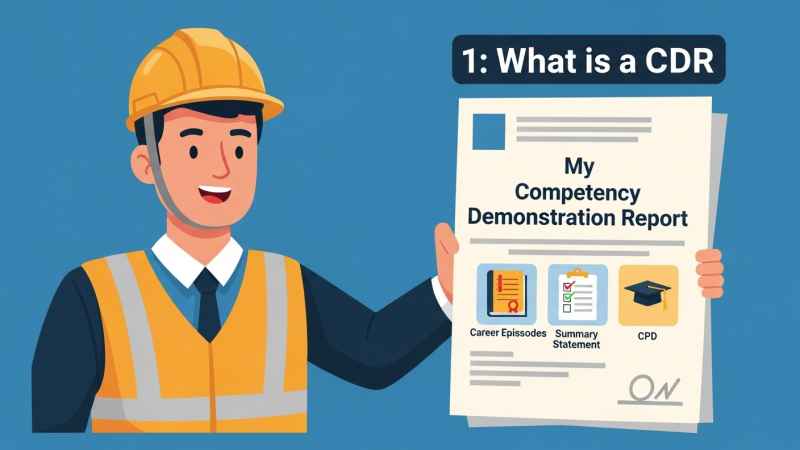
Engineers Australia CDR is covered in this guide for Engineers Australia applicants. A CDR requires you to describe such real-world engineering work in detail. Engineers Australia requires overseas engineers to submit a Competency Demonstration Report (CDR) when their degrees aren’t recognized through international accords. The CDR is a detailed technical report that documents your engineering qualifications, work history, and projects to demonstrate you meet Australia’s entry-to-practice competency standards.
It typically includes three Career Episodes, a Summary Statement, and evidence of Continuing Professional Development (CPD). Preparing a strong CDR is crucial: Engineers Australia will only issue a positive skills assessment (needed for visas like Subclass 189, 190 or 491) if you clearly show your abilities. In this CDR Writing Guide, we explain what the CDR is, why it matters, and how to write a CDR for Engineers Australia step-by-step.
What Is the Engineers Australia CDR?

A Competency Demonstration Report (CDR) is a package of documents used by Engineers Australia to assess an engineer’s competency for skilled migration. In practice, the CDR proves your engineering skills by showcasing real projects you have worked on. It must cover both your technical knowledge and how you applied that knowledge in practice. The core CDR documents are:
-
Three Career Episodes: First-person narratives (1000–2500 words each) focused on specific engineering projects or roles.
-
Summary Statement: A table cross-referencing your career episodes against the required competency elements for your occupational category.
-
Continuing Professional Development (CPD): A list of all relevant engineering training, courses, workshops, and other development activities you’ve undertaken.
-
Curriculum Vitae (CV): A chronological record of your education and work history.
If your engineering qualification is not accredited by the Washington, Sydney or Dublin Accords (as is often the case for degrees from India, Pakistan, Bangladesh, etc.), you must apply via the CDR pathway. In other words, if your degree is not recognized through those international agreements, your first step in migrating as an engineer is to submit a CDR. Only after a positive CDR outcome can you proceed to apply for skilled visas.
Engineers Australia recognizes four occupational categories. You will be assessed under the one that matches your qualifications and experience: Professional Engineer, Engineering Technologist, Engineering Associate, or Engineering Manager. Choose the category that best fits your background before preparing your CDR. The standard and format of the CDR vary slightly by category, but the core documents (career episodes, summary, CPD) are required for all.
Why Is the CDR Important?
The CDR is essentially a skills assessment. Engineers Australia uses it to verify that overseas engineers meet the same standards as Australian graduates. A well-prepared CDR demonstrates your engineering competence and helps secure a positive outcome. Conversely, a weak or incomplete CDR will be rejected, blocking your visa application. For example, if your career episodes fail to address all of the required competency elements, your entire CDR will be deemed deficient.
In short, the CDR is a gatekeeper for skilled migration. Only with a successful CDR assessment can you obtain the official letter needed for visa applications. That is why writing a thorough, accurate CDR is a critical step. By meeting all the criteria and avoiding common pitfalls, you greatly increase your chances of getting a positive skills assessment.
Who Needs to Write a CDR?
Not everyone needs a CDR. If you earned an engineering qualification that is fully accredited by one of the international Accords, you can use the relevant accreditation pathway and skip the CDR. But if your degree is not accredited – for example, if you studied in a country that is not a full signatory of the Washington, Sydney, or Dublin Accords – then you must use the CDR pathway.
In practice, many engineers from India, Pakistan, Bangladesh, Nepal, Sri Lanka, the Philippines and similar countries fall into this category. Even if you have some accreditation, you might still need a CDR if you wish to be assessed for a different engineering occupation than your degree, or if you hold only a provisional accreditation. In summary, any engineer without an Australia-accredited degree should plan to prepare a CDR.
Remember to identify the appropriate occupational category (Professional Engineer, Engineering Technologist, Engineering Associate, or Engineering Manager) before you begin. This choice affects the competencies you must demonstrate.
The CDR Assessment Process
Engineers Australia’s migration skills assessment involves a four-step process. Understanding each step will help you prepare thoroughly:
-
Choose Your Occupational Category. Early on, you will select whether you are applying as a Professional Engineer, Engineering Technologist, Engineering Associate, or Engineering Manager. This decision is based on your qualifications and experience. It determines which competencies apply and which summary statement template you will use.
-
Gather All Required Documents. Before writing the CDR, collect the supporting documents you will need. Key documents include:

-
Identity documents: A recent passport-sized photo and proof of identity (passport bio-data page or official birth certificate).
-
Education certificates: Your engineering degree certificate(s) and official academic transcripts. If you have multiple engineering qualifications, include all relevant certificates.
-
English language test results: Demonstrate proficiency in English via IELTS, TOEFL or PTE. Engineers Australia typically requires scores (for example, at least IELTS 6.0 in each band, or equivalent). Test results must be valid (usually no more than 2 years old).
-
Curriculum Vitae (CV): A complete and up-to-date resume listing your academic qualifications and engineering work experience. Include job titles, dates of employment, and key duties or projects. The CV must be a chronological record of everything, even gaps or studies.
-
Work experience evidence (if applicable): If your career episodes are based on paid employment or you claim relevant skilled employment, obtain employer reference letters or contracts. Each letter should be on official company letterhead, show your position, start/end dates, and be signed by the author.
-
Other documents: Depending on your case, you may also need proof of name change (if any), exam enrollment letters (if still studying), or any awards. Check the official Migration Skills Assessment (MSA) booklet for the full list. A bullet list might help keep track:
-
Passport-style photo and ID document (bio-page or birth certificate).
-
Engineering degree certificate(s) and transcripts.
-
English language test score report (IELTS/TOEFL/PTE).
-
Updated CV/resume with complete education and employment history.
-
Employment references or contracts to support any work experience claimed.
-
Official translations for any non-English documents (translated by an accredited translator).
-
-
Write Your CDR. The heart of the process is drafting your report. As noted, your CDR must contain:

-
Three Career Episodes: Write three detailed stories in English, in first person, about engineering projects or tasks you’ve worked on. Each episode should be 1000–2500 words long. Start each episode with a title, dates, location, and your role. Then provide background (brief context), explain the engineering problem and how you applied skills (personal engineering activity), and conclude with what you achieved or learned.
Use the engineering design process (define, design, implement, evaluate) to structure your narrative. Make sure to emphasize your personal contribution – describe what you did, not just what the team or company did. For example, even if the project was a group effort, clearly state your specific tasks and responsibilities.
-
Each career episode should focus on different competencies. Use numbered paragraphs so you can later reference them in the summary. Illustrate the engineering work with evidence (diagrams, tables, code snippets, photos, calculations) if available, to show your hands-on role. If you’re a recent graduate without work experience, you may base episodes on major academic or capstone projects; just be sure to highlight what you personally did.
-
Summary Statement: After your episodes, prepare a competency summary. This is a table (with separate templates for each occupational category) where you list every required competency element and cite the exact paragraphs in your career episodes where you demonstrated it. The summary ties your narratives to Engineers Australia’s standards. Use the official summary template for your category, and cross-reference using the numbered paragraphs from your episodes.
-
Continuing Professional Development (CPD): Compile a chronological list of all relevant professional development activities you’ve undertaken since completing your degree. Format it in a table or list with columns for the title of the activity, date, duration, and location (or provider). Include things like formal courses, conferences (attended or papers given), workshops, short courses, seminars, technical lectures, volunteering, publications, or even significant self-study (books, journals). EA expects “all relevant CPD,” so be thorough – even half-day online courses or webinars can be listed.
-
Personal Statement/Declaration: The MSA booklet also requires a signed declaration that the CDR is your own work. You should confirm that all typed sections are your own and that you’ve followed EA’s ethics standards.
-
-
Submit Your Application. Once your documents are ready, create an account on the Engineers Australia myPortal. In your migration skills assessment application, select the CDR pathway and your nominated occupation. Upload all required documents (ID, CV, education, career episodes, summary, CPD, etc.) and pay the assessment fee. Engineers Australia notes that once “all of the above are prepared, you are now ready to log into myPortal and lodge a CDR application”.
Double-check that every item is included and correctly labelled before submitting. After submission you’ll receive an email confirmation and later an assessment outcome letter.

Key CDR Requirements and Common Pitfalls
Engineers Australia enforces strict guidelines on CDR content and format. To avoid rejection:
-
Follow the prescribed structure: Use essay style for your episodes (in narrative first-person) and the official summary template. Do not use bullet points or lists in career episodes. Make sure each episode has the required sections (introduction, background, personal engineering activity, summary) as recommended.
-
Showcase your role: Write all career episodes in the first person singular and focus on what you did. Do not simply describe the team or company’s actions. If you were part of a group project, clearly explain your individual contributions. The MSA guidelines explicitly warn against narratives that present the work of others as your own.
-
Original writing only: Plagiarism is prohibited. Engineers Australia requires that “the CDR must be all your own work”. Using content from others’ CDRs or online examples is strictly forbidden. Copying any template or another person’s report will lead to immediate rejection (and potentially other penalties). Always use your own words and engineering details. You should draft and type the report yourself.
-
Clear, professional English: Write clearly and check your grammar. Poor English or technical inaccuracies can hurt your credibility. Use formal tone (avoid casual language or slang) and explain technical terms where needed. The reviewers will judge your communication skills as part of the assessment.
-
Complete documentation: Make sure every required document is included and correctly certified. Missing pages, unreadable scans, or unsigned forms are common reasons for delays or refusal. Use certified English translations for any foreign-language documents. For example, if you list work experience in an episode, ensure you have the supporting employer letter or payslips on file.
In summary, the official MSA booklet and other guidelines spell out exactly what’s needed. Following them closely will help ensure your report meets all standards.
Processing Time and Fees
After submission, expect a wait. Standard processing for a CDR assessment typically takes about 15 weeks just to assign an assessor. This does not include the actual evaluation time after assignment, so plan ahead. Engineers Australia does offer a Fast-Track option (for an extra fee) that aims to allocate your application within 20 business days. Note, even with Fast-Track, the final outcome depends on EA’s workload and whether they need to query any issues. As of 2024–2025, the fees for skills assessment are roughly:
-
Standard CDR assessment: ≈ AUD $880 (ex GST). This is about $968 including GST.
-
Fast-Track (additional): ≈ AUD $335.
These fees are updated yearly, so always check Engineers Australia’s official Assessment fees page for the latest amounts. Keep in mind that other related services (like employment assessment or PhD evaluation) carry separate fees.
Frequently Asked Questions
Can I write my own CDR?
Yes – many engineers prepare their own CDR. It’s not mandatory to hire a consultant. However, you must carefully study the MSA rules and ensure your report fully complies with them. Engineers who attempt it themselves often spend months reading guidelines and revising drafts to avoid mistakes. If you’re confident and meticulous, you can write your own CDR.
How many words should each Career Episode have?
Each episode should be 1000–2500 words. Within that, focus most content on your engineering work (about 600–1000 words) and provide enough background (200–500 words) and summary (50–100 words) to frame it. Keeping to the word range is important; too short won’t show enough detail, too long may waste words on irrelevant information.
Do I need work experience to apply?
Not necessarily. New graduates without professional engineering jobs can still submit a CDR based on their major academic projects or internships. Just ensure those episodes clearly highlight what you personally accomplished (e.g. in your final year project). If you claim experience, you must document it (e.g. with reference letters) as discussed above.
Can I reuse someone else’s CDR?

Absolutely not. Engineers Australia requires all CDR content to be original. Reusing any portion of another person’s report is plagiarism and will lead to instant rejection. Even if two engineers worked on the same project, each must write their own account. Copying in any form is strictly forbidden.
What if my CDR is rejected?
If EA refuses your CDR, they will usually give reasons. You have the right to ask for a review or make corrections and resubmit. It often helps to get professional feedback on a rejected draft. Review the deficiencies noted and revise carefully, ensuring you fully address every competency requirement the next time.
Conclusion
The Engineers Australia CDR is a critical milestone on the path to migrating as an engineer. By following EA’s guidelines and structuring your report properly – three clear career episodes, a precise summary statement, and a thorough CPD list – you demonstrate your readiness to work in Australia’s engineering sector. Stay organized: gather all documents early, plan your episodes in advance, and proofread meticulously.
Remember the golden rules: be original, be concise, and always write in first person about your engineering activities. For additional help, numerous resources and guides are available (including the official EA guide on writing career episodes and summary statements). Whether you write it yourself or seek expert review, a strong CDR opens doors to skilled visas and new career opportunities in Australia.
Good luck as you prepare your Engineers Australia CDR – a key step toward your engineering future Down Under!
Engineers Australia CDR: Best Guide 2026
Engineers Australia CDR should start with the applicant selecting real engineering evidence instead of generic duties. A strong Engineers Australia CDR page explains the project context, personal engineering actions, and measurable outcomes. Use Engineers Australia CDR to connect career episode examples with Engineers Australia competency elements. The best Engineers Australia CDR preparation keeps claims specific, factual, and supported by documents.
For migration applicants, Engineers Australia CDR is most useful when it avoids copied samples and focuses on individual work. Engineers Australia CDR can improve review quality when each project paragraph answers what, why, and how. Before submission, Engineers Australia CDR should be checked for structure, evidence, language clarity, and consistency. Applicants using Engineers Australia CDR should keep CPD, summary statement, and career episode details aligned.
A practical Engineers Australia CDR checklist helps reduce avoidable Engineers Australia assessment delays. Professional Engineers Australia CDR support should protect accuracy while improving readability and presentation. The Engineers Australia CDR process also helps applicants identify missing technical details before final review. Every Engineers Australia CDR draft should show the engineer’s own decisions, calculations, coordination, and problem solving.
Engineers Australia CDR is strongest when the final document is clear enough for an assessor to follow quickly. A final Engineers Australia CDR review should confirm that the report supports the nominated occupation. Using Engineers Australia CDR carefully helps keep the application focused on evidence rather than broad claims. Well planned Engineers Australia CDR content can make the complete CDR package easier to assess.
A reliable Engineers Australia CDR workflow includes topic selection, drafting, checking, and final compliance review. The main purpose of Engineers Australia CDR is to present engineering competency in a clear migration assessment format.
Engineers Australia CDR checklist for Engineers Australia
- Confirm the nominated occupation and ANZSCO code before drafting.
- Use project evidence that shows your own engineering decisions.
- Keep paragraphs short, specific, and easy for an assessor to scan.
- Review the latest Engineers Australia guidance before submission.
