CDR for Electronics Engineer ANZSCO 233411 Explained

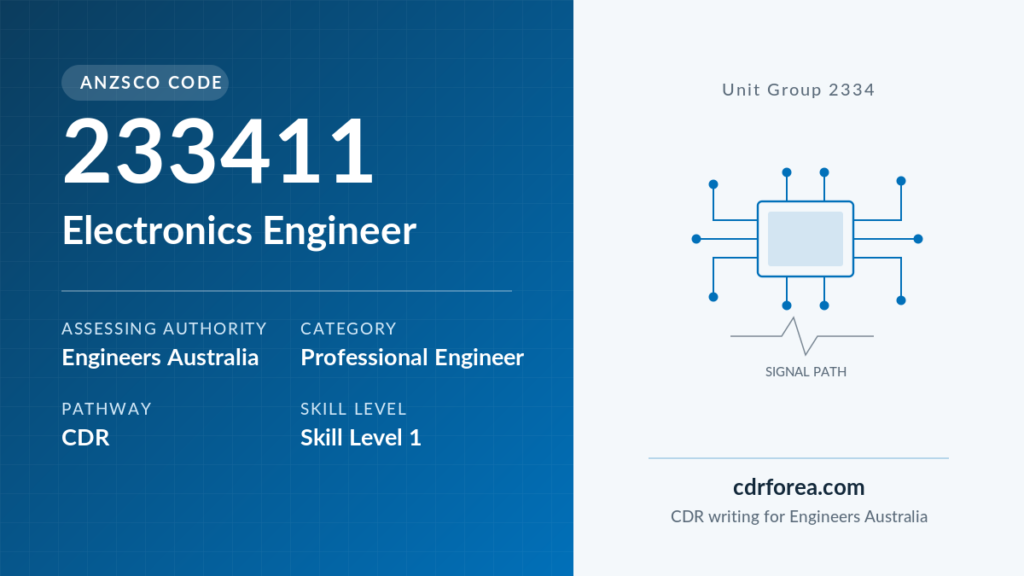
ANZSCO 233411 Electronics Engineer assessed by Engineers Australia as a Professional Engineer via the CDR pathway

Electronics Engineer is ANZSCO 233411, assessed by Engineers Australia through the Competency Demonstration Report pathway. It is also one of the most frequently mis-selected codes in engineering migration, because three neighbouring occupations look close enough to be confusing: 233311 Electrical Engineer, 263311 Computer Network and Systems Engineer, and 263312 Telecommunications Network Engineer.

Choosing wrong does not usually produce a rejection. It produces something worse — a positive assessment for an occupation you then cannot use, or an outcome that does not match your nomination. This guide covers where the boundaries actually fall, and how to write career episodes that place you clearly inside 233411.

The ANZSCO definition, and why it is narrower than people assume

From the ABS classification:

Designs, develops, adapts, installs, tests and maintains electronic components, circuits and systems used for computer, communication, command and warfare systems, entertainment, transport and other industrial applications.

Unit Group 2334 contains this one occupation and no others, with Combat System Engineer as its listed specialisation. The task list explicitly includes designing embedded software within electronic systems, developing test apparatus and procedures, designing signal processing algorithms and choosing the hardware and software to implement them, and designing communications bearers across wired, optical fibre and wireless media.

That last cluster is why the boundary with telecommunications is genuinely blurry, and why it needs to be settled deliberately rather than by guesswork.

Where 233411 ends and the neighbouring codes begin

If your engineering object is… Likely code
Circuits, PCBs, embedded systems, signal processing, instrumentation, control electronics 233411 Electronics Engineer
Power generation, transmission, distribution, motors, switchgear, building electrical services 233311 Electrical Engineer
IP networks, routing and switching, server and systems infrastructure 263311 Computer Network and Systems Engineer
Carrier transmission networks, RF planning, fibre and radio network design 263312 Telecommunications Network Engineer

A working rule: if your competency is in the physics and design of the electronics, you are 233411. If it is in the configuration and operation of a network built from other people’s electronics, you are in the 2633 family. An RF engineer designing a transceiver front end is 233411. An RF engineer planning cell site coverage is closer to 263312.

Note that 233411 is a Skill Level 1 occupation requiring a bachelor degree or higher, and Engineers Australia will normally assess it in the Professional Engineer category where the qualification is an accredited four-year engineering degree. A three-year technology degree typically leads to Engineering Technologist instead. Both are valid outcomes with different visa consequences.

Three career episode structures for electronics engineers

Electronics work compresses badly. Engineers write “designed the control board” and move on, when the design decisions inside that sentence are the entire competency claim. Slow down and show the reasoning.

1. A hardware design you took from requirement to validated board

Choose something you owned: a sensor interface, a motor driver, a power supply stage, an RF front end, a data acquisition board. Walk through the engineering argument — the specification you were given and the ambiguities you had to resolve, the architecture options you considered, component selection with the actual trade-offs (cost against noise figure, power against thermal margin, availability against performance), schematic and layout decisions, and how you handled signal integrity, EMC or thermal constraints.

Then show validation. What did you measure, against what limit, with what instrument, and what did you change when the first revision did not meet spec? A board that worked first time is a less useful episode than one that did not and was fixed.

2. An embedded firmware or signal processing problem

ANZSCO explicitly lists embedded software design and signal processing algorithm development under this unit group, so these episodes are squarely on-code. Good subjects: a real-time control loop you tuned, a filter you designed and implemented under fixed-point constraints, a communication protocol you implemented on constrained hardware, a timing or interrupt latency problem you diagnosed.

Write about the constraint that made it hard — the cycle budget, the memory ceiling, the deterministic deadline. Anyone can describe code that works; competency shows in the engineering compromise.

3. A test, compliance or integration project

Developing test apparatus and procedures is a listed task for 2334 and makes a strong third episode, particularly if your first two are design-heavy. Subjects that work: designing an automated functional test rig for production, taking a product through EMC compliance and fixing what failed, integrating an electronic subsystem into a larger platform, or root-causing a field failure back to a design cause.

Compliance episodes are underrated. They demonstrate standards knowledge, measurement rigour and the ability to close a problem — three things assessors are explicitly looking for.

Mistakes that specifically affect electronics applicants

  • Drifting into IT. Episodes about network configuration, server administration or application software will make an assessor question whether 233411 is your occupation at all.
  • Naming parts instead of justifying them. “I used an STM32F4” is a fact. “I selected the STM32F4 over the F1 because the DSP instructions let me run the 1 kHz control loop within the 200 µs budget without an external coprocessor” is competency.
  • No measurements. Electronics is a measured discipline. Episodes with no numbers, no test conditions and no instruments read as theoretical.
  • Confidentiality used as an excuse for vagueness. Defence and commercial work has real restrictions, but you can always describe your engineering reasoning without disclosing protected specifics. Generalise the application, keep the technique concrete.
  • Recycled samples. Electronics CDR samples are among the most copied online and Engineers Australia screens for plagiarism. Use samples for structure only — see our CDR samples by discipline for what a well-formed report looks like.

Assembling the rest of the application

Three career episodes are only part of it. You also need a CPD record, a CV, and a summary statement mapping every paragraph of your episodes onto the competency elements for your category. Our summary statement guide explains the cross-referencing table, and the Engineers Australia CDR guide covers the full package.

Get your documentation right before you submit — the document requirements are stricter than most applicants expect, particularly around employment evidence. English test requirements are in the IELTS guide, and the EA skill assessment overview covers timelines and process.

Frequently asked questions

I have an electrical engineering degree but work in electronics. Which code applies?

ANZSCO codes describe the occupation you work in, not the degree you hold, so 233411 can be correct with an electrical degree. Engineers Australia will assess whether your qualification and your evidence support the nominated occupation, so your episodes need to be clearly electronic in nature.

Can embedded software work alone support a 233411 assessment?

It can, because embedded software design sits inside the unit group definition. A mix of hardware and firmware is stronger, but firmware-only reports succeed when the episodes stay tied to the electronic system rather than reading as general software development.

Does defence or combat systems work create a problem?

Combat System Engineer is a listed specialisation of 233411, so the occupation itself is well aligned. Handle classification carefully — describe your engineering reasoning at a level you are permitted to disclose.

Should I list every project I have worked on?

No. Three episodes, each covering one project or period in depth, beats a survey of your whole career. Depth is what is assessed.

Getting your 233411 CDR right

Most electronics CDRs that come back with queries are not written by weak engineers — they are written by strong engineers who compressed their best work into two sentences. If you want help expanding your technical decisions into competency evidence, our CDR writing services for Engineers Australia cover electronics and every other discipline Engineers Australia assesses.

Occupation definitions on this page come from the Australian Bureau of Statistics ANZSCO classification. Assessing authorities, occupation lists and fees change periodically — confirm current requirements with Engineers Australia and the Department of Home Affairs before you apply.