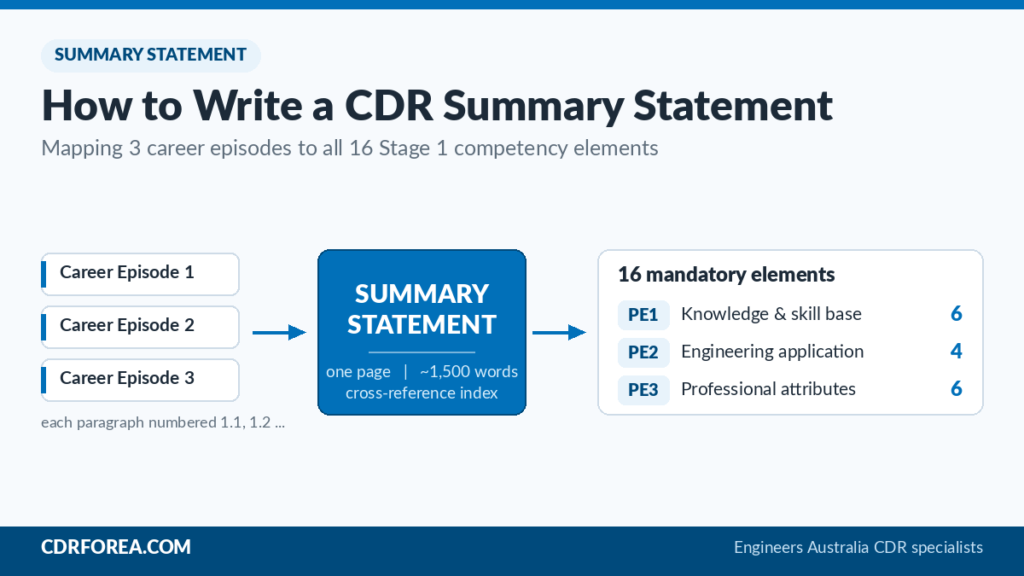
A CDR summary statement is the one-page cross-reference table that tells an Engineers Australia assessor exactly where, in your three career episodes, you demonstrated each of the 16 mandatory Stage 1 competency elements. It contains no new information. Its only job is to point — precisely, paragraph by paragraph — at evidence you have already written.
It is also the single most common reason a technically strong CDR gets a negative outcome. Assessors work from the summary statement first. If an element has no reference, or the reference points to a paragraph that doesn’t actually show that competency, the element is marked as not demonstrated — no matter how good your career episodes are.
Key facts at a glance
- What it is: a cross-reference index, not an essay or a personal summary.
- You must use Engineers Australia’s template. Engineers Australia publishes a summary statement template for each occupational category — professional engineer, engineering technologist, engineering associate and engineering manager. Download the one for your category and complete it; don’t invent your own layout.
- Length: Engineers Australia does not publish a word count or page limit. Complete the template fully and stop there — it should not read like a fourth career episode.
- Coverage: every competency element in your category’s template. For professional engineers that is 16 elements.
- Format: every claim is followed by a reference to a numbered career episode paragraph, such as
CE 2.14— career episode 2, paragraph 14. - Quantity: one summary statement per CDR, covering all three career episodes together.
The 16 Stage 1 competency elements you must address
Engineers Australia’s Stage 1 Competency Standard for Professional Engineer groups 16 mandatory elements under three competencies. The wording below is quoted from the current standard. Note that the standard itself numbers the elements 1.1 to 3.6 — the “PE” prefix comes from the summary statement template.
PE1 — Knowledge and skill base (6 elements)
| Element | What you must demonstrate |
|---|---|
| PE1.1 | Comprehensive, theory based understanding of the underpinning natural and physical sciences and the engineering fundamentals applicable to the engineering discipline. |
| PE1.2 | Conceptual understanding of the mathematics, numerical analysis, statistics, and computer and information sciences which underpin the engineering discipline. |
| PE1.3 | In-depth understanding of specialist bodies of knowledge within the engineering discipline. |
| PE1.4 | Discernment of knowledge development and research directions within the engineering discipline. |
| PE1.5 | Knowledge of engineering design practice and contextual factors impacting the engineering discipline. |
| PE1.6 | Understanding of the scope, principles, norms, accountabilities and bounds of sustainable engineering practice in the specific discipline. |
PE2 — Engineering application ability (4 elements)
| Element | What you must demonstrate |
|---|---|
| PE2.1 | Application of established engineering methods to complex engineering problem solving. |
| PE2.2 | Fluent application of engineering techniques, tools and resources. |
| PE2.3 | Application of systematic engineering synthesis and design processes. |
| PE2.4 | Application of systematic approaches to the conduct and management of engineering projects. |
PE3 — Professional and personal attributes (6 elements)
| Element | What you must demonstrate |
|---|---|
| PE3.1 | Ethical conduct and professional accountability. |
| PE3.2 | Effective oral and written communication in professional and lay domains. |
| PE3.3 | Creative, innovative and pro-active demeanour. |
| PE3.4 | Professional use and management of information. |
| PE3.5 | Orderly management of self, and professional conduct. |
| PE3.6 | Effective team membership and team leadership. |
If you are applying as an engineering technologist, your elements are numbered ET1.1–ET3.6; as an engineering associate, EA1.1–EA3.6. Engineering managers have their own template too. The structure is similar, but the wording and the expected depth differ, so never reuse a professional engineer summary statement for a different occupational category. The authoritative wording for your category is in that category’s Stage 1 competency standard and in the official summary statement template, both linked from Engineers Australia’s Prepare your Migration Skills Assessment application guide — the current replacement for what applicants still call the MSA booklet.
How cross-referencing actually works
Cross-referencing only works if your career episodes are numbered first. Before you write a single line of the summary statement:
- Number every paragraph of each career episode in the format
1.1, 1.2, 1.3…for career episode 1,2.1, 2.2…for career episode 2, and so on. - Keep paragraphs short and single-purpose. A paragraph covering four different activities is almost impossible to reference cleanly.
- Then write the summary statement, quoting the exact paragraph numbers.
If you renumber a career episode after writing the summary statement, every reference must be checked again. This is where most self-written CDRs break.
What a correct entry looks like
Each entry has three parts: the element, a short statement of what you personally did, and the reference. For example:
| Element | How it was demonstrated | Reference |
|---|---|---|
| PE1.1 | Applied Ohm’s law, per-unit impedance calculations and symmetrical component theory to determine three-phase fault levels at the 11 kV switchboard before selecting protection settings. | CE 1.8, CE 1.9 |
| PE2.1 | Diagnosed repeated relay maloperation by comparing measured CT saturation against calculated knee-point voltage, then re-specified the CT ratio to eliminate the fault. | CE 1.14–CE 1.17 |
| PE2.4 | Prepared the works programme, resource plan and shutdown sequence for the substation upgrade, and tracked progress against the baseline each week. | CE 3.11, CE 3.12 |
| PE3.2 | Presented the protection coordination study to the client’s operations team, including non-technical stakeholders, and issued the written design report. | CE 1.21 |
Note what these entries have in common: a specific technical action, in first person singular, tied to a narrow paragraph range. “I was responsible for the electrical design” would fail — it names a role, not a demonstrated competency.
Format and presentation requirements
- Use Engineers Australia’s template for your occupational category. Download it from the Engineers Australia website and complete it — this is a requirement, not a preference, and the template already sets out the elements and the reference column.
- First person singular. Write “I calculated”, not “we calculated” or “the team calculated”. Engineers Australia assesses your competency.
- English only, in the same terminology used in your career episodes.
- No new projects or claims. Everything referenced must already exist in a career episode.
- Consistent titles. Use the same project name, employer, location and dates as your career episodes.
- Every element referenced at least once. Not one gap.
Seven mistakes that get summary statements rejected
- Missing elements. PE1.4 (research directions) and PE3.4 (management of information) are the two most commonly left blank, because engineers assume day-to-day work doesn’t cover them. It usually does — literature reviews, standards research, drawing revision control, document registers.
- References that don’t match. The statement cites CE 2.9, but CE 2.9 is about site mobilisation. Assessors check.
- Copied text. Engineers Australia screens submissions for similarity to previously submitted reports, and treats copying as an ethical breach rather than a formatting error. Its stated consequences are immediate rejection of the application plus a 12, 24 or 36-month ban on applying again, and your details may be reported to the Department of Home Affairs. Engineers Australia’s own definition is broad: presenting work completed by others as your own, copying other people’s words, or “having your career episodes or summary statement written by a third party/person”. Read that definition yourself before you decide how to get help with your CDR.
- New information. Introducing a project, calculation or responsibility that appears nowhere in the career episodes invalidates the reference.
- Vague, role-based claims. “Managed the project” instead of the specific systematic approach you applied.
- Plural voice. Team achievements with no visible personal contribution.
- Wrong category. Using PE elements when you nominated engineering technologist, or vice versa.
A five-step process that works
- Finalise and number your career episodes. Do not start the summary statement until the episodes are locked.
- Build a coverage matrix. List all 16 elements down one column, then read through each episode and note every paragraph that could support each element.
- Find the gaps. Any element with no candidate paragraph means a career episode needs revising to include that evidence — not that you should invent a reference.
- Write each entry as action + technical specifics + reference.
- Audit backwards. Take each reference, open that paragraph, and confirm it genuinely shows the element. Fix anything that doesn’t survive that test.
Pre-submission checklist
- All 16 elements for your nominated category are present.
- Every paragraph number cited actually exists in the career episode.
- Every cited paragraph genuinely demonstrates the element claimed.
- Written entirely in first person singular.
- No project, employer or date contradicts your career episodes or CV.
- No sentence has been copied from a sample or another applicant’s report.
- Length is around one page and clearly reads as an index, not a narrative.
Frequently asked questions
How long should a CDR summary statement be?
Engineers Australia does not publish a word count or a page limit. It asks you to download the summary statement template for your occupational category and complete it, mapping every competency element to a specific numbered paragraph in your career episodes. Length is whatever that takes — but if it starts reading like a narrative rather than an index, new content has crept in.
Do I write one summary statement or three?
One. A single summary statement covers all three career episodes together, drawing references from whichever episode contains the best evidence for each element.
Can I use a sample summary statement as a template?
Use Engineers Australia’s official template for your occupational category, not someone else’s completed summary statement. You can study a sample to understand the structure, but you must not reuse the wording. Engineers Australia checks submissions for similarity against previously submitted reports, and its stated consequence for plagiarism is immediate rejection plus a 12, 24 or 36-month ban on reapplying, with details possibly reported to the Department of Home Affairs.
Which competency elements are hardest to demonstrate?
In practice, PE1.4 (knowledge development and research directions) and PE1.6 (sustainable engineering practice, safety and risk) are the most frequently under-evidenced, followed by PE3.4 (professional use and management of information). All three are usually present in real engineering work but rarely written up unless you plan for them.
What happens if one element is missing?
The assessor may request further information, or issue a negative outcome for failing to demonstrate the competency. If you have already received a negative outcome, you can request a review or an appeal — see our guide to the Engineers Australia review and appeal process.
Does the summary statement need to match my CV?
Yes. Employers, dates, positions and locations must be consistent across your summary statement, career episodes, CV and employment evidence. Inconsistencies are one of the fastest routes to a request for further information.
Need your summary statement written or checked?
Our writers map every element to the right paragraph and audit each reference before delivery. If your career episodes are already drafted, our review service will build the summary statement around them and flag any element your episodes don’t yet support.
- See plans and pricing — full CDR packages including summary statement and CPD.
- Review, edit and plagiarism check — from $50, if you have written your own draft.
- Career episode writing service — get the episodes right first.
- Get a free quote for your discipline.
Source: Engineers Australia, Stage 1 Competency Standard for Professional Engineers. Requirements can change — always confirm against the current MSA booklet before you submit.
Related reading
- Start with the complete Engineers Australia CDR guide.
- See also our approach to CDR writing.
- Related: what goes into a CDR for Engineers Australia.
- Background: the Relevant Skilled Employment Assessment (RSEA) and the documents EA accepts.
- Next step: our CDR review, edit and plagiarism check service.

