
Competency Demonstration Report (CDR) – Requirements for Australian Immigration
Competency Demonstration Report CDR is covered in this guide for Engineers Australia applicants.
Migrating to Australia as a skilled engineer requires a formal Migration Skills Assessment by Engineers Australia . As the Australian Government–appointed authority Engineers Australia evaluates overseas qualifications and experience to ensure you meet local engineering standards.
A Competency Demonstration Report (CDR) is a technical report you must submit if your engineering degree is not accredited under international accords (Washington Sydney or Dublin) or if you seek assessment in a different occupation.
In this report, you document your engineering education and work projects to prove that you have the knowledge and abilities needed for your nominated occupation.
Engineers Australia’s official guidelines emphasize that your CDR should provide evidence of both your core technical knowledge and the application of that knowledge in real projects. In other words, it must show what you know (from your studies) and how you used it (in practice). Crucially, the MSA Booklet warns that “the CDR must be all your own work.” Any plagiarism or use of others’ writing will lead to immediate rejection and even bans. Preparing a thorough, genuine CDR is therefore the key step in getting a positive skills assessment – which is required before you can apply for skilled visas. Without it, you cannot proceed with visa applications such as the points-tested subclass 189, 190, or 491 visas.
Why the CDR Matters for Migration
The CDR is essentially a gatekeeper for skilled migration in engineering. Engineers Australia uses it to verify that foreign engineers meet the same “stage 1” competency standards as Australian graduates. A well-prepared CDR demonstrates that you have the right qualifications experience and communication skills. Conversely a weak or non-compliant CDR will block your visa application.
For example the CDR needs to address all the required competency elements (entry-to-practice competencies).
If your Career Episodes or Summary Statement fail to cover even one element, your entire application can be deemed deficient. As one guide notes, Engineers Australia “will only issue a positive skills assessment (needed for visas like Subclass 189, 190 or 491) if you clearly show your abilities” in the CDR.
In short the CDR is a critical skills assessment report. Only after a positive CDR outcome will you receive the formal skills assessment letter needed for visa applications. This applies to all points-based skilled visas: for example the Skilled Independent visa (Subclass 189) Skilled Nominated visa (Subclass 190) and Skilled Work Regional (Provisional) visa (Subclass 491).
These permanent or provisional residence visas require you to have an EA skills assessment matching your occupation.
Who Must Submit a CDR?
Not every engineer needs a CDR. If you hold an accredited engineering degree (e.g., from a Washington or Sydney Accord country under the approved intake year), you may use the direct accreditation pathway. However, if your qualification is not fully accredited, you must use the CDR pathway.
This applies to non-accredited engineering programs or qualifications from institutions that are not accredited under an international Accord.
Engineers Australia lists the following criteria for the CDR pathway:
-
Non-accredited qualification – Your engineering degree is not recognized under the accords.
-
Different occupation – You have an accredited degree but are seeking assessment for a different occupational category than your degree title.
-
Engineering Manager applicants – Those applying under the Engineering Manager category use the CDR route.
For example, you might hold a Bachelor of Engineering in Mechanical Engineering that is not Accord-accredited, or you might hold an accredited engineering degree but want to be assessed as an Engineering Technologist instead of a Professional Engineer. In these cases, the CDR is required.
Engineers Australia recognizes four occupational categories for skilled migration: Professional Engineer Engineering Technologist Engineering Associate and Engineering Manager . You must choose the category that best fits your background before submitting your CDR because each category has its own set of competency elements.
The format of your Summary Statement and the specific competencies you demonstrate will depend on your chosen category.
Types of Skilled Visas
A successful CDR assessment enables you to apply for Australia’s main points-tested skilled visas:
-
Subclass 189 (Skilled Independent Visa): A permanent visa for skilled workers without needing sponsorship. You must have an occupation on the relevant skilled list, a positive skills assessment (via your CDR), and score enough points.
-
Subclass 190 (Skilled Nominated Visa): A permanent visa that requires nomination by an Australian state or territory. Similar points and skills assessment requirements as the 189.
-
Subclass 491 (Skilled Work Regional (Provisional) Visa): A five-year provisional visa for skilled workers nominated by a state/territory or sponsored by a relative in regional Australia. Also points-tested and requires a positive skills assessment.
Although home affairs policy can change, having a positive Engineers Australia outcome is a common requirement for these visas. (There are other visas for employment, but the GSM visas above are the main skilled migration pathways for engineers.)
Document Checklist: Personal and ID Documents
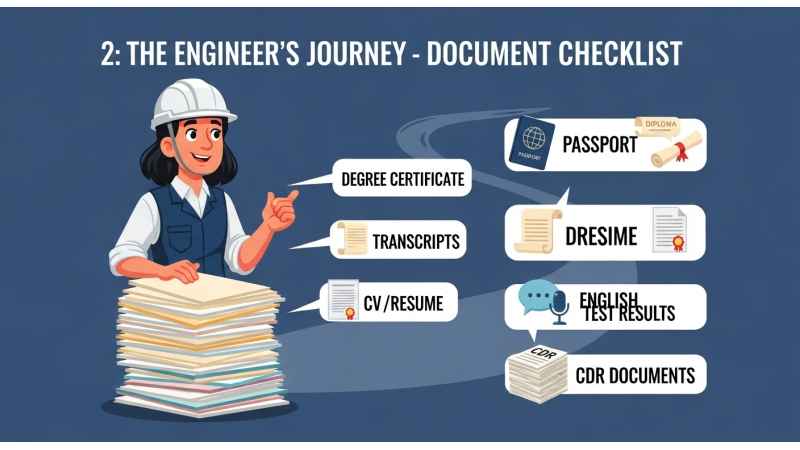
Before writing your CDR, gather all the personal and identity documents required by Engineers Australia. These must be scanned in color and uploaded in the online portal. The official checklist includes:
-
Passport-size Photo: A recent color photo (35×45 mm) of yourself with a plain background, saved as a JPEG (1200×1600 pixels). It must show your full head and shoulders clearly.
-
Primary ID: A clear color scan of your current passport bio-data page (showing photo, name, DOB). If you don’t have a passport, a certified copy of your birth certificate or national ID card may suffice.
-
Name Change Documents: If your current name differs from the name on certificates or transcripts, include official name change evidence (e.g., marriage certificate, deed poll).
-
Education Certificates: Your engineering degree certificate (or letter of completion) and official academic transcripts. If you have multiple engineering qualifications, upload all relevant degree certificates and transcripts. If you are still studying, include your enrollment letter and current transcript.
-
Curriculum Vitae (CV/Resume): A concise summary of your engineering education and work history. See below for CV details.
-
English Test Results: Certificates showing your scores on an approved English test (IELTS, TOEFL iBT, or PTE Academic). See English Requirements below for details.
Each of the above must be uploaded as a PDF file. The portal allows multiple pages per PDF (e.g. your transcript can be one multi-page PDF) but do not upload each page separately. Keep each document as one file. Also ensure all scans are color not black-and-white
and of good quality (at least 300 dpi). Low-resolution or photocopied scans can lead to delays or requests for resubmission.
English Language Requirements
Engineers Australia requires evidence of English proficiency unless you qualify for an exemption. Accepted tests and minimum scores are specified in the MSA requirements. You must provide test results for one of these:
-
IELTS (Academic or General): Minimum score 6.0 in each component (Listening, Reading, Writing, Speaking).
-
TOEFL iBT: Minimum section scores – Listening 12, Reading 13, Writing 21, Speaking 18.
-
PTE Academic: Minimum score 50 in each component.
Your test results must be valid (usually taken within 3 years before application). When you apply, you upload your test report form. (For PTE, Engineers Australia requires you to submit your result through Pearson’s portal to verify the score.)
Exemptions: You do not need to take a test if you satisfy certain criteria. For example if you completed at least two years of full-time study in an Australian tertiary institution (CRICOS-registered) or you are a citizen of the UK USA Canada New Zealand or Ireland with a passport you may be exempt. However
EA can still request proof of English even if exempt in some cases.
Curriculum Vitae (CV)
Your CV should be a chronological resume covering all engineering-related education and work history. It must be a complete record (include any gaps or periods of study). The CV should not exceed 3–4 A4 pages, so be concise and relevant.
Include the following for each entry:
-
Education: List your degrees (degree title, university, year of graduation). You need to upload the formal certificates separately, so the CV only needs to summarize them.
-
Work Experience: For each job or internship state the organization name and location dates and duration (month/year to month/year) and your position title. Provide a brief duty statement or bullet points of your responsibilities. For example: “Civil Engineer XYZ Builders June 2015–July 2018: Designed structural frameworks for residential buildings supervised site construction
prepared as-built drawings.”
-
Other Skills/Activities: You may include relevant non-engineering roles (e.g., military service, if any), certifications, or professional memberships.
Remember the CV is not a narrative: do not describe engineering projects or achievements here (that belongs in Career Episodes). It is just a factual chronology. Each item should clearly show what you did where and when. The MSA instructions stress that the CV is a chronological listing of employment not projects.
If your CV is poorly structured or misses key dates it can raise questions.
Academic Qualifications and Transcripts
You must upload official copies of all your engineering education documentation. This includes:
-
Degree Certificate: Your primary engineering degree certificate (testamur) from the university. If the degree is in progress, a letter of completion or provisional certificate may suffice.
-
Academic Transcript: Official transcript showing courses and grades. For multi-year programs, provide transcripts from each year or a consolidated transcript.
-
Additional Qualifications: If you have multiple engineering degrees (e.g., bachelor’s and master’s), include those certificates and transcripts as well.
-
Supporting Details: If EA requests, you may also need to upload course descriptions or syllabi for key subjects. Ensure the university’s name is entered consistently (respecting upper/lower case) when you fill the online form.
-
Translations: If any document is not in English, you must provide a certified English translation along with the original-language document. Translations must be done by an authorized translator (e.g., NAATI-accredited). Untranslated documents will not be accepted.
Career Episodes: Demonstrating Your Engineering Skills
The heart of the CDR is the three Career Episodes. Each episode is a narrative essay describing a specific engineering project or significant task you undertook. It is your chance to show Engineers Australia exactly how you apply engineering knowledge in practice.
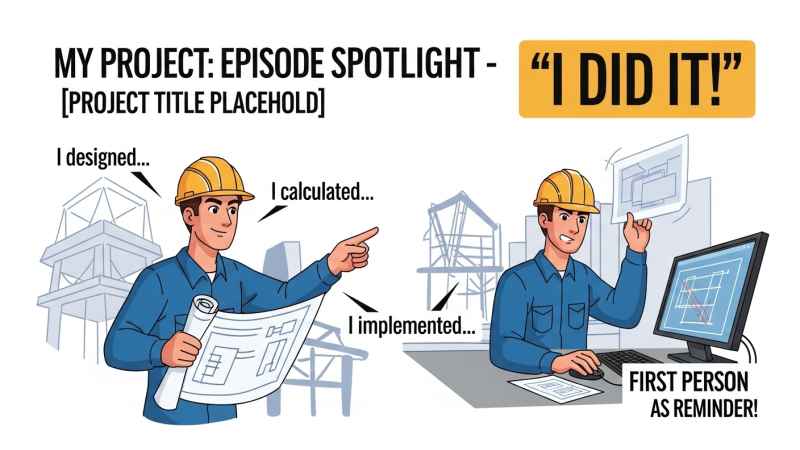
Format of Each Episode: Engineers Australia provides a strict format for Career Episodes. Each episode must be written in English in the first person (use “I did…” statements) and must highlight your personal contribution. The episodes should not be tables or resumes; they should read as detailed stories of your work. According to the official MSA booklet
each Career Episode should contain:
-
Introduction (Approx. 150 words): Give a short overview with the project’s title, dates/duration, location, and your role/position on that project. For instance: “Introduction: Project Title – XYZ Bridge Design, March–June 2019, Brisbane, Role: Structural Engineer.” This orients the reader to the context.
-
Background (200–500 words): Describe the context and objectives of the project. Explain the nature of the engineering problem or assignment the goals of the project and any organizational setting. Mention what your part of the company/academic unit was responsible for. If you were part of a team you can include an organizational chart or duty statement
but focus on the project’s scope.
-
Personal Engineering Activity (600–1500 words): This is the main body and the “meat” of the episode. Here you must describe in detail the actual work performed by you. State clearly what you did and how you did it – do not just describe team actions. Detail the engineering tasks you undertook the technical challenges encountered
and how you solved them.
For example explain calculations you performed design decisions you made analyses you conducted or codes/standards you applied. The guidelines explicitly say it is not sufficient to describe the activities performed by a team or group – your own role must be clearly identified. In other words use first-person language (“I designed…” “I calculated…”
“I implemented…”) and emphasize YOUR contribution. Include any original ideas creative designs or strategies you devised.
If you used any diagrams, photos, tables, or software in your work, you may attach them as supporting evidence, but the narrative text should still focus on what you did.
-
Summary (50–150 words): Conclude each episode by summarizing the overall outcome and your role. Reflect on how well the project met its goals and highlight the skills you demonstrated. For example, note any technical achievements or what you learned.
Using this format ensures you cover all necessary details. Typical word counts are roughly 1000–2500 words per episode. (Newer guidelines suggest about 600–1500 words for the main activity, but a total of ~1000–2000 words each is common.)
First Person and Personal Role: Engineers Australia stresses the use of first-person voice and a personal focus. Always talk about what you did how you did it and why. For example: “I designed the XYZ circuit and calculated its parameters…” rather than “The team designed a circuit.” Make it clear you drove the engineering work.
The MSA booklet warns: “It is not sufficient to describe the activities performed by a team or group – your own role must be clearly identified.”
Engineering Emphasis: Concentrate on technical aspects in the Personal Activity section. Describe relevant calculations standards tests simulations or design processes. Explain problems and your solutions. For example: if you wrote a program or created a prototype briefly describe its function. Use engineering terminology and where possible quantify results (e.g. “reduced energy loss by 15%”).
The majority of each Career Episode should be devoted to engineering work – the Introduction and Background set the stage while the core is the Personal Engineering Activity.
Paragraph Numbering: It is strongly recommended to number the paragraphs in each Career Episode. This is not only good organization, but it is required for the Summary Statement (see next section) so that each competency can be referenced by episode and paragraph number.
Recent Graduates: If you have limited work experience (e.g. you recently graduated) you may use major academic projects or internships for one or more episodes. Just be sure to emphasize what you personally did in the project. For example if the episode is based on a capstone design project
describe your individual tasks (even if done in a team) and the skills you applied.
Summary Statement
The Summary Statement ties everything together. It is essentially a table that cross-references your Career Episodes to the “Elements of Competency” required by Engineers Australia for your chosen category. After writing your episodes, you must complete the official Summary Statement template provided by EA for your occupational category.
In this document list each entry-to-practice competency element (for example PE1.2 PE2.3 etc. for Professional Engineers) and cite exactly where in your Career Episodes you addressed it. You will refer to specific paragraph numbers (hence the earlier numbering) and explain briefly how that part of your episode demonstrated the element. For instance:
“PE1.3 – Ability to systematically apply knowledge – Demonstrated in CE 1 Paragraph 3 where I analyzed the fluid flow equations for the system.”
Follow the instructions carefully: each competency element must appear at least once in the summary. The Summary Statement essentially proves that collectively your three episodes cover all the competencies for your category. Be precise and use first-person wording (“my role was…” “I demonstrated…”) in the summary as well. Download the correct template for your category (Professional Engineer
Technologist Associate or Manager) and fill it out fully. This summary is a key deliverable – a well-linked summary can greatly strengthen your CDR.
Continuing Professional Development (CPD)
You must also document your professional development activities in a CPD table. CPD shows that you keep your skills current beyond formal education. Include all relevant CPD since graduation – even short courses, workshops, or seminars. The EA guidelines require this to be a table with columns for Activity Title, Date, Duration, Venue, and Organiser. Typical entries might include:
-
Attended technical conferences or seminars (with title, date, and location).
-
Completed short courses or workshops (e.g., a week-long structural engineering course).
-
Undertaken online courses or webinars.
-
Published an engineering paper or technical report.
-
Professional contributions (e.g., serving on a standards committee).
-
Self-study (reading technical journals or industry publications).
List everything relevant, but keep it succinct. The EA booklet notes that all relevant CPD must be included, and it “may include details of …postgraduate study, conferences, short courses, volunteer services, private study.” Many CDRs simply use one row per activity in the table. The CPD table is typically limited to one page.
Employment Evidence (When Applicable)
If any of your Career Episodes are based on work experience, you must provide documentary evidence of that employment. For the Standard CDR Assessment, Engineers Australia requires a reference letter or certificate from your employer(s). This letter should be on the company’s official letterhead and signed by an authorized person. It must clearly state:
-
Your job title/position.
-
Dates of employment (start and end).
-
A brief list of duties or responsibilities (or attach the official appointment letter if available).
For example: “This is to certify that [Name] was employed as a Mechanical Design Engineer at ABC Corp from Jan 2016 to Dec 2019. During this period [Name] performed tasks including [list of duties]…” and signed. Upload one letter for each relevant job with contact details in case EA verifies it.
If you do not include employment-based episodes this section may not be needed.
For Relevant Skilled Employment Assessment (a separate service), you would provide both primary and secondary evidence (like payslips, tax records), but for the standard CDR just focus on reference letters.
Additional Submission Requirements
Follow these rules when preparing files:
-
PDF Format: All documents, including your completed Career Episodes and Summary Statement, must be submitted as PDF files.
-
Separate Files: Upload each document separately (a multi-page PDF is fine, but do not combine unrelated documents). For example, your passport page is one PDF, each academic transcript a separate PDF, etc.
-
File Naming: Use clear file names (e.g., “Passport.pdf”, “DegreeCertificate.pdf”) to avoid confusion.
-
Quality Scans: As noted, scans must be in color (no black-and-white or photocopied images) and at least 300 dpi. Blurry or low-res images may be rejected.
-
Size Limit: Typically, each PDF should be under 10 MB. If your transcript is very large, consider splitting it, but keep each document logically intact.
-
Honesty and Ethics: Remember the ethical standards. Do not copy text from others’ CDRs websites textbooks or templates. It is forbidden to use any unoriginal material. When you submit you will confirm that the CDR is entirely your own writing. Engineers Australia uses plagiarism detection software
and even one copied sentence can cause outright rejection and a ban on reapplying for 12 months.
Always use first-person and only include what you personally did; if you took a sentence from your project report, put it in quotes or (preferably) rephrase it.
Before uploading, double-check that all pages are legible and correctly oriented, and that none are missing. It’s wise to keep backup copies of everything you submit.
Processing Time
After submission Standard Migration Skills Assessment applications generally take about 15 weeks to be assigned to an assessor, while Fast Track applications are assigned within 20 business days. You will receive an outcome letter indicating whether your skills were assessed as suitable. EA also offers a Fast Track assessment (for an extra fee) that promises a decision in approximately 20 business days. However
Fast Track is only applicable if all your documents are complete and error-free – otherwise EA may stop Fast Tracking if issues arise. Plan your schedule accordingly: a rejected or delayed CDR can stall your visa timeline significantly.
Common Pitfalls to Avoid
Even if you include all required sections, many applications fail on technicalities. Be alert to these common reasons for rejection:
-
Plagiarism or Poor Originality: Using content from the internet, other CDR samples, or even parts of your university thesis without attribution is not allowed. EA treats copied text very seriously.
-
Weak First-Person Focus: Describing only what “the team” or “we” did can raise suspicion. Make sure each episode highlights your specific actions. For example, avoid phrases like “In our project we did X.” Instead say, “I did X.”
-
Missing or Incomplete Career Episodes: Each episode must tell a complete story. Skipping key information (like dates, your role, or technical detail) will hurt your case.
-
Not Addressing Competencies: The CDR must collectively cover all required competency elements. If any element is missing or only weakly addressed in your episodes and summary, EA may mark the CDR as incomplete.
-
Grammar and Writing Quality: Poor English, grammar mistakes, or a disorganized report can cause rejection. Remember, your Career Episodes also demonstrate communication skills. It’s worth having your CDR reviewed or edited carefully (even by a colleague or mentor) to ensure clarity and correctness.
-
Outdated Guidelines: EA periodically updates its rules (word counts, section formats, etc.). Always use the latest Migration Skills Assessment (MSA) Booklet and Portal instructions. Don’t rely on older CDR examples or checklists.
If your CDR is rejected for any of these reasons, you will have to fix the issues and resubmit. This can cost significant time – potentially months – so thoroughness up front is critical.
Professional Assistance and CDR Services
Because of the complexity and stakes of the CDR, many applicants enlist professional help. Specialized CDR writing services (like cdrforea.com and others) offer expert assistance in crafting or reviewing your report. They typically provide:
-
Original Writing: Crafting 100% plagiarism-free Career Episodes and Summary Statements tailored to your experience.
-
Editing and Proofreading: Improving language, structure, and compliance with EA’s guidelines.
-
Plagiarism Checks: Running your draft through software to ensure uniqueness.
-
Resubmission Help: Revising and rewriting any portions of a CDR that was previously rejected.
-
Consultation: Advising which projects to include, which competencies to emphasize, etc.
-
Fast Turnaround: If deadlines are tight, professionals often expedite portions of the CDR.
Using such a service does not guarantee approval but it can greatly reduce the chance of simple errors. If you do hire help make sure any written content is fully reviewed by you and remains true to your own work history. According to EA’s rules you must not submit anything you did not personally author.
Even when using a writer or editor you should fully understand and “own” the content of your CDR.
Frequently Asked Questions
Q: Can I write my own CDR report? Yes many engineers prepare their own CDR. It is allowed and free. However you must strictly follow Engineers Australia’s guidelines and ensure the report is entirely your original work. Because these rules are strict many applicants choose expert help to avoid mistakes. Just remember: if you write it yourself
be diligent about format language and honesty.
Q: Is plagiarism really a big deal? Absolutely. EA conducts integrity checks on all applications. Copying even a single sentence from a source without citation can lead to rejection and a ban of 12 months. EA explicitly states that presenting others’ work as your own is forbidden. Even using text from friends or “sample CDRs” is unsafe.
Always write everything in your own words and cite properly if you ever quote or use someone else’s idea (though quoting is generally discouraged in Career Episodes).
Q: How many words should a Career Episode have? The recommended length is roughly 1,000–2,500 words per episode. Within that the MSA format suggests about 100–150 words for the Introduction 200–500 for Background 600–1,500 for Personal Activity and 50–150 for Summary. Don’t go significantly over these ranges
but ensure you fully cover the technical work. Quality is more important than quantity; concise and relevant detail is best.
Q: Can I use a university or academic project for my Career Episodes? Yes. If you have limited professional experience (for example, you are a recent graduate), you may use significant academic projects or internships as Career Episodes. The key is that you played a major role in the project.
When writing about an academic team project, make sure to explain your personal contributions clearly (e.g., “I carried out the structural analysis for the wing design…”). Educational projects are acceptable, but they should still demonstrate real engineering tasks and problem-solving by you.
Q: What if my CDR gets rejected by Engineers Australia? If EA rejects your CDR they will usually provide a reason (e.g. plagiarism incomplete documentation unaddressed competencies). You can revise your report to fix the issues and then resubmit. Many candidates in this situation seek professional help to strengthen their CDR. For example
services like cdrforea.com offer rewriting and review of rejected reports. It’s possible to eventually get a successful assessment but it can be a lengthy process so aim for a strong submission initially.
Additional Resources
For more guidance on writing your report, see our CDR Writing Guide, which explains step-by-step how to prepare each part of your application. You can also refer to CDR Examples Engineers Australia to view sample reports and see how successful CDRs are structured. These resources can help ensure your own CDR meets Engineers Australia’s standards.
Conclusion
Preparing a high-quality Competency Demonstration Report (CDR) is a demanding but essential part of migrating to Australia as a skilled engineer. You must carefully document your personal engineering experience follow the prescribed format and meet all EA requirements. By collecting the right documents writing detailed Career Episodes in first person mapping competencies in the Summary Statement
and including a thorough CPD list you demonstrate to EA that you have the knowledge and skills to succeed.
Pay close attention to the MSA guidelines and use official resources – mistakes can be costly. Whether you tackle the CDR on your own or enlist professional help prioritize originality clarity and completeness. A well-structured authentic CDR significantly increases your chances of a positive skills assessment. This in turn
paves the way for applying to Australia’s skilled visas with confidence.
Good luck with your CDR preparation – your careful work today brings you one step closer to your engineering career in Australia!
Competency Demonstration Report CDR checklist for Engineers Australia
A strong application should make the assessor’s job easy. Keep the discussion specific to your nominated occupation, explain your personal engineering contribution, and connect each claim with evidence from your projects, employment documents, CPD records, and career episodes.
- Use the same occupation wording consistently across the CV, CDR, career episodes, and summary statement.
- Explain what you personally designed, calculated, tested, supervised, improved, or solved.
- Support technical claims with project context, tools, standards, constraints, and measurable outcomes.
- Check that the final report follows Engineers Australia guidance before submission.
For related support, see our CDR writing services, sample CDRs for Engineers Australia, and Engineers Australia Skill Assessment guide.
FAQs about Competency Demonstration Report CDR
Why does Competency Demonstration Report CDR matter for a CDR?
It helps align your report with the occupation and assessment pathway you are presenting to Engineers Australia. Clear alignment can reduce confusion and make your competency evidence easier to review.
What should I prepare before writing?
Prepare your CV, academic records, employment evidence, CPD list, project notes, calculations, drawings, and any documents that prove your personal engineering role.
Can I use a sample before writing?
Yes. A sample can help you understand structure and tone, but your final report should be written around your own work, decisions, and engineering responsibility.
Competency Demonstration Report CDR review checklist for 2026
Competency Demonstration Report CDR should be checked against the latest Engineers Australia assessment expectations. A practical Competency Demonstration Report CDR review confirms that the applicant has used real engineering evidence. The final Competency Demonstration Report CDR draft should explain personal responsibility, technical decisions, and project outcomes. Applicants preparing Competency Demonstration Report CDR should avoid vague claims and keep the report evidence based. A clear Competency Demonstration Report CDR structure helps the assessor follow the project from problem to result.
Before upload, Competency Demonstration Report CDR should be reviewed for grammar, formatting, originality, and consistency. Strong Competency Demonstration Report CDR preparation connects project evidence with the nominated engineering occupation. Professional Competency Demonstration Report CDR support should improve clarity without changing the applicant’s facts. Every Competency Demonstration Report CDR section should support the migration skills assessment pathway clearly. A complete Competency Demonstration Report CDR review can reduce delays caused by missing or unclear information.
Competency Demonstration Report CDR should be checked against the latest Engineers Australia assessment expectations. A practical Competency Demonstration Report CDR review confirms that the applicant has used real engineering evidence. The final Competency Demonstration Report CDR draft should explain personal responsibility, technical decisions, and project outcomes. Applicants preparing Competency Demonstration Report CDR should avoid vague claims and keep the report evidence based. A clear Competency Demonstration Report CDR structure helps the assessor follow the project from problem to result.
Before upload, Competency Demonstration Report CDR should be reviewed for grammar, formatting, originality, and consistency. Strong Competency Demonstration Report CDR preparation connects project evidence with the nominated engineering occupation. Professional Competency Demonstration Report CDR support should improve clarity without changing the applicant’s facts. Every Competency Demonstration Report CDR section should support the migration skills assessment pathway clearly. A complete Competency Demonstration Report CDR review can reduce delays caused by missing or unclear information.
Competency Demonstration Report CDR should be checked against the latest Engineers Australia assessment expectations.
Related reading
- Start with the complete Engineers Australia CDR guide.
- Background: how the EA skills assessment works from start to finish.
- Next step: our CDR review, edit and plagiarism check service.
- Background: CDR samples by engineering discipline.
- Next step: the Mechanical Engineering Draftsperson pathway (ANZSCO 312511).
- Also useful: writing a CDR as a Chemical Engineer (233111).
- See also: how many points you would score for PR.