
If you are an engineer who wants to move to Australia, you’ve heard the word CDR many times, and you know it is a confusing term. It’s mentioned in forums, Facebook groups, and on every visa consultant’s website, but very few people explain it. This guide explains what a Competency Demonstration Report is, who needs one, what it includes, how long it takes, and what it is missing that causes them to be rejected.
What Is a CDR, Exactly?
A Competency Demonstration Report (CDR) is a technical portfolio that engineers present to Engineers Australia to demonstrate that they have the necessary qualifications and work experience to meet the Australian engineering standards. It is the route taken by engineers who have not been trained under the Washington, Sydney or Dublin Accords, which in practice applies to the majority of engineers trained outside Australia, the UK, the US, Canada and a few other countries that have signed the accords.
Engineers Australia is the official assessing authority for engineering occupations on Australia’s skilled migration list. If your CDR is unsuccessful, you will not be able to apply for a skilled visa through an engineering occupation code.
Who Actually Needs a CDR?
The CDR pathway is normally required when your engineering qualification is not accredited under the Washington Accords, Sydney Accords or Dublin Accords; when your qualification is provisionally accredited; when your qualification does not directly relate to the occupation you are applying for; or when your qualification does not fit into the occupation you are applying for and you need to demonstrate the underpinning knowledge yourself.
It’s important to note that if your degree is from an Accord-accredited program, you might be able to get a quicker, document-only pathway instead — so check your qualification against the Accord accreditation list before assuming you must submit a full CDR.
What Goes Into a CDR?
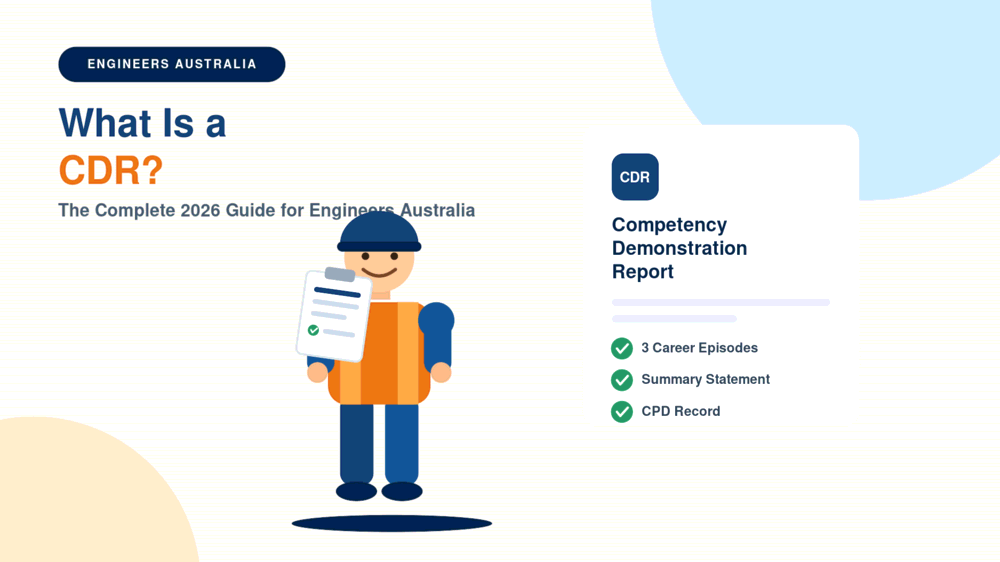
There are three parts to a complete CDR, and Engineers Australia is very particular about each.
1. Three Career Episodes. Each Career Episode is a story about a project, task, or role that you personally completed, using “I” statements instead of “we” or passive voice, because the goal is to focus on your individual contribution rather than your team’s work as a whole. Each episode should run roughly 1,000–2,500 words, and the projects you describe should generally fall within the last 10 years.
2. A Summary Statement. This is a table that correlates specific paragraphs from your three Career Episodes to Engineers Australia’s official competency elements for your occupation category — and it’s a common weak point in otherwise strong CDRs. If the Summary Statement doesn’t accurately reference where each competency is demonstrated, assessors can send the whole application back.
3. A CPD summary. This is a tabular, one-page document showing the professional development activities you’ve undertaken — training, seminars, conferences, and further study.
How Long Does a CDR Assessment Take?
Processing times vary by pathway:
- CDR pathway: typically 10–16 weeks after you submit a complete application.
- Washington Accord pathway (accredited qualifications): typically 8–12 weeks.
- Priority processing: available for an extra fee, cutting the wait to roughly 4–6 weeks.
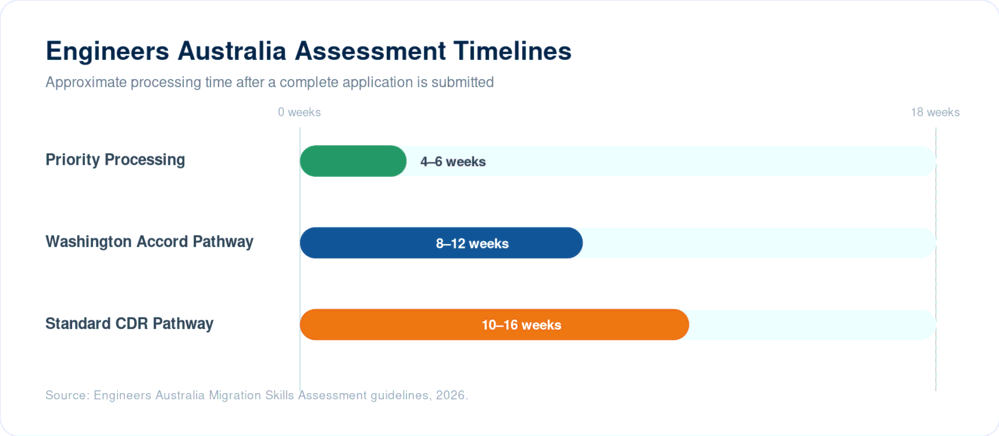
The top reason processing timelines blow out isn’t the assessor’s queue — it’s incomplete or inconsistent applications getting returned for clarification. An internally consistent CDR (Career Episodes, Summary Statement, and CPD all lining up correctly) moves through the process far more smoothly than one that needs a few rounds of back and forth.
Why Do CDRs Get Rejected?
A few patterns keep recurring in applications that get rejected:
- Third-person or team-focused writing. When it’s written in “we” rather than “I,” it’s not obvious what was done by whom.
- Vague or generic project descriptions. A description that’s vague or general is no help to an assessor — specific technical detail is what actually shows competency.
- Summary Statement mismatches. A competency element is claimed in a paragraph that doesn’t actually demonstrate it.
- Plagiarism and AI-generated content. These are no longer treated as style issues but as integrity issues — Engineers Australia screens submissions through detection tools, so every Career Episode needs to be original and reflect your own words and experience.
- Missing or outdated project timeframes. Using projects well outside the current allowed window.
Can You Fast-Track a CDR Assessment?
If you have a tight visa timeframe, it may be worth considering priority processing through Engineers Australia for an extra fee. Outside of that official option, the best way to avoid delays is to submit a complete, internally consistent application the first time — resubmissions after a query or rejection will add weeks or months back onto your timeline. If you want the full breakdown of how EA’s fast-track option works and whether it’s worth paying for, we’ve covered it in detail in our Engineers Australia fast-track assessment guide.
How CDRforEA Can Help
It’s hard to write a technically accurate, competency-mapped, completely original CDR while working full-time — and that’s exactly the gap our writing service is built to fill. Every CDR we write is individually prepared from scratch by writers familiar with the current MSA Booklet requirements, mapped competency-by-competency in the Summary Statement, and checked for plagiarism before delivery. We offer plans ranging from guided, you-answer-we-write support (see Plan 1) through to fully done-for-you packages (Plan 2), plus a standalone review and plagiarism-check service if you’ve already drafted your own CDR (Plan 5). You can compare all the options on our services and fees page.
Frequently Asked Questions
How many words should each Career Episode be?
Between 1,000 and 2,500 words, with around 2,000 words generally recommended.
How long does the whole CDR process take?
Typically 10–16 weeks for the standard CDR pathway, 8–12 weeks for the Washington Accord pathway, or 4–6 weeks with priority processing.
Can I use a project from more than 10 years ago?
Generally no — current guidelines expect the projects in your Career Episodes to fall within the last 10 years.
Do I need three Career Episodes even if I’ve only ever done one type of engineering work?
Yes. You need three separate episodes, but they can come from different phases, roles, or aspects of your career rather than three unrelated jobs.
Will Engineers Australia know if I used AI to write my CDR?
Submissions are screened through plagiarism and AI-detection tools, and CDRs flagged as AI-generated or copied risk rejection on integrity grounds — so original, personally written content matters as much as technical accuracy.
Sources: Engineers Australia Migration Skills Assessment guidelines and MSA Booklet requirements, current as of 2026.
Related reading
- Start with the complete Engineers Australia CDR guide.
- Background: how the EA skills assessment works from start to finish.
- Next step: compare our CDR plans and pricing.
- Background: CDR samples by engineering discipline.
- Next step: the Mechanical Engineering Draftsperson pathway (ANZSCO 312511).
- Also useful: writing a CDR as a Chemical Engineer (233111).
- Try our Australia PR points calculator.