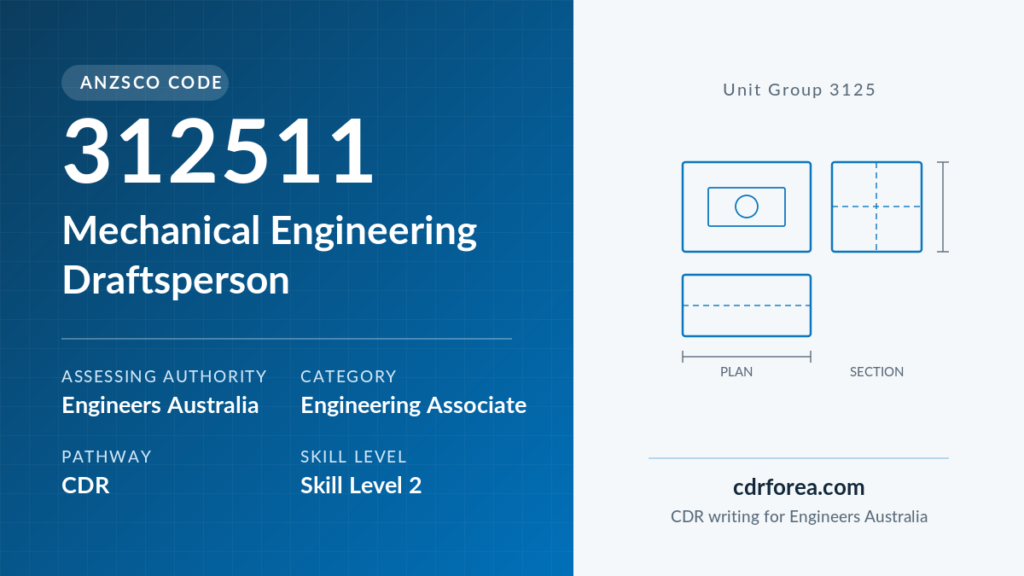
If you work in mechanical drafting and you are planning a skilled migration application, the first thing to get right is not your report — it is your occupation code. Mechanical Engineering Draftsperson sits at ANZSCO 312511, and Engineers Australia assesses it through a Competency Demonstration Report. The code immediately next to it, 312512 Mechanical Engineering Technician, is assessed by a different authority entirely. Applicants lose months to that one-digit difference.
This guide covers what 312511 actually is, which occupational category you will be assessed in, and how to choose career episode projects that read like drafting work rather than borrowed engineering design.
312511 vs 312512: check this before anything else
Both codes live in ANZSCO Unit Group 3125, and the titles look interchangeable if you are skim-reading. They are not.
| Code | Occupation | ANZSCO definition | Typical assessing authority |
|---|---|---|---|
| 312511 | Mechanical Engineering Draftsperson | Prepares detailed drawings and plans of mechanical engineering work in support of Mechanical Engineers and Engineering Technologists | Engineers Australia (CDR pathway) |
| 312512 | Mechanical Engineering Technician | Conducts tests of mechanical systems, collects and analyses data, and assembles and installs mechanical assemblies | Trades Recognition Australia |
The dividing line is drawings versus testing. If your day is spent producing GA drawings, fabrication details, P&ID markups and BOMs, you are 312511. If your day is spent commissioning rigs, running instrumented tests and installing assemblies, you are closer to 312512 and Engineers Australia is not your assessor.
Assessing authorities are set by legislative instrument and do change. Confirm your code against the current Department of Home Affairs occupation list before you pay anything.
Which occupational category will you be assessed in?
Engineers Australia does not assess everyone against the same competency standard. It uses distinct occupational categories, and your qualification decides which one applies:
- Professional Engineer — accredited four-year bachelor of engineering (honours) or accredited master’s
- Engineering Technologist — accredited three-year bachelor of engineering technology or engineering science
- Engineering Associate — two-year Australian diploma or associate degree in engineering following 12 years of schooling, or the overseas equivalent
A Mechanical Engineering Draftsperson is almost always assessed as an Engineering Associate. This matters more than most applicants realise, because nearly every CDR guide online is written for Professional Engineers. The report structure is the same; the competency expectations are not.
As an Engineering Associate you are demonstrating applied technical competence within an established framework — correct standards, correct tolerances, correct documentation, sound judgement inside a defined scope. You are not expected to show original research or novel design methodology, and padding your report with claims of that kind reads as inflated rather than impressive. It is a common reason otherwise solid Associate-level reports get queried.
What goes into a 312511 CDR
The package Engineers Australia expects is the same across categories: a CPD list, three career episodes, a summary statement cross-referencing your competency claims, and a CV. Our Engineers Australia CDR guide walks through each component in detail, and the summary statement guide covers the cross-referencing table that trips up most applicants.
What changes for a draftsperson is the evidence. Your competency lives in drawings, revisions, standards compliance and coordination — not in calculations you did not perform.
Three career episode projects that work for mechanical drafting
The single most common failure in draftsperson CDRs is describing what the design engineer decided instead of what you decided. Every episode needs your own technical judgement at the centre. These three shapes reliably contain it.
1. A fabrication drawing set you took from concept to issued-for-construction
Pick a package where you owned the detailing: a skid, a pressure vessel support frame, a conveyor structure, a piping spool set. Write about the decisions that were genuinely yours — weld symbol selection and joint preparation, tolerance stack-up across mating parts, material and section callouts, how you resolved a clash between the structural and mechanical models, which drawing standard you applied and why. Include a revision you issued after a fabricator RFI and explain what you changed. That RFI loop is strong evidence: it shows a real consequence and a real correction.
2. An HVAC or hydraulic services layout you coordinated
Air conditioning drafting is an explicitly listed specialisation under 312511, alongside heating and ventilating technical officer and tool design. If you have services work, use it. Describe how you set out duct routes against available ceiling void, where you had to negotiate with the electrical or sprinkler trade, how you sized and annotated the plant, and how you documented the result so the installer could build from it without interpretation. Coordination is technical work and assessors treat it as such when you write it concretely.
3. A drawing office improvement you drove
Building a parametric family library, migrating a department from 2D to 3D modelling, writing a layer and titleblock standard, or setting up a checking protocol that cut rework. This episode shows initiative and judgement without requiring you to overclaim design authority. Quantify it — drawings produced per week before and after, RFI count per package, revision cycles per issue.
Avoid the reverse temptation too. Three episodes drawn from three near-identical detailing jobs give the assessor no range. Aim for variety in project type, software and your role.
Mistakes that specifically catch draftspersons
- Writing in the passive voice. “The bracket was redesigned” tells the assessor nothing about who did it. Career episodes are written in first person singular for exactly this reason.
- Claiming the engineer’s analysis. If you did not run the FEA, do not imply you did. Describe how you interpreted the results into a manufacturable detail — that is your competency and it is a legitimate one.
- Listing software instead of demonstrating it. “Proficient in SolidWorks, AutoCAD, Inventor” is a CV line. The episode needs to show a specific modelling problem and how you solved it.
- Applying for the wrong category. If you hold a four-year engineering degree but work in drafting, you may have a choice of category and code. That decision has downstream visa consequences and is worth thinking through properly.
- Reusing a published sample. Engineers Australia runs plagiarism checks and the penalties are severe. Samples are for structure only.
Documents and English
Alongside the report you will need identity documents, qualification transcripts and employment evidence in the forms Engineers Australia accepts — the list is stricter than most applicants expect, and several document types people assume are fine are not accepted. See documents required for skill assessment before you start collecting. English testing requirements are covered in our IELTS requirement guide, and current pricing sits on the skill assessment fees page.
Frequently asked questions
Can I apply as 312511 with a trade background and no diploma?
ANZSCO notes that at least three years of relevant experience may substitute for the formal qualification for skill level 2 occupations. Engineers Australia applies its own rules on top of that, and an assessment without a recognised qualification is harder. Get advice on your specific transcript before committing.
Do Engineering Associates write three career episodes like everyone else?
Yes. The number of episodes and the report structure do not change between categories. What changes is the competency standard your episodes are mapped against in the summary statement.
Is a Mechanical Engineering Draftsperson assessment easier than a Professional Engineer one?
No — it is different. The competencies are pitched at applied technical practice rather than complex engineering problem solving, but the evidentiary standard is the same. Vague episodes fail at every level.
What if I have worked across mechanical and electrical drafting?
Choose the code matching the majority of your recent relevant experience and keep your episodes consistent with it. If your work has been mostly electrical, look at electrical engineering draftsperson skill assessment instead.
Getting help
A draftsperson CDR is not a smaller version of an engineer’s CDR — it needs someone who understands what Engineering Associate competency actually looks like on paper. If you want your episodes reviewed or written with that in mind, our CDR writing services for engineers cover all Engineers Australia occupational categories, and you can browse CDR samples by discipline to see the structure before you commit.
Occupation definitions on this page are drawn from the Australian Bureau of Statistics ANZSCO classification. Assessment requirements and fees are set by Engineers Australia and change periodically — always confirm against their current published guidance before applying.

