Relevant Skilled Employment Assessment (RSEA) Explained

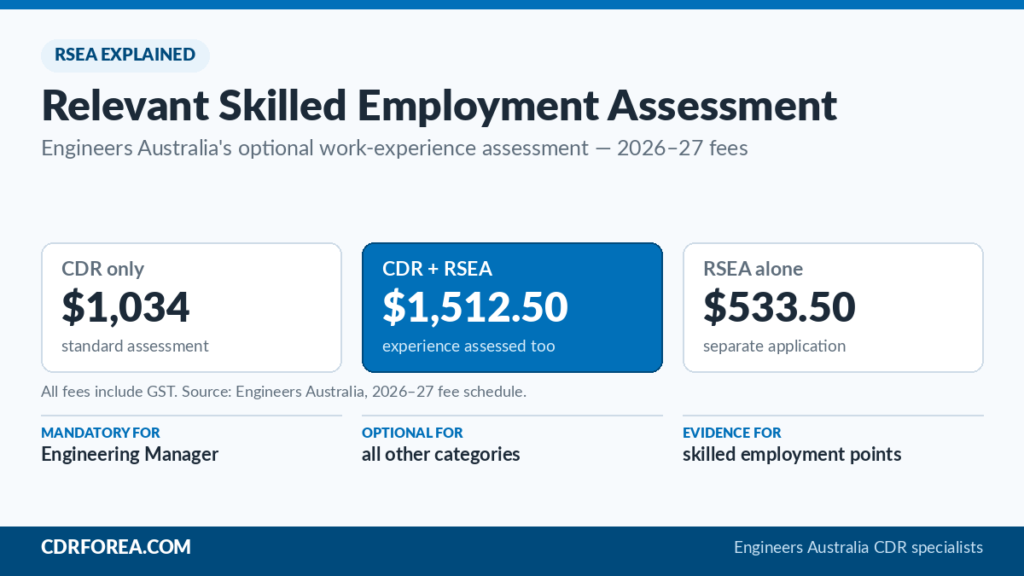
Comparison of Engineers Australia 2026-27 fees for CDR only, CDR plus relevant skilled employment assessment, and RSEA applied for separately

The Relevant Skilled Employment Assessment (RSEA) is an additional Engineers Australia service that reviews documentary evidence of your engineering work experience and states, in your outcome letter, how much of that employment Engineers Australia accepts as relevant skilled employment at the required skill level.

It is optional for every occupational category except engineering manager, where it is a mandatory part of the CDR assessment. Most applicants who add it do so because the Department of Home Affairs awards points for skilled employment, and a formal assessment of your employment dates gives you documented backing for that claim.

Key facts at a glance

  • What it assesses: your paid engineering employment — not your qualifications, which the MSA or CDR handles.
  • Mandatory for: engineering manager applicants.
  • Optional for: professional engineer, engineering technologist and engineering associate.
  • 2026–27 fee: $533.50 (incl. GST) as a separate application, or bundled with your assessment for less.
  • Applied for: inside your migration skills assessment application, or separately afterwards.

What RSEA is — and what it is not

Engineers Australia’s core job in a migration skills assessment is to decide whether your qualifications and competency meet the standard for your nominated occupation. Employment evidence is not assessed as part of that decision. RSEA is the bolt-on service that does assess it.

Service What it assesses What the outcome letter says
MSA (Accord pathway) Whether your degree is recognised under the Washington, Sydney or Dublin Accord Occupational category and engineering occupation
CDR pathway Your competency against the Stage 1 standard, via three career episodes, a summary statement and CPD Occupational category and engineering occupation
RSEA Your documented, paid engineering employment at the relevant skill level The employment periods Engineers Australia accepts as relevant skilled employment

Two consequences follow from this. First, RSEA does not improve your chances of a positive skills assessment — it is a separate finding. Second, Engineers Australia does not award migration points and cannot give migration advice; it only states what employment it accepts. How that translates into points is a matter for the Department of Home Affairs.

Do you actually need RSEA?

You must have it if…

You are applying as an engineering manager. RSEA is a mandatory component of that CDR assessment and cannot be skipped.

It is usually worth it if…

  • You intend to claim points for skilled employment and want your employment periods formally recognised by the assessing authority.
  • Your career includes roles that might be questioned — job titles that don’t sound like engineering, mixed technical and administrative duties, or periods with small employers.
  • You have worked in several countries or for employers that no longer exist, and you want the evidence tested now rather than later.
  • You changed occupational category during your career and need clarity on which periods count at the required skill level.

You can probably skip it if…

  • You are not claiming skilled employment points at all.
  • Your experience is entirely Australian and already well documented for the points test.
  • You have very little post-qualification experience, so there is nothing meaningful to assess.

Engineers Australia RSEA fees for 2026–27

Bundling RSEA with your assessment is cheaper than applying separately. All figures include GST.

Application Fee (incl. GST)
Competency demonstration report (standard, no RSEA) $1,034.00
CDR + relevant skilled employment assessment $1,512.50
CDR + RSEA + overseas engineering PhD assessment $1,815.00
Washington / Sydney / Dublin Accord qualification assessment $555.50
Accord qualification assessment + RSEA $1,034.00
Australian engineering qualification assessment $346.50
Australian qualification assessment + RSEA $825.00
Separate RSEA (applied for on its own) $533.50
Separate RSEA + overseas engineering PhD assessment $836.00
Fast-track fee (additional to the assessment fee) $396.00

Adding RSEA to a CDR application costs $478.50 more than the standard CDR fee, against $533.50 to apply separately later — so if you think you will want it, add it at the start. For the full fee picture, see our breakdown of Engineers Australia skill assessment fees.

Documents you need for RSEA

RSEA is decided on documents alone. There is no interview. Weak or wrong-category evidence is the main reason employment periods are not counted — and Engineers Australia is specific about which documents it will and won’t accept.

Engineers Australia assesses each employment period on both primary and secondary documents. Missing either category is fatal to that period.

Mandatory primary documents (employees)

A reference letter on company letterhead for each role. Engineers Australia requires it to include all of the following:

  • Type of employment — part-time or full-time.
  • Your pay rate. This is the item most often missing from letters drafted by employers.
  • The period of employment, including start and end dates.
  • Your job title.
  • Endorsement and signature of the issuing manager, HR representative or direct supervisor, including their work email address and phone number.
  • The company stamp, if applicable.
  • The date the letter was issued.
  • At least five main engineering duties you performed in the role.

Duties must be specific and technical. “Responsible for engineering activities” is not usable; “performed load flow and short-circuit studies in ETAP for 33/11 kV distribution feeders” is.

If your reference letter doesn’t list all your duties, you can supplement it with either a copy of your job offer letter, or your annual performance review on company letterhead — each showing at least five detailed engineering duties.

Mandatory secondary documents (employees)

Secondary evidence must be government-issued, must show both your name and your employer’s, and must cover the whole period of the employment. You provide a high-resolution scan of either:

  • Income tax statement and superannuation fund statements, social security insurance statement, retirement contribution report, or employee provident fund contribution; or
  • Work permit and residence permit, including other official government documentation such as a work contract showing your employment details.

Important — two documents most applicants get wrong. Engineers Australia states plainly that bank statements and payslips are not accepted as secondary documents, and that statutory declarations and affidavits are not accepted as assessment evidence at all. If your plan was a reference letter plus payslips, or a statutory declaration because your employer has closed, that plan will not work. The assessor also reserves the right to specify which secondary documents are acceptable for a particular country.

If you are self-employed

Self-employed applicants provide a different bundle: client or contracting employer letters on official letterhead (naming the client, the engineering services contracted, exact start and end dates, weekly hours and your rate), original invoices covering the full period, an organisation chart for your business, a business registration certificate, a business tax report covering the whole trading period, and a bank statement showing business transactions. Payroll tax receipts, your personal income tax return, contribution statements, business financial reports and a practice certificate may also be required.

Also worth preparing

  • A CV in reverse chronological order, with no unexplained gaps.
  • Organisation charts showing your reporting line, particularly for engineering manager applicants.
  • Your degree certificate and transcript, to fix the date after which employment can be counted.
  • Evidence of completion or exemption if military service is mandatory in your country.

Our wider list of documents required for an Engineers Australia skill assessment covers the qualification and English-language side.

What makes employment “relevant”

Several tests decide whether a period counts, and some of them exclude work that applicants assume is safe:

  1. It falls after the qualification. Engineers Australia states that work experience cannot be claimed before completion of the applicable qualification.
  2. It is at least 20 hours a week, and regular. “Employed” means engaged in an occupation for remuneration for at least 20 hours a week, as regular employment, without long periods of unpaid leave. Genuinely part-time roles below that threshold are not counted.
  3. It is paid at a market or salaried rate. Stipends, cash payments, living allowances and scholarships are not generally treated as salaried.
  4. It is engineering work at the right skill level and closely related to your nominated occupation. Technician-level duties will not support a professional engineer claim, and a civil role generally won’t count towards a mechanical nomination.

Periods Engineers Australia specifically removes or refuses

  • Study leave and parental leave — generally removed from the skilled employment recognition period.
  • PhD or MPhil research, and work as a research assistant or research fellow while undertaking a PhD or MPhil — cannot be counted as relevant skilled employment.
  • Lecturer, demonstrator or tutor roles — not considered relevant skilled employment in the engineering profession, because those duties are classified under a different ANZSCO code.

If a large part of your career is academic, work through these exclusions before you pay for RSEA — the assessable period may be much shorter than your CV suggests.

Why employment periods get excluded

  • Reference letter incomplete — fewer than five duties, no pay rate, no issue date, or no work email and phone number for the signatory.
  • Duties written generically so the skill level can’t be judged.
  • Wrong secondary documents — submitting payslips and bank statements, which Engineers Australia does not accept as secondary evidence, instead of government-issued documents.
  • Secondary evidence with gaps — tax or contribution statements covering only part of the employment period rather than the whole of it.
  • Date conflicts — the reference letter, CV, secondary documents and career episodes disagree on when you worked somewhere.
  • Duties below skill level — drafting, testing or maintenance execution without design, analysis or engineering decision-making.
  • Wrong discipline — the role is engineering, but not the occupation you nominated.
  • Self-employment without independent evidence — no client letters, invoices, business registration or tax filings.

If your former employer no longer exists or will not issue a letter, note that a statutory declaration will not fill the gap — Engineers Australia does not accept statutory declarations or affidavits as assessment evidence. The realistic options are tracking down a former manager who can sign on available letterhead, or relying on the government-issued documents that cover that period. Our review service includes drafting referral and experience certificates so the wording contains every mandatory item before you approach your employer.

Applying for RSEA: with your assessment or separately

Together with your MSA or CDR application

When you start your application in the Engineers Australia portal, you select whether you want RSEA included. This is the cheaper route and produces a single outcome letter covering both findings.

As a separate application afterwards

If you have already received a positive skills assessment and later decide you need your employment assessed — often because your points total is short — you can lodge RSEA on its own for $533.50. You will receive an updated finding on your employment.

How long RSEA takes

Engineers Australia states that standard migration skills assessment applications generally take around 15 weeks to be assigned to an assessor. That is time to allocation, not to outcome — total time depends on the quality of your documents and whether the assessor needs to come back to you.

With the fast-track option ($396 on top of the assessment fee), Engineers Australia says your application can be assigned to an assessor within 20 business days. That is a possibility, not a guarantee, and it says nothing about when you receive an outcome. The fast-track fee is non-refundable, so confirm your pathway and account ID before you pay. See our note on fast-track assessment timing and what to expect while your assessment is in progress.

Frequently asked questions

Is RSEA compulsory?

Only for engineering manager applicants, where it forms a mandatory part of the CDR assessment. For professional engineer, engineering technologist and engineering associate applicants it is optional.

How much does RSEA cost in 2026?

For 2026–27, a separate RSEA application is $533.50 including GST. Added to a CDR assessment the combined fee is $1,512.50; added to an Accord qualification assessment it is $1,034.00; added to an Australian qualification assessment it is $825.00.

Does RSEA give me migration points?

No. Engineers Australia assesses and records which employment it accepts as relevant skilled employment. Points are awarded by the Department of Home Affairs under the points test, and Engineers Australia is not permitted to give migration advice.

Can I add RSEA after my skills assessment is finished?

Yes. You can lodge a separate relevant skilled employment assessment after your qualification or CDR assessment has been finalised, at the separate-application fee.

Will experience gained while studying count?

Generally no. Work experience cannot be claimed before completion of the applicable qualification, and Engineers Australia specifically excludes research undertaken as a PhD or MPhil student, and work as a research assistant or fellow while undertaking a PhD or MPhil. Lecturer, demonstrator and tutor roles are also excluded, as they sit under a different ANZSCO code.

Does part-time work count towards relevant skilled employment?

Only if it meets the threshold. Engineers Australia treats “employed” as engaged in an occupation for remuneration for at least 20 hours a week, as regular employment without long periods of unpaid leave. Study leave and parental leave are generally removed from the recognition period.

What if I worked in several countries?

Overseas employment is assessable, but each period needs its own reference letter and payment evidence, and work permits or visas are often requested to confirm you were legally employed.

Get your employment evidence assessment-ready

Most RSEA problems are document problems, and they are fixable before you lodge. We draft reference and experience letters to Engineers Australia’s expected structure, check consistency between your CV, career episodes and employment evidence, and tell you honestly which periods are likely to be counted.

Sources: Engineers Australia, Assessment fees and additional services (2026–27 schedule), Migration skills assessment, and Prepare your Migration Skills Assessment application (January 2026, v1.1). Fees and document rules change — confirm on the Engineers Australia website before you apply.


Related reading