
CDR for Aspiring Migrant Engineers is the main topic of this guide for Engineers Australia applicants. This section explains how CDR for Aspiring Migrant Engineers connects with migration skills assessment evidence, CDR preparation, and practical document review before submission.
CDR for Migrant Engineers is covered in this guide for Engineers Australia applicants. Migrating to Australia as an engineer is an exciting goal but it requires meeting strict standards. In particular overseas engineers must undergo a Migration Skills Assessment by Engineers Australia the government-authorized body that evaluates engineering qualifications.
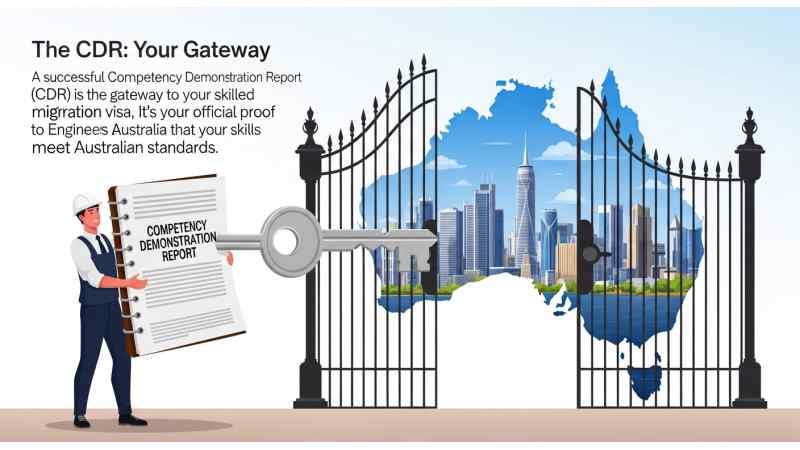
One of the central requirements of this assessment is the Competency Demonstration Report (CDR) .
A CDR is not merely paperwork – it’s a detailed dossier showcasing an applicant’s engineering knowledge skills and professional experience. Engineers Australia explicitly states that the CDR assessment is based on your academic background and “demonstrated graduate competencies” in your field. In practice
this means proving that you have both the core technical knowledge for your occupation and have applied that knowledge in real engineering projects.
For many engineers from non-accredited programs or countries outside the Washington/Sydney/Dublin accords, the CDR is mandatory. As Engineers Australia explains, you should choose the Competency Demonstration Report (CDR) pathway if you:
“have an engineering qualification that is not accredited” or if your qualifications differ from your intended occupational role.
In other words if your degree isn’t automatically recognized under international accords you must submit a CDR to demonstrate equivalence to Australian standards. This CDR is submitted as part of the Migration Skills Assessment (MSA) process. Only after Engineers Australia issues a positive skills assessment outcome letter can you apply for an Australian engineering visa. Therefore
preparing a strong CDR is effectively a gateway to your eligibility for skilled migration.
Understanding CDR for Australia Migration
A Competency Demonstration Report (CDR) is a comprehensive self-assessment document required by Engineers Australia for the migration skills assessment. Its purpose is to verify that your engineering education and experience meet Australian standards. According to the official MSA guidelines the CDR “assessment is based primarily upon the undergraduate qualification and demonstrated graduate competencies”. In plain terms
you must provide evidence of both your fundamental engineering knowledge and how you have applied it professionally.
Engineers Australia is authorized by the Australian government to evaluate your skills, and they stress that migrating engineers “need to have your skills formally assessed” by them.
The assessment focuses on Stage 1 competencies – essentially the foundation skills every graduate engineer must have. For context a graduate from a fully accredited Australian program is assumed to meet these competencies automatically. If your qualifications are not pre-accredited you prove equivalency through the CDR . In practical terms
your CDR must demonstrate that you satisfy all the required competency elements for your nominated occupation.
Engineers Australia explicitly warns that you must show “all the competency elements” at least once across your three career episodes. These competency elements cover areas like technical expertise problem solving design ethics communication and teamwork. By addressing each element in your report
you convince the assessors that you have the same level of skill as an Australian graduate in the same field.
In summary the CDR plays a pivotal role in your migration journey. It is more than a formality; it is your evidence to Engineers Australia that you possess the necessary engineering capabilities. Only after passing this Skills Assessment (of which the CDR is the core) will you receive the outcome letter needed for visa application. Throughout this process
Engineers Australia evaluates your report against the official competency standards and the ANZSCO occupation description you select.
As they note in their handbook, your CDR “will be assessed against the graduate competency standards and the ANZSCO definition of the occupational category nominated by you”. In essence, the CDR is your chance to show that your background matches Australian expectations for your occupation, paving the way toward your engineering career in Australia.
Components of Engineering Australia CDR
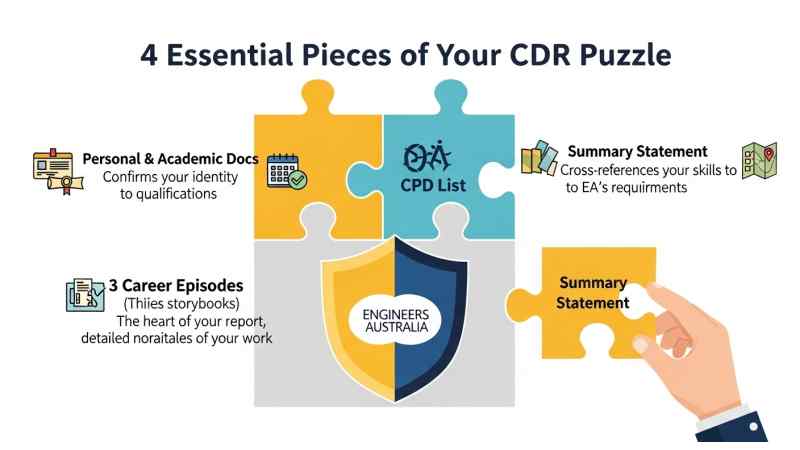
A complete CDR submission consists of several distinct parts. According to Engineers Australia’s Migration Skills Assessment guidelines you must compile both documentation and the report content itself. The main components are: continuing professional development (CPD) career episodes and a summary statement . In addition you will submit personal and academic documents (like your ID degree certificate transcripts
and CV) to verify your background. Specifically EA’s checklist includes:
-
Personal and Academic Documentation: This includes a recent passport-sized photo identification (such as passport bio-data page) official degree certificate(s) complete transcripts and a detailed CV. These items confirm your identity and educational qualifications. (For academic work-in-progress
a letter of completion may be accepted temporarily.) You may also need to show English test scores if required.
-
Continuing Professional Development (CPD) List: A chronological record of all professional learning activities you have undertaken since graduation. This might include courses seminars workshops certifications webinars or technical training. The purpose is to show that you keep your engineering knowledge up-to-date.
Engineers Australia defines CPD as the means to “keep up-to-date with developments in your field of engineering after you have gained your undergraduate qualification”. Include dates activity titles providers and hours.
-
Three Career Episodes: These are the heart of your CDR. Each Career Episode is a first-person narrative (typically 1,000–2,500 words long) describing a distinct engineering project or work experience. For each episode, you detail the project scope, your specific role, the engineering tasks you performed, and the outcomes. Engineers Australia advises:
“Write your career episodes in English in essay format and in the first person”. Each episode should focus on how you applied your engineering knowledge and skills to solve problems. For example you should “detail the particular problems you needed to solve
how you applied your engineering knowledge and skills and the learning experiences you gained” in that project. Emphasize your own contributions: write “what I did” rather than general statements.
The episodes are meant to cover real tasks you personally handled, supported by evidence. EA recommends including relevant engineering evidence (diagrams, photos, calculations, tables, software outputs, etc.) to support each episode.
-
Summary Statement: This document cross-references your Career Episodes against Engineers Australia’s competency requirements. Using the paragraph numbers you’ve assigned the Summary Statement maps each EA competency element (of which there are 16 for professional engineers) to where it is demonstrated in your episodes. As EA explains
the summary “cross-references the competency elements with the particular paragraph in your Career Episode where each element occurs”.
In other words, for each entry-to-practice competency element (e.g. “PE3.1 – Apply systematic engineering synthesis processes”), you point out the paragraph in your narrative where you demonstrated that skill. This ensures the assessors can quickly verify that every required competency has been met.
Each part plays a role: your personal/academic documents confirm eligibility, CPD shows ongoing learning, Career Episodes prove practical ability, and the Summary ties it all to EA’s standards. Together, they form the complete CDR submission that EA will evaluate.
CDR Skill Assessment: Demonstrating Your Expertise
Engineers Australia’s assessment of your CDR is rigorous. The key criterion is whether you have shown the required Stage 1 competency elements for your nominated occupational category. In practical terms this means your report must illustrate professional engineering ability not just academic knowledge.
The official instructions stress that your episodes must “clearly demonstrate the application of engineering knowledge and skills in the nominated occupation”.
Each episode should therefore describe how you solved technical problems or carried out engineering tasks, with enough detail to show your expertise. For example, EA’s guidance says episodes should emphasize “any engineering problems identified by you and any particular problem solving techniques you applied”. This demonstrates your problem-solving and innovative thinking.
Every element of the EA competency framework must be addressed at least once across your Career Episodes . In fact Engineers Australia bluntly requires that you “demonstrate all the competencies at least once somewhere in your three career episodes”. These competency elements cover areas such as technical proficiency design teamwork communication and ethics.
The assessors will analyze your narrative to ensure you meet each listed element.
To aid this, you should number the paragraphs in each episode (e.g. 1.1, 1.2, etc.) as recommended. Numbered paragraphs allow you to reference specific sections in your Summary Statement and prove that no element is omitted. The official EA guide explicitly advises:
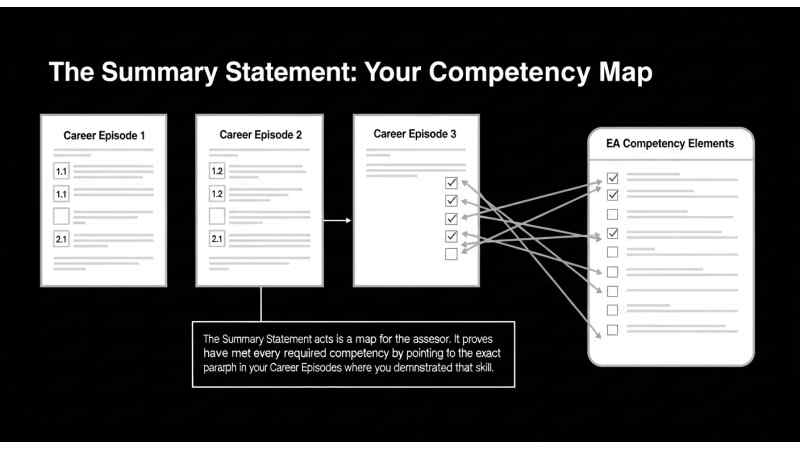
“To help you put together your summary statement, number the paragraphs in your career episodes. This will help you to cross-reference it against each of the competency elements”.
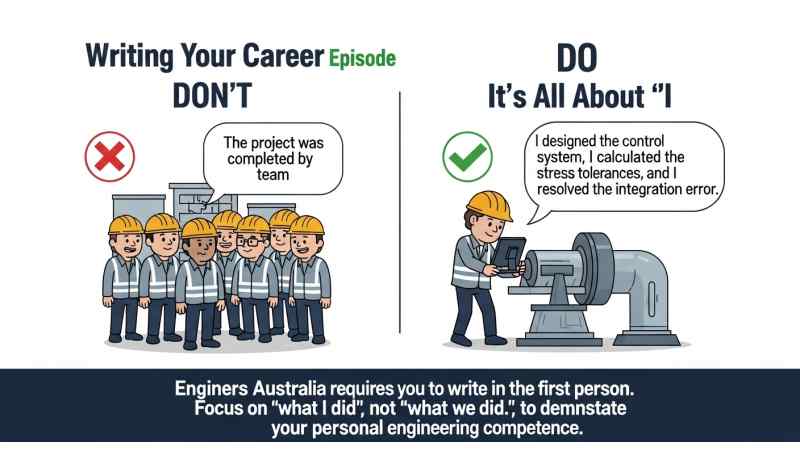
Importantly the CDR must reflect your personal contributions. You should write in the first person and focus on “what I did” not on what your team did or what others did. Engineers Australia cautions that it is “not sufficient to merely describe work in which you were involved” – each sentence should highlight your own role. For example
use phrases like “I designed the circuit and conducted the simulations” rather than passive descriptions. This first-person perspective signals your leadership and responsibility in projects.
Accuracy and honesty are also critical. The EA guidelines make it clear that plagiarism is forbidden. Your Career Episodes must be written entirely in your own words. Any use of other people’s work or templates without citation will be penalized.
The official MSA instructions warn that “presenting work conducted by others as your own and/or using other people’s words… is considered as plagiarism”.
Likewise, failing to credit any sources or references in your episodes “would be considered as plagiarism”. In short, the writing must be authentic and original – no part of it should be copied from textbooks, colleagues, or sample reports.
In summary the CDR skill assessment scrutinizes the substance of your engineering experience. The assessors verify that you meet the Stage 1 competencies (which accredited graduates automatically satisfy) by examining your detailed project narratives. They ensure you have demonstrated both depth and breadth: technical knowledge practical problem-solving management ethics and communication.
Only candidates who clearly fulfill all of these criteria will pass the assessment.
Best Practices for Preparing a Successful CDR
Preparing a competitive CDR requires careful planning, clarity, and adherence to Engineers Australia’s guidelines. Here are some best practices:
-
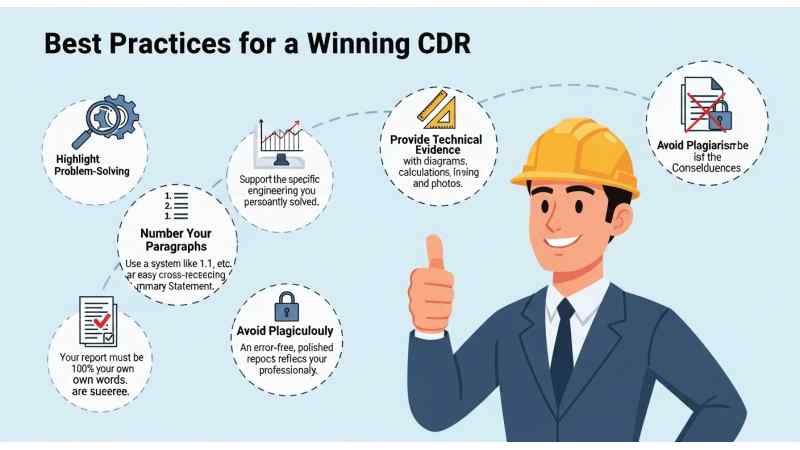
Emphasize Your Personal Role: Write every career episode in the first person, clearly spelling out your contributions. As EA stresses, use language like “I designed…”, “I calculated…”, not “we did…”. Detailing your role (and only your role) helps assessors see exactly what skills you personally used.
-
Highlight Problem-Solving and Innovation: Focus on engineering challenges you faced and how you solved them. For each episode describe specific problems or tasks and how you applied engineering principles to address them. Engineers Australia advises you to “detail the particular problems you needed to solve” and the techniques you used.
Emphasize any creative or advanced methods you applied which showcases your expertise.
-
Provide Technical Evidence: Support your narratives with concrete details. Include diagrams, figures, tables, calculations, design drawings, screenshots or code snippets where relevant. EA recommends including “reliable and sufficient engineering evidence (diagrams, photos, calculations, tables, etc.) to support each career episode”. This evidence strengthens your claims and demonstrates real engineering work.
-
Maintain Required Length and Focus: Each episode should generally be between 1000 and 2500 words. Longer narratives allow depth but keep them concise and on-topic. The EA guide notes that the majority of the episode should be technical work. Stay focused on engineering activities – skip unrelated background details or excessive theory.
-
Cover All Competency Elements: Use the Summary Statement as a checklist. After drafting episodes double-check that every entry-to-practice competency is addressed. By EA rule “you must be able to demonstrate all the [Stage 1] competencies at least once” across your episodes. In the Summary Statement map each competency element to the appropriate episode paragraphs.
This cross-referencing ensures nothing is missed.
-
Number Paragraphs Systematically: Number each paragraph in every episode to facilitate mapping. For example paragraphs in Career Episode 1 should be labeled 1.1 1.2 etc. in Episode 2 use 2.1 2.2 etc.. This convention is recommended by EA and makes it easy to link to the summary table. It also presents a neat
organized structure.
-
Write Clearly and Professional: Use correct English grammar and engineering terminology. Explain your points clearly; remember that assessors may not be familiar with acronyms or shorthand from your home country. Subheadings (e.g. Background Engineering Activity Summary) can help organize each episode though they should appear in your own words. The EA guide suggests a logical structure: define
plan design deliver evaluate.
-
Avoid Plagiarism at All Costs: Only present your own work and ideas. Do not copy any text from colleagues online samples or publications. EA explicitly states that any plagiarism – including hiring someone to write your CDR – will lead to instant rejection and possibly a ban from re-application. If you use ideas or data from other projects
be sure to cite or describe them as background context not as your own effort.
-
Follow Format and Guidelines Exactly: Stick to all of Engineers Australia’s specified formats. Use the official summary statement template for your category, and upload documents per their instructions (e.g. scanned color copies of originals). The MSA booklet even notes which file resolution and file types to use. Paying attention to these details avoids administrative delays.
-
Revise and Proofread: Double-check every entry for accuracy. Ensure dates company names project titles and responsibilities are correct. Errors or inconsistencies (e.g. mismatched dates or untranslated text) can raise doubts. It’s wise to have a trusted peer or mentor review your draft for clarity and completeness (but remember they must not rewrite it). A polished
error-free CDR reflects professionalism.
By following these practices, you improve the quality of your submission. In essence, writing a CDR for Engineers Australia is about crafting three compelling, authentic project stories that together prove you meet Australia’s engineering standards. Every element — from the detailed technical descriptions to the final summary table — must be meticulously prepared to satisfy the assessors.
Conclusion
The Competency Demonstration Report is a critical milestone on the road to becoming an Australian engineer. By clearly documenting your engineering projects skills and learning the CDR serves as proof that you can perform at the same level as an Australian graduate in your field.
Achieving a positive outcome in the skills assessment opens the door to migrating with an engineering qualification.
Conversely omission of key details or failure to follow guidelines can lead to rejection. In short preparation and compliance are key: engineers who carefully follow the official CDR requirements and authentically showcase their expertise greatly enhance their chances of success. As Engineers Australia emphasizes
migration applicants “need to have [their] skills formally assessed” by them – and a well-crafted CDR is your primary evidence in that assessment.
By understanding what goes into the CDR and adhering to these best practices, aspiring migrant engineers can navigate the process confidently and move one step closer to their goal of an engineering career in Australia.
CDR for migrant engineers checklist for Engineers Australia
A strong application should make the assessor’s job easy. Keep the discussion specific to your nominated occupation, explain your personal engineering contribution, and connect each claim with evidence from your projects, employment documents, CPD records, and career episodes.
- Use the same occupation wording consistently across the CV, CDR, career episodes, and summary statement.
- Explain what you personally designed, calculated, tested, supervised, improved, or solved.
- Support technical claims with project context, tools, standards, constraints, and measurable outcomes.
- Check that the final report follows Engineers Australia guidance before submission.
For related support, see our CDR writing services, sample CDRs for Engineers Australia, and Engineers Australia Skill Assessment guide.
FAQs about CDR for migrant engineers
Why does CDR for migrant engineers matter for a CDR?
It helps align your report with the occupation and assessment pathway you are presenting to Engineers Australia. Clear alignment can reduce confusion and make your competency evidence easier to review.
What should I prepare before writing?
Prepare your CV, academic records, employment evidence, CPD list, project notes, calculations, drawings, and any documents that prove your personal engineering role.
Can I use a sample before writing?
Yes. A sample can help you understand structure and tone, but your final report should be written around your own work, decisions, and engineering responsibility.
CDR for Aspiring Migrant Engineers review checklist for 2026
CDR for Aspiring Migrant Engineers should be checked against the latest Engineers Australia assessment expectations. A practical CDR for Aspiring Migrant Engineers review confirms that the applicant has used real engineering evidence. The final CDR for Aspiring Migrant Engineers draft should explain personal responsibility, technical decisions, and project outcomes. Applicants preparing CDR for Aspiring Migrant Engineers should avoid vague claims and keep the report evidence based. A clear CDR for Aspiring Migrant Engineers structure helps the assessor follow the project from problem to result.
Before upload, CDR for Aspiring Migrant Engineers should be reviewed for grammar, formatting, originality, and consistency. Strong CDR for Aspiring Migrant Engineers preparation connects project evidence with the nominated engineering occupation. Professional CDR for Aspiring Migrant Engineers support should improve clarity without changing the applicant’s facts. Every CDR for Aspiring Migrant Engineers section should support the migration skills assessment pathway clearly. A complete CDR for Aspiring Migrant Engineers review can reduce delays caused by missing or unclear information.
CDR for Aspiring Migrant Engineers should be checked against the latest Engineers Australia assessment expectations. A practical CDR for Aspiring Migrant Engineers review confirms that the applicant has used real engineering evidence. The final CDR for Aspiring Migrant Engineers draft should explain personal responsibility, technical decisions, and project outcomes. Applicants preparing CDR for Aspiring Migrant Engineers should avoid vague claims and keep the report evidence based. A clear CDR for Aspiring Migrant Engineers structure helps the assessor follow the project from problem to result.
Before upload, CDR for Aspiring Migrant Engineers should be reviewed for grammar, formatting, originality, and consistency. Strong CDR for Aspiring Migrant Engineers preparation connects project evidence with the nominated engineering occupation. Professional CDR for Aspiring Migrant Engineers support should improve clarity without changing the applicant’s facts. Every CDR for Aspiring Migrant Engineers section should support the migration skills assessment pathway clearly. A complete CDR for Aspiring Migrant Engineers review can reduce delays caused by missing or unclear information.
CDR for Aspiring Migrant Engineers should be checked against the latest Engineers Australia assessment expectations. A practical CDR for Aspiring Migrant Engineers review confirms that the applicant has used real engineering evidence. The final CDR for Aspiring Migrant Engineers draft should explain personal responsibility, technical decisions, and project outcomes. Applicants preparing CDR for Aspiring Migrant Engineers should avoid vague claims and keep the report evidence based. A clear CDR for Aspiring Migrant Engineers structure helps the assessor follow the project from problem to result.
Before upload, CDR for Aspiring Migrant Engineers should be reviewed for grammar, formatting, originality, and consistency. Strong CDR for Aspiring Migrant Engineers preparation connects project evidence with the nominated engineering occupation. Professional CDR for Aspiring Migrant Engineers support should improve clarity without changing the applicant’s facts. Every CDR for Aspiring Migrant Engineers section should support the migration skills assessment pathway clearly. A complete CDR for Aspiring Migrant Engineers review can reduce delays caused by missing or unclear information.
CDR for Aspiring Migrant Engineers should be checked against the latest Engineers Australia assessment expectations. A practical CDR for Aspiring Migrant Engineers review confirms that the applicant has used real engineering evidence. The final CDR for Aspiring Migrant Engineers draft should explain personal responsibility, technical decisions, and project outcomes. Applicants preparing CDR for Aspiring Migrant Engineers should avoid vague claims and keep the report evidence based. A clear CDR for Aspiring Migrant Engineers structure helps the assessor follow the project from problem to result.
Before upload, CDR for Aspiring Migrant Engineers should be reviewed for grammar, formatting, originality, and consistency.
For related preparation, read the Engineers Australia Skill Assessment guide and the CDR Writing guide before finalising CDR for Aspiring Migrant Engineers documents.
Related reading
- Start with the complete Engineers Australia CDR guide.
- Background: how the EA skills assessment works from start to finish.
- Next step: our fully done-for-you CDR package.
- Background: CDR samples by engineering discipline.
- Next step: the Mechanical Engineering Draftsperson pathway (ANZSCO 312511).
- Also useful: writing a CDR as a Chemical Engineer (233111).
- Also useful: the 2026 Australia PR points calculator.