
EA Accredited Course Guide: How to Check Engineers Australia Accredited Courses
EA accredited course is one of the most important checks for engineers planning an Engineers Australia skill assessment. If your qualification is listed as an Engineers Australia accredited course, the assessment pathway is usually simpler because the academic program has already been reviewed against recognised engineering standards.
This guide explains how to check EA accredited courses, what Engineers Australia accreditation means, how the Washington Accord, Sydney Accord and Dublin Accord apply, and what to do if your course is not listed. It also explains when a Competency Demonstration Report (CDR) may still be needed for migration or professional recognition.
[Image: Engineers collaborating on a project plan. Accredited courses ensure graduates are prepared for real-world engineering work.]
What Are Accredited Courses?
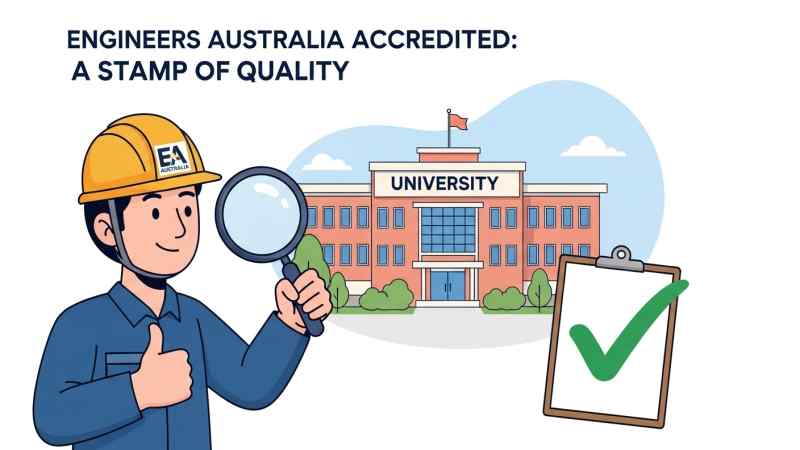
In Australia, accreditation is the formal evaluation of an engineering degree by Engineers Australia. EA is the officially approved accreditation body for tertiary engineering education. Through its Australian Engineering Accreditation Centre (AEAC), EA reviews a program’s curriculum, faculty, resources and graduate outcomes to check it meets the entry-to-practice competencies for engineering. In other words, EA ensures that an accredited course produces graduates ready to meet international standards in engineering practice.
Accreditation is a voluntary process for universities and colleges. Institutions request accreditation for their engineering programs to demonstrate quality. Once approved, the program is listed in EA’s accredited programs register. For example, as of May 2025 EA publishes a comprehensive PDF list of all currently accredited engineering programs nationwide. Graduating from a fully accredited program means you are deemed to have met the academic requirements for a professional engineer (or technologist/associate, depending on the program level) without needing additional academic assessment.
Key points about EA accreditation:
-
It applies to programs, not individuals. If you graduated from an accredited program in a given year, you are considered qualified. EA does not individually accredit people, only courses.
-
EA accredits programs at three levels: Professional Engineer (4+ year degrees), Engineering Technologist (3-4 year tech degrees), and Engineering Associate (diplomas/associate degrees).
-
Accredited programs in Australia are universally recognized by international accords and mutual recognition agreements. This means your degree is on par with equivalent accredited degrees in other Accord countries.
-
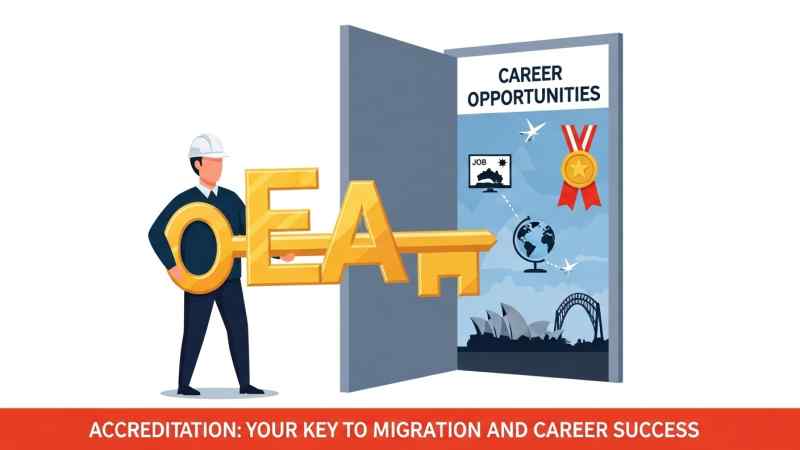
Completing an EA-accredited degree is a strong signal to employers and registration boards. It assures them you’ve covered all core engineering fundamentals and are ready for professional practice. In short, an accredited course is your passport to both migration and membership in the Australian engineering profession.
Why Accreditation Matters for Migration and Recognition
Accreditation matters a lot if you plan to migrate to Australia or have your overseas qualifications recognized here. The Australian Department of Home Affairs requires most skilled visas that list engineering occupations to have an EA migration skills assessment result. In practice, this means before you apply for a visa (like 189, 190, 482, etc.) you need a skills assessment letter from Engineers Australia.
Formal Skills Assessment: For skilled migration, Home Affairs authorises Engineers Australia to perform a migration skills assessment of your engineering qualifications and experience. This is often called a degree assessment. EA itself emphasizes that:
“Engineers Australia is authorised by the Australian government’s Department of Home Affairs to assess your qualifications, skills and experience to work in Australia”.
You must obtain this outcome letter to lodge a visa application.
Streamlined Process for Accredited Degrees: If your degree is accredited (or recognized under an accord), the assessment process is much simpler. EA will verify your program against the relevant accreditation standards or accord criteria. Graduates from accredited programs are deemed to have met the Stage 1 academic competencies, so EA does not require extra coursework proof. This can fast-track your visa application.
Global Recognition (Accords): Accredited programs are “universally-recognised through international accords and mutual recognition agreements”. In practice, this means a Washington Accord engineering degree from Canada or the USA is taken as equivalent to an Australian accredited degree. By contrast, a non-accredited course (even if it’s an engineering degree) may not be automatically accepted.
Future Professional Membership: In Australia, to become a Chartered Professional Engineer or join the National Engineering Register (NER), you typically need to complete EA’s Stage 1 competencies. Accredited graduates automatically meet Stage 1. Those without an accredited degree must complete an Entry-to-Practice Competency Assessment (Stage 1) before applying for membership or registration. Similarly, migrating with a non-accredited degree often means extra hurdles (see below).
Regulatory and Legal Practice: Some engineering fields require professional registration (e.g. some civil engineering, electrical work in regulated industries). Accredited degrees align with those registration requirements. If your degree is not recognized, you might face extra exams or experience requirements for state licensure.
In summary, accreditation matters because it opens doors. An accredited degree means easier migration (no full CDR needed), automatic qualification recognition, and a smoother path to professional status. A non-accredited degree usually triggers stricter checks. For instance, EA notes that non-accredited qualifications are “not approved or recognised by Engineers Australia” and require extra assessment steps.
Since 1 September 2024, EA even updated its policy so that only EA-accredited advanced diplomas and associate degrees are eligible under the Australian qualification assessment pathway. This underscores how accreditation is increasingly pivotal for migration.
How to Check if a Course is Accredited
Before enrolling, always verify accreditation of the program. Here are ways to check:
-
Engineers Australia Accredited Programs List: EA maintains a regularly updated list of all accredited tertiary engineering programs in Australia. This is usually available on their website or via a downloadable PDF. If the program and your year of study fall within the listed accredited intake, it’s approved. For example, EA’s “Accredited Programs – April 2025” lists hundreds of university engineering degrees.
-
International Engineering Alliance (IEA) Qualification Checker: EA recommends using the International Engineering Alliance’s online checker to see if your degree is accredited under any Accord. The IEA website lets you select your country and Accord (Washington, Sydney, Dublin) to confirm accreditation status. For any international qualification, this tool shows if the awarding institution has an accord-recognized program.
-
University or Institution: Most universities proudly state accreditation on their program web pages. Look for “Engineers Australia accreditation” logos or statements on the course details. If in doubt, contact the university’s academic or admissions office – they can confirm accreditation status or refer you to EA’s records.
-
Migration Portal Tools: When applying for migration, EA’s portal will ask if your degree is accredited. If you choose “accredited” and it’s Australian, EA cross-checks it against the official list. For foreign degrees, you will need to specify the Accord pathway.
If a program is accredited, it should explicitly say so in its description and be on EA’s list. If it is not on EA’s list but is in an Accord country, use the IEA checker to see if it was accredited during your graduation year. Remember that EA requires programs to have been fully accredited (provisional accreditation alone does not qualify) during the intake year you started the course.
Always verify before you apply, as EA’s migration guidelines stress “Your qualification is the main factor in choosing the right assessment pathway”.
Washington Accord, Sydney Accord, Dublin Accord
Engineers Australia accreditation is tied to three international agreements known as the Accords. These Accords set common standards for engineering education across many countries. Understanding them helps explain accreditation levels:
-
Washington Accord (Professional Engineer) – Established in 1989, this Accord is an agreement between engineering bodies to recognize engineering degree programmes for professional engineers. It covers 4-year (or equivalent) engineering bachelors/master’s degrees that produce graduates at the professional level. In practice, Washington Accord signatories (Australia, USA, Canada, UK, India, etc.) agree that accredited engineering degrees are substantially equivalent in quality. An EA-accredited professional engineering degree meets Washington Accord standards.
-
Sydney Accord (Engineering Technologist) – Signed in 2001, this Accord covers engineering technology degrees, which are usually 3-year bachelor’s or similar programs. These programs train Engineering Technologists – professionals who apply engineering principles at the associate level. Signatories (including Australia, UK, Canada, South Africa, etc.) recognize each other’s accredited technologist programs. EA accredits Australian engineering technology programs under the Sydney Accord category.
-
Dublin Accord (Engineering Technician/Associate) – From 2002, this Accord covers engineering technician qualifications (e.g. advanced diplomas, associate degrees). It ensures mutual recognition of technical certifications that underpin the base education for Engineering Technicians or “Engineering Associates”. Graduates of Dublin Accord signatory programs (Australia, UK, Canada, etc.) share a common foundation of skills. Note that Engineers Australia refers to this level as “Engineering Associate” in its categories.
In summary, Washington = Professional Engineers; Sydney = Technologists; Dublin = Technicians/Associates. Each Accord has a defined scope in terms of level and learning outcomes. Importantly, Engineers Australia is a full signatory to all three accords. This means EA automatically recognizes degrees accredited by any other full signatory under the same accord (subject to accreditation dates). For migration purposes, EA will recognize your qualification under the relevant Accord if it meets the signatory and timing requirements.
Significance of the Accords
Accreditation under any one of these Accords means your degree is recognized internationally at that professional level. For example, a Washington-Accord accredited degree from India (post-2009 when India joined) is treated as equivalent to an Australian four-year engineering degree.
EA’s occupational categories align with the accords: Professional Engineer (Washington), Technologist (Sydney), Engineering Associate (Dublin). These categories determine your migration occupational category and assessment pathway.
As a student choosing a course, knowing these differences helps. If you want the widest recognition, aim for a Washington-Accord level degree (full professional engineer level). If you’re considering a technologist or technician path, ensure the program is Sydney– or Dublin-accredited, respectively.
Degree Assessment for Migration
If you want to work in Australia under a skilled visa, you must go through Engineers Australia’s Migration Skills Assessment (MSA) process. This is often informally called a degree assessment or skills assessment. In short, EA evaluates your engineering qualification and experience and issues an outcome letter which must accompany your visa application.
The 6-Step Assessment Process: EA outlines a step-by-step approach:
-
Check your qualification. Determine if it is accredited and where you obtained it. The country and accreditation status are the main factors for the pathway.
-
Understand the occupational categories. EA recognizes four categories: Professional Engineer, Engineering Technologist, Engineering Associate, and Engineering Manager. Your highest qualification and experience will place you in one of these.
-
Choose an assessment pathway. Depending on accreditation, you pick one of the available pathways (see below).
-
Prepare your application. Gather all documents: degree certificates, transcripts, CV, CPD records, etc. EA provides checklists and guidelines for each pathway.
-
Submit your application via EA’s online portal. You create an EA account and submit your forms and documents.
-
Receive the outcome. EA will confirm your occupational category and issue the official assessment letter.
You only get the outcome letter after EA completes the assessment. This letter is critical – without it you cannot proceed with the visa application.
Accredited Qualification Pathways
If your degree is accredited by EA or recognized under an Accord signatory in the year you finished, you can use a fast-track pathway:
-
Australian Accredited Pathway: If you have an Australian engineering degree accredited by EA (and you enrolled during or after the start of that accreditation period), you apply via the Australian qualifications pathway. For example, an accredited BEng (Australia) earned in 2021 would fit this. EA simply verifies that your program appears on the accredited list for 2021.
-
International Accord Pathways: If you earned your degree in another country, but it was accredited under one of the international accords, you use the corresponding accord pathway:
-
Washington Accord: Applies if you have an engineering degree from a country like the USA, Canada, Hong Kong, UK, etc., and it was accredited under the Washington Accord for the year you graduated.
-
Sydney Accord: Similar concept for technologist-level degrees from accord countries (e.g. Australia, UK, Canada, etc., accredited under Sydney Accord).
-
Dublin Accord: For technician/associate degrees from Dublin Accord countries (e.g. Australia, UK, Canada, etc.).
-
If eligible for an Accord pathway, EA will recognize your qualification under that Accord. Note: For example, a French Diplôme d’Ingénieur (a 5-year degree) is recognized under the Washington Accord.
These accredited pathways have lower fees and much simpler documentation requirements. EA’s fee schedule shows, for instance, that an Australian accredited degree assessment costs about A$305 (excl. GST), whereas other pathways like CDR cost significantly more.
What Happens on Assessment
During the application, you’ll indicate your occupational category and the specific occupation (ANZSCO code) you are nominating. For CDR pathways, you select from a list of 31 engineering occupations defined by the government. EA will then evaluate your documentation against its Stage 1 Competency Standards for that category.
Upon successful assessment, the EA outcome letter explicitly states your occupational category and ANZSCO occupation. For accredited pathways, the focus is verifying your degree and academic credentials. For CDR pathways (see next section), EA also examines written evidence of your competencies.
Degree Assessment for Non-Accredited Qualifications
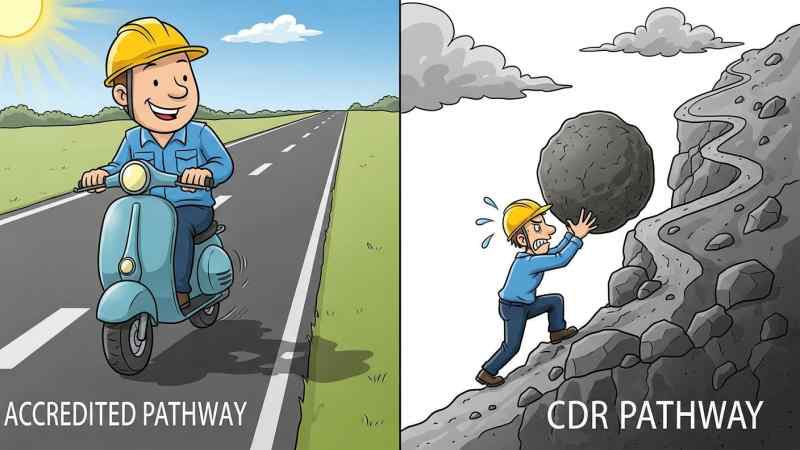
If no accredited pathway applies (for example, your degree isn’t on EA’s list and not recognised under an Accord, or is provisional, or your job role differs from your degree), you must use the Competency Demonstration Report (CDR) pathway. CDR is an in-depth case study approach where you document your engineering knowledge and experience in writing.
Key points about the CDR pathway:
-
When to use CDR: EA specifies CDR should be used if you have “an engineering qualification that is not accredited” (this includes overseas or private institution degrees) or if you have an accredited degree but are applying for a different occupation than the degree title suggests. Also, provisionally-accredited Australian qualifications require CDR.
-
What to Submit: A CDR application typically includes:
-
Application form and declaration.
-
Three Career Episodes: These are detailed narratives describing three distinct engineering projects or tasks you completed. Each episode should highlight the application of engineering knowledge and competencies relevant to your nominated occupation.
-
Summary Statement: A cross-referencing document that maps your career episodes to EA’s competency elements.
-
Continuing Professional Development (CPD) Report: A list of trainings, courses, seminars or certifications you’ve completed to maintain and enhance your engineering skills.
-
Educational and Experience Evidence: Copies of degrees, transcripts, work references, etc.
-
-
Assessment Focus: Under the CDR pathway, EA thoroughly evaluates your knowledge, skills and competencies against the standards for your nominated category. They are looking to see if your overall profile equates to the Stage 1 competencies of the occupation. It is essentially a way to “fill the gaps” if you didn’t come through an accredited program.
-
Outcome: If EA finds your CDR convincing, you will receive the same style of outcome letter as other pathways (with your category and occupation specified). However, the cost is higher and the writing effort is substantial (EA lists the fee for a standard CDR at A$940).
In short, non-accredited graduates must prove their qualifications through writing and documentation. This route is rigorous and should be undertaken carefully (many use professional CDR writers to assist). It is always preferable, if possible, to enroll in an accredited program to avoid the need for a CDR.

Use Cases and Benefits of Accredited Courses
Completing an EA-accredited engineering course offers multiple useful advantages for your career. Engineers Australia itself notes that graduates of accredited programs meet Stage 1 competency requirements automatically. Here are some concrete benefits and use cases:
-
Seamless Migration: As noted, accredited degrees allow direct migration skill assessment under official pathways. This means no CDR is required, saving you time, effort and money. For example, the EA fee for an accredited Australian degree assessment is only around A940 (and requires weeks of report writing).
-
Automatic Stage 1 Competency: EA considers graduates of fully accredited programs to have “met the stage 1 competencies for the relevant occupational category”. In practical terms, this fast-tracks your path to becoming a Chartered Engineer or joining the National Engineering Register (NER) in Australia. You won’t need to prove your academic competencies again when applying for chartered status; you can proceed to Stage 2 (professional competencies) if you wish.
-
Global Mobility: Thanks to the accords, an EA-accredited degree is recognized in other signatory countries. If you ever work overseas in another Washington/Sydney/Dublin Accord jurisdiction, your Australian degree is considered equivalent to the local accredited degree. Likewise, if you did a Washington-Accord degree abroad, Australia will accept it. This mutual recognition is a major perk of accreditation.
-
Employer Recognition: Many Australian employers, especially large engineering firms or government agencies, prefer or require candidates to have an accredited degree. It assures them the candidate covered required technical fundamentals. In sectors like construction, mining, aerospace and defense, having an accredited qualification can give you a competitive edge and may even be a prerequisite for certain roles.
-
Industry Projects: Accredited programs often include practical components (labs, projects, internships) aligned with industry needs. For example, working on real infrastructure problems (like the tunnel project pictured below) is more likely in an accredited degree. The hands-on training means when you graduate, you’re ready to contribute to complex projects immediately.
[Image: Engineers in a major tunnel construction project. Accredited engineering programs often include practical training so graduates can contribute to projects like these.]
-
Registration and Charter: In many Australian states, to be recognized as a professional engineer, you ultimately need to be Chartered through Engineers Australia or registered with a state authority. Starting with an accredited degree means you’ve already done the academic portion. You only need to document work experience (Stage 2) rather than re-demonstrating academic knowledge.
-
Cost and Time Savings: As mentioned, accreditation reduces fees and administrative burden. EA’s migration fees show a big cost difference. Less time writing reports or gathering extra evidence also speeds up the visa process. The non-accredited route can add months to your application.
-
Up-to-Date Curriculum: Accredited programs are reviewed regularly against current standards. This ensures your education stays relevant with evolving engineering practices. Non-accredited programs may not update as systematically, potentially leaving skill gaps.
In summary, an accredited course is like a golden ticket for international engineers: it guarantees quality education, international acceptance, and a simpler path to living and working in Australia as an engineer. It’s highly recommended for anyone serious about an engineering career here.
ANZSCO Classifications and Aeronautical Engineers
Australia uses the ANZSCO (Australian and New Zealand Standard Classification of Occupations) system to define and organize jobs by code and skill level. ANZSCO codes are crucial for migration visas, as each engineering occupation is listed by its code in the skilled occupation lists. Here’s what you should know:
-
What is ANZSCO? The ABS (Australian Bureau of Statistics) maintains ANZSCO, which assigns a 6-digit code to each occupation and describes the tasks, qualifications and experience required. The system also indicates the skill level (usually Skill Level 1 for engineer roles, meaning a bachelor’s degree or higher). Home Affairs uses ANZSCO (and the new OSCA system) to map occupations to visas.
-
Example – Aeronautical Engineer: For instance, Aeronautical Engineer is ANZSCO code 233911. This falls under Unit Group 2339 “Other Engineering Professionals.” The official ANZSCO description states that an Aeronautical Engineer “performs and supervises engineering work concerned with the design, development, manufacture, maintenance and modification of aircraft for flight.”. In practice, this means designing aircraft structures, propulsion, avionics systems, or related aerospace engineering tasks.
-
ANZSCO 2339 – Other Engineering Professionals: Unit Group 2339 encompasses engineering roles not classified elsewhere. It explicitly includes Aeronautical Engineers along with Agricultural, Biomedical, Environmental Engineers and Naval Architects (Aus) or Marine Designers (NZ). These occupations typically require a bachelor’s degree or higher (Skill Level 1). Since 233911 is part of this group, its assessing authority is Engineers Australia (as indicated on the ANZSCO site).
-
Assessing Authority: ANZSCO also specifies the skills assessment authority for each occupation. For 233911 (Aeronautical Engineer), the authority is Engineers Australia. That means EA will assess your qualification if you claim this occupation. (In contrast, an electronics engineer or civil engineer would also be assessed by EA, but some fields like IT might use a different body.)
-
OSCA Update: Note that ANZSCO is being replaced by the Occupation Standard Classification of Australia (OSCA) as of 2024. OSCA refines and expands occupation definitions. For example, under OSCA the title “Aeronautical Engineer” has been updated to “Aerospace Engineer” with new specializations like Propulsion Engineer. However, for current visa purposes both ANZSCO and OSCA codes still map to the same roles, and EA provides guidance on any overlaps. In general, the career and skills requirements remain similar.
-
Visa Implications: Being listed under a skilled occupation code is essential for migration. Many visas require your nominated occupation to be on the relevant skilled list and at the required skill level. ANZSCO 233911 (Aeronautical Engineer) is on the national skilled list and in most states shows as in demand. According to Jobs and Skills Australia, Aeronautical Engineers (233911) have a “shortage” rating (S) in nearly all jurisdictions. This makes it a promising field for skilled migration.
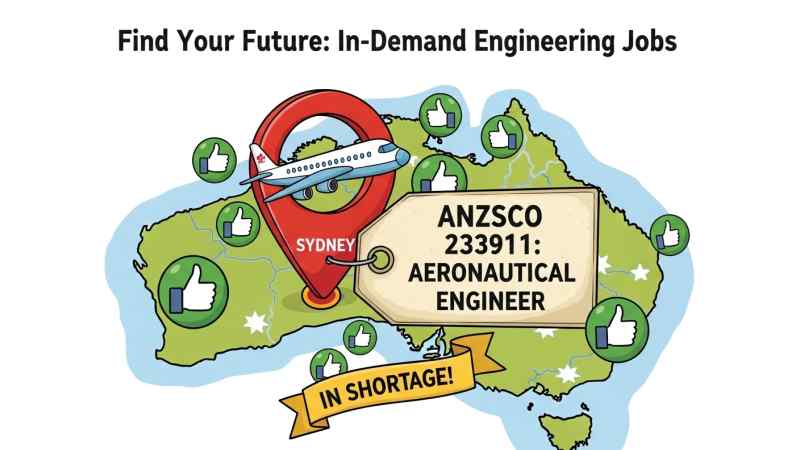
[Image: A map of Australia with a pin in Sydney. ANZSCO codes (like 233911 for Aeronautical Engineers) determine which occupations and skills are in demand nationwide.]
In summary, ANZSCO (and now OSCA) codes classify engineering jobs at the national level. International students should check that their intended career corresponds to an ANZSCO code on the skilled occupation lists. For example, as shown, ANZSCO 233911 – Aeronautical Engineer is recognized for skilled visas and assessed by EA. Understanding your occupation code and its skill level helps in preparing your visa application and career plans.
Tips for Students Choosing Courses for Skilled Migration

If you’re an international student planning to study engineering in Australia (or study abroad with intent to migrate), here are some practical tips:
-
Pick an EA-accredited program: The most important tip is to choose a course accredited by Engineers Australia for your intended field. Universities will often mention on the program page if the degree is EA-accredited for Professional Engineer (and under which Accord). You can cross-check on EA’s list or by contacting EA if unsure. Starting an accredited program means you can use the smoother migration pathway later (avoiding the need for a CDR).
-
Verify the intake year: If a course gained accreditation in a certain year, make sure your year of commencement falls within the accredited period. EA requires your start year to be the same or after the accreditation commencement year. For example, if a program was accredited starting 2020, beginning in 2021 is fine.
-
Consider international accords: If studying outside Australia, pick a university whose engineering programs are accredited by the local Accord-signing body in your country. For example, studying engineering in a Washington-Accord country (US, UK, Canada, etc.) at an accredited university can give you recognition in Australia. The IEA Qualifier tool can help you find if that university’s program is Washington/Sydney/Dublin accredited.
-
Check the ANZSCO list and demand: Look up the ANZSCO code of your future occupation. Ensure that occupation is on the Australian Skilled Occupation List for the visa subclass you want. Also check demand – Jobs and Skills Australia (JSA) and Home Affairs publish data. For instance, Aeronautical Engineers (233911) are in national shortage, which is encouraging. But some specialties (e.g. niche fields) might be excluded or have limited visa spots.
-
Research the course content: Accredited programs must cover broad competencies. Compare curricula to EA’s Stage 1 competency guidelines. Programs with practical components (labs, industry projects, capstone design projects) tend to prepare you better for accreditation standards. Reach out to current students or alumni to ask about the program’s focus on professional skills.
-
Be aware of changes (OSCA vs ANZSCO): The ANZSCO overhaul to OSCA means occupation definitions are evolving. Ensure your intended course and career still align with recognized occupations. EA news updates (like the Jan 2025 notice) explain any major changes.
-
Plan post-graduation pathways: An accredited Australian degree lets you apply directly for an Australian skills assessment. If your degree is not accredited, you may need extra time for CDR writing. Consider whether doing a master’s in Australia at an accredited level could add value (in some cases, an Australian-accredited master’s could open the Australian pathway even if your bachelor’s wasn’t).
-
State registration and Charter: If you aim to register in a specific state (e.g. as a professional engineer or electrical contractor), check state requirements. Some require graduates of particular programs. For example, if you want to become a Chartered engineer through EA, an accredited degree covers Stage 1. If you only plan to work for a few years, even a non-accredited course might suffice if you’re ready for CDR, but this is more work.
-
Language and Documentation: Regardless of accreditation, ensure your English and documents meet EA/visa requirements. Gather academic transcripts, syllabi, and syllabus outlines as soon as possible – you’ll need to provide detailed evidence.
In essence, the safest strategy is: start with an accredited degree in the branch of engineering you want, at a university known to the industry. This avoids future hurdles. Use official resources (EA, Home Affairs, ABS) to check everything. And remember the buzzword: accredited = accepted.
Useful Resources and Government Bodies
-
Engineers Australia (EA): The accrediting authority and migration skills assessor. EA’s website has detailed information on accreditation, assessment pathways and occupational categories. Start at the Accreditation page and Migration Skills Assessment pages.
-
International Engineering Alliance (IEA): Hosts the Accreditation/Accord information and the Qual Checker tool (). Use it to verify foreign credentials.
-
Department of Home Affairs: The Australian government department responsible for immigration. Their site provides the Skilled Occupation Lists and visa rules (). It explains visa eligibility and references ANZSCO/OSCA codes.
-
Jobs and Skills Australia (JSA): Publishes occupation demand and shortage data (). For example, their ANZSCO search shows that Aeronautical Engineers (233911) are in shortage.
-
Australian Bureau of Statistics (ABS): Manages the ANZSCO and OSCA classification system. While their site is technical, ABS release bulletins describe any changes (e.g. the switch to OSCA in 2025).
-
National Engineering Register (NER): EA’s online register of certified engineers. Registration often requires meeting Stage 1 (accredited degree) and Stage 2 (experience).
-
University Accreditation Offices: Many universities have QA or accreditation departments. They can confirm if a course is EA-accredited.
-
Professional Engineers Australia News: EA news articles (e.g. on OSCA updates) keep you up to date on classification changes.
By leveraging these resources and ensuring your course is accredited, you’ll set yourself on the right path for skilled migration to Australia as an engineer.
EA Accredited Course vs Non-Accredited Course
An EA accredited course is a program that Engineers Australia has recognised for a specific engineering occupational level, such as Professional Engineer, Engineering Technologist or Engineering Associate. A non-accredited course can still be assessed, but the applicant may need to provide stronger academic evidence and, in many cases, a complete CDR application.
The main difference is risk and documentation. With an Engineers Australia accredited course, the academic standard has already been checked for the listed intake years. With a non-accredited qualification, Engineers Australia must review the degree content, project work, transcripts and competency evidence more closely.
Do You Need a CDR if Your Course is EA Accredited?
If your degree is an EA accredited course and your graduation year is covered by the official list or accord recognition, you may be able to use an accredited qualification pathway instead of preparing a full Competency Demonstration Report. However, a CDR may still be required if your course is not listed, your graduation year is outside the accredited period, your qualification is from a non-accord program, or your nominated occupation does not match your academic background clearly.
Before starting the application, check the exact course title, campus, qualification level and graduation year. Small differences in the course name or intake year can affect whether Engineers Australia treats it as an accredited program.
What to Do if Your Course is Not Listed
If you cannot find your qualification in the Engineers Australia accredited courses list, do not assume the application will fail. First, check the International Engineering Alliance qualification checker and confirm whether your qualification is covered by the Washington Accord, Sydney Accord or Dublin Accord. Then compare your course subjects, projects and learning outcomes with the Engineers Australia Stage 1 competency standards.
If the course is still not recognised, prepare for the CDR pathway. This usually means writing three career episodes, a summary statement, CPD records and supporting documents that demonstrate your engineering knowledge and application of professional competencies.
FAQ: EA Accredited Courses and Engineers Australia
What is an EA accredited course?
An EA accredited course is an engineering program reviewed and recognised by Engineers Australia as meeting the required academic standard for a specific engineering occupational category.
How do I check EA accredited courses?
Use the official Engineers Australia accredited programs list and the International Engineering Alliance qualification checker. Check the institution name, course title, campus, qualification level and the year you graduated.
Are Engineers Australia accredited courses the same as Washington Accord courses?
Not always. Engineers Australia accredits Australian programs directly, while the Washington Accord recognises professional engineering degrees from signatory countries. Sydney Accord and Dublin Accord recognition may apply to engineering technologist or associate-level qualifications.
What happens if my degree is not an Engineers Australia accredited course?
You may need to apply through the CDR pathway and provide career episodes, a summary statement, CPD evidence and academic documents to prove your engineering competency.
Related reading
- Start with how your engineering degree is assessed.
- See also overseas qualification assessment explained.
- Related: how the EA skills assessment works from start to finish.
- Next step: our career episode writing service.
- Next step: CDR samples by engineering discipline.
- Also useful: the Mechanical Engineering Draftsperson pathway (ANZSCO 312511).
- Related: the skilled migration points calculator.