
Documents Required for Skill Assessment Engineers Australia
Documents Required for Skill Assessment is covered in this guide for Engineers Australia applicants.
If you’re an engineer planning to migrate to Australia one crucial hurdle is obtaining a positive skills assessment from Engineers Australia . The Engineers Australia skills assessment evaluates your engineering qualifications experience and competencies to ensure they meet Australian standards. This process applies to all engineering disciplines – whether you’re a civil mechanical electrical chemical or software engineer
you will need to go through this assessment before you can apply for a skilled visa.
In this friendly, blog-style guide, we’ll break down the documents required for a Skill Assessment by Engineers Australia, explain key requirements (like the IELTS Requirement for English), and walk you through the application steps. By understanding the Skills Assessment Requirements and preparing your documents carefully, you can approach the process with confidence.
What is the Engineers Australia Skills Assessment and Why Is It Needed?
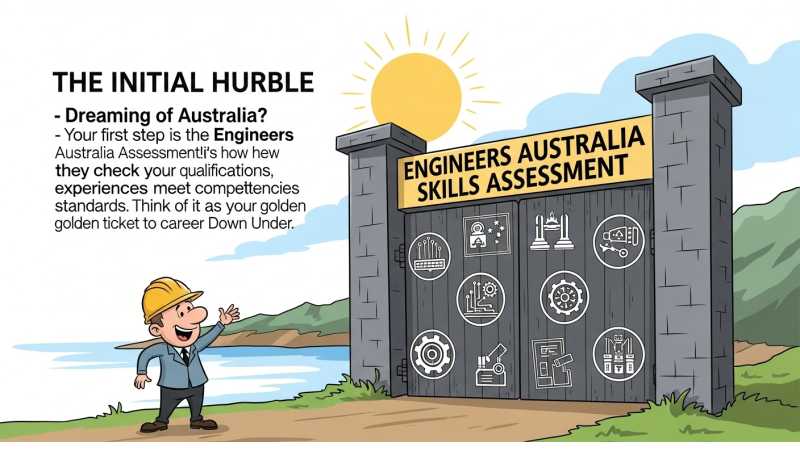
Engineers Australia is the designated assessing authority for engineering occupations under Australia’s skilled migration program. In other words if you want to migrate to Australia as an engineer you must have your qualifications and experience formally assessed by Engineers Australia ( engineersaustralia.org.au ).
You will receive an outcome letter from Engineers Australia which you must include in your visa application to the Department of Home Affairs. Without this positive skills assessment outcome you cannot apply for a skilled visa to Australia.
The skills assessment verifies that you are a genuine engineering professional with the qualifications and skills claimed. It checks that your education meets Australian standards and that you have the competency required for your engineering role. In some cases
the assessment can also award points for work experience if you choose to have your employment history evaluated (more on that later). Ultimately the Engineers Australia assessment is a gatekeeping step to ensure Australia admits qualified engineers into the workforce.
Who needs to apply? Any engineer intending to apply for skilled migration (visa subclasses 189 190 491 etc.) under an engineering occupation needs a skills assessment. This includes engineers of all disciplines and at all levels (Professional Engineers Engineering Technologists Engineering Associates and Engineering Managers). It applies whether you obtained your engineering degree in Australia or overseas.
The process is slightly simpler for those with accredited qualifications (more on the pathways below) but the documentation requirements are largely the same across all engineering fields.
Accredited vs Non-Accredited Qualifications (Pathways Overview)
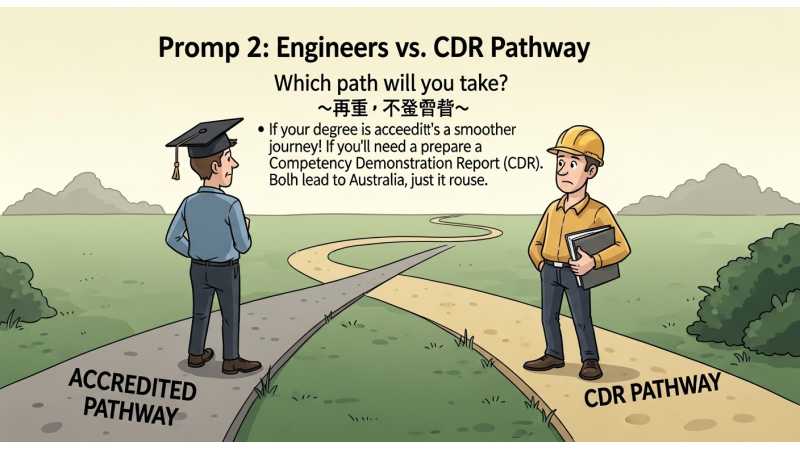
Before diving into the document checklist, it’s important to understand the two main pathways for Engineers Australia migration skills assessment:
- Accredited Qualifications Pathway: If your engineering degree is from an accredited program (for example an Australian degree or a degree recognized under the Washington Accord Sydney Accord or Dublin Accord) you fall under an accredited qualifications pathway.
- This means Engineers Australia already recognizes your degree as meeting the benchmark so you do not need to submit a Competency Demonstration Report (CDR). The assessment will focus mainly on verifying your documents.
-
Non-Accredited Qualifications Pathway (CDR Pathway): If your degree is not accredited or not recognized through those international agreements, you will need to undergo a Competency Demonstration Report (CDR) assessment. In addition to the standard documents, you must prepare a detailed report showcasing your engineering competencies (we will explain the CDR documents required in a later section).
Regardless of the pathway, all applicants must provide a core set of documents to Engineers Australia. The difference lies in additional requirements: CDR pathway applicants have to furnish extra reports (career episodes, etc.), whereas accredited-pathway applicants do not. Now, let’s break down the documents required for Engineers Australia skill assessment.
Common Documents Required for Engineers Australia Skill Assessment
Engineers Australia provides a checklist of documents that every applicant must submit with their skills assessment application. These ensure proof of your identity, qualifications, and other personal details. Below is a comprehensive list of the key documents you will need:
- Primary Identification (Passport): A scan of the identification page of your current passport (the page with your photo and personal details) is required as the primary ID document ( engineersaustralia.org.au ).
- If you don’t have a passport a national identity card or driver’s license may be acceptable but a passport is the most commonly used. Ensure the scan is in color and clearly shows your photo and text.
- Passport-Sized Photograph: A recent passport-style photograph of yourself typically with dimensions 35mm x 45mm in color ( engineersaustralia.org.au ). This should be a clear headshot on a neutral background (similar to a visa or passport photo).
- Many applicants provide the same style photo used in their passport. Check Engineers Australia’s current guidelines – usually a JPEG photo can be uploaded digitally.
- Curriculum Vitae (CV)/Resume: A complete CV or résumé detailing your engineering education and work history. This should be up-to-date and include relevant dates roles responsibilities and achievements.
- Engineers Australia wants to see a chronological picture of your professional career or academic background. Include all your significant engineering experience or projects (even those done during study if you are a recent graduate).
- A well-structured CV helps the assessor understand your journey and any work experience you might later claim for points.
- Educational Certificates (Degree/Diploma): Copies of your engineering degree certificate for each qualification you have earned. For example if you have a Bachelor’s and a Master’s include both certificates.
- These should be the official certificates (also known as testamurs) issued by your university upon graduation ( engineersaustralia.org.au ). If you completed your qualification in Australia
- a letter of completion can be accepted only if you have not yet received the formal degree certificate (and only for Australian grads) ( engineersaustralia.org.au ). For overseas degrees the certificate must be provided.
- Ensure these are high-quality color scans of the original documents.
- Academic Transcripts: Official academic transcripts for your engineering qualifications showing the courses/subjects taken and grades or marks achieved. The transcript should also indicate the year you completed the program.
- If you received any credits or exemptions (recognition of prior learning) make sure those are reflected or include documentation of that ( engineersaustralia.org.au ). Like the certificates transcripts must be clear color scans.
- If the transcripts are not in English you will need to provide translations (more on translations in a moment).
- English Language Proficiency (IELTS Requirement): Unless you qualify for an exemption you must provide evidence of your English language ability. Engineers Australia accepts results from several English tests most commonly IELTS (International English Language Testing System) ( engineersaustralia.org.au ).
- The IELTS requirement is usually an Academic or General Training IELTS score of at least 6.0 in each band (Listening Reading Writing Speaking) ( engineersaustralia.org.au ). They also accept TOEFL iBT and Pearson PTE Academic as alternatives
- with equivalent minimum scores (e.g. TOEFL iBT: Writing 21 Speaking 18 Reading 13 Listening 12; or PTE Academic: 50 in each part) ( engineersaustralia.org.au ). Important:
- Your test results must be less than 3 years old at the time you lodge your assessment ( engineersaustralia.org.au ).
- Some applicants are exempt from providing an English test – for instance if you hold a passport from the UK USA Canada New Zealand or Ireland or if you completed a couple of years of study in Australia you might not need
- to submit a test result as proof of English ( engineersaustralia.org.au ).
- Check the latest Engineers Australia policy on English test exemptions. If you do need to submit a test IELTS TOEFL or PTE score sheets are acceptable.
- Be sure to upload the official score report and include the test report number or verification code so that Engineers Australia can validate your results ( engineersaustralia.org.au ).
- (For PTE Academic you’ll need to send your score electronically to Engineers Australia through Pearson’s portal as well ( engineersaustralia.org.au ).)
- Proof of Name Change (if applicable): If your current name is different from the name on your academic documents or passport (for example due to marriage or legal name change) include official name change evidence.
- This could be a marriage certificate deed poll or other legal certificate indicating the change of name. Make sure this is also translated to English if in another language and is a certified copy of the official document.
- Using this Engineers Australia can connect all your documents to you even if the names vary.
- Professional Registration or License (if applicable): This isn’t always mandatory but if you are registered as a professional engineer in your home country (or elsewhere) or are a member of an engineering association
- it’s a good idea to include evidence of that. For example a state engineering license or membership certificate of a recognized engineering body. While not listed as a core requirement
- providing these professional membership documents can strengthen your profile and help verify your standing in the profession. Engineers Australia however is primarily focused on your degrees and experience so consider these as optional supporting documents.
- Additional Supporting Documents: In some cases you might include visa or immigration status documents (if you are already in Australia on a temporary visa for instance you could include a copy of your current visa).
- This is not explicitly required for the assessment but could be relevant if asked. Another item is payment receipts – if you have paid the assessment fee and received a receipt you may attach proof of payment
- though the online system usually records this automatically. We’ll discuss fees later but just note that you will have to pay the assessment fee as part of the application.
- Translations (if needed): Any document that is not originally in English must be accompanied by an official translation. You should provide both a copy of the original-language document and the English translation.
- The translation must be done by a certified/authorized translator and should include the translator’s details (name credentials and contact information) on the translated copy ( engineersaustralia.org.au ).
- This applies to transcripts certificates reference letters or any other supporting docs that aren’t in English. Make sure translations are accurate and complete to avoid delays.
A few important tips on document format: Engineers Australia requires high-quality color scans of all documents. Do not upload black-and-white scans or scans of photocopies; scan the original documents in color at a good resolution (300 dpi or higher is recommended) ( engineersaustralia.org.au ). In fact
Engineers Australia explicitly notes not to submit “certified copies” or black-and-white copies of documents ( engineersaustralia.org.au ).
This means if you have a paper copy that was notarized or certified do not scan the notarized copy (which often is a photocopy with a stamp); instead scan the original. Color scans of original documents are preferred because they tend to be clearer and more secure. Following the file upload guidelines (e.g. each document uploaded separately
not as one huge file) will help ensure your application is processed smoothly ( engineersaustralia.org.au ).
Failing to adhere to these can delay your processing (engineersaustralia.org.au).
Now that we’ve covered the common documents for all engineers, let’s look at additional documents you might need in specific situations, such as if you come under the CDR pathway or if you want to claim work experience in your assessment.
Additional Documents for the CDR Pathway (Non-Accredited Qualifications)
If your qualification is not accredited by Engineers Australia or not recognized under the Washington/Sydney/Dublin Accords you will be assessed via a Competency Demonstration Report (CDR). Essentially the CDR is how you demonstrate your engineering competencies to Australian standards when your degree alone isn’t pre-approved.
In addition to all the documents listed in the previous section CDR applicants must prepare the following documents:
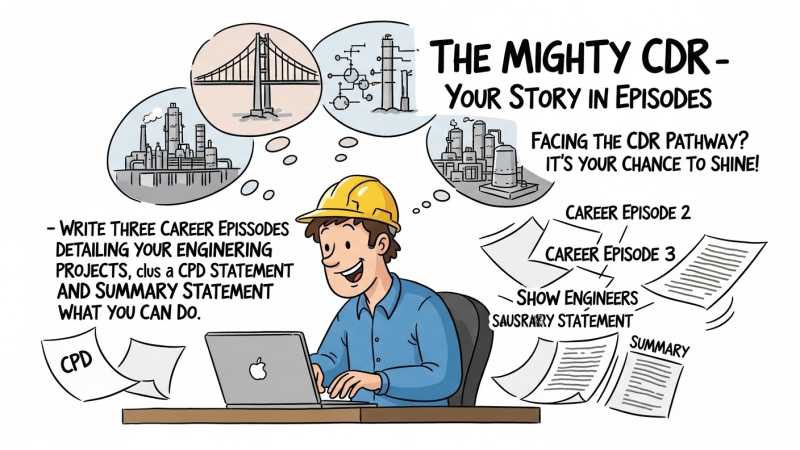
- Continuing Professional Development (CPD) Statement: A CPD statement is a list or summary of how you have kept your engineering knowledge up-to-date after graduation.
- It typically includes things like workshops seminars courses conferences private study or any professional development activities you’ve done. You don’t need to include certificates for each activity but you should list the activities (with dates duration and a brief description).
- Engineers Australia just wants to see that you are actively learning and staying current in your field.
- Three Career Episodes: These are three separate essay-style reports (typically 1,000 to 2,500 words each) that you write about specific engineering projects or work experiences you have been involved in.
- Each career episode focuses on a different project or piece of work (for example one could be about a design project you did at university another about a problem you solved in a job etc.).
- In each episode you need to describe what the project or problem was what role you played what tasks you performed and how you applied your engineering skills to achieve an outcome.
- Essentially you are showcasing your problem-solving abilities and engineering knowledge in practice. Write these in the first person (“I did X…”) and focus on your personal contribution.
- Include technical details like calculations design decisions or standards you followed – this gives evidence of your competency. Career episodes are the heart of the CDR so they require effort and honesty. (Tip:
- avoid any plagiarism – the episodes must be entirely your own work and written in English. Engineers Australia has strict ethical standards and will reject applications with copied content.)
- Summary Statement: The summary statement is a document (usually one or two pages) where you map each of the competency elements required by Engineers Australia to specific paragraphs in your career episodes.
- Engineers Australia provides templates listing the competency elements for each occupational category (Professional Engineer Technologist etc.). You will take each competency (like “application of systematic engineering synthesis and design processes” for example) and pinpoint where in your episodes you demonstrated that.
- The summary statement is essentially an index or checklist that proves you’ve covered all required competencies across your three episodes. It’s usually done after writing the episodes as a cross-referencing exercise.
Preparing a CDR can be time-consuming but it’s your chance to prove your skills beyond your academic documents. Along with the CDR you still must submit all the basic documents (ID degree transcript CV English test etc.) as listed earlier.
Be aware that a CDR is required for most Engineering Manager applicants and engineers whose qualifications fall outside the recognized accords.
If you’re unsure whether you need to do a CDR, check if your engineering degree is listed as accredited on the International Engineering Alliance website or Engineers Australia’s list. If it’s not, then you’ll be doing the CDR route.
Note: All the components of the CDR (CPD Episodes Summary) should be prepared by you and will be uploaded as part of your application. There is no formal template for the career episodes (you write them as essays)
but there are guidelines in the official Engineers Australia Migration Skills Assessment booklet and plenty of examples available (just ensure any example is only used as a reference never copy content). This is a critical part of meeting the Engineers Australia skills assessment requirements for those with non-accredited qualifications.
Documents for Work Experience (Employment Assessment)
Many engineers not only want their degree assessed but also their work experience evaluated by Engineers Australia. While having your work experience assessed is not mandatory for a positive skills assessment of your qualification it can be very beneficial.
A Relevant Skilled Employment Assessment from Engineers Australia can validate your years of engineering work and is often used to claim points in the visa application. If you wish to include this you will need additional documents related to your employment:
- Work Reference Letters: You will need to obtain reference letters from your past and present employers detailing your role and duties as an engineer.
- Each reference letter (sometimes called an employment certificate or experience letter) should be on the company’s official letterhead dated and signed by an authorized person (supervisor or HR).
- It must include your job title the period of employment (start date and end date or “to present” if ongoing) whether it was full-time or part-time and a description of the engineering duties you performed in that role.
- The duties described should ideally highlight the engineering tasks you undertook demonstrating how they align with your claimed occupation. The letter should also have the company’s contact details (address phone email) so that it can be verified if needed.
- If you had multiple positions or promotions in the same company it’s good to have each role’s details and dates clarified. Tip:
- Make sure the letters are detailed – Engineers Australia sometimes wants at least five major duties or responsibilities listed for each job to properly evaluate your experience.
- Additional Evidence of Employment: In some cases Engineers Australia may ask for further proof of your employment. This can include documents like pay slips tax records social security contributions or employment contracts that corroborate the dates and employment claimed.
- For example tax filings or superannuation statements can show you were on payroll during that period. If you are self-employed you might provide business registration documents client invoices or affidavits from clients.
- These support documents are usually needed if there’s any doubt or if you’re claiming points for that experience. It’s a good idea to have them handy just in case
- though they might not need to be uploaded initially unless specifically requested.
- Professional Registration (if applicable): If a particular work experience required a professional engineering license (for example some countries or roles require you to be a registered engineer) you can include your license or registration proof as part of the work documents.
- This was mentioned earlier as an optional document – it can also serve to verify that you were authorized to practice in that job.
When you apply for the Relevant Skilled Employment Assessment you typically will indicate the periods of employment you want assessed. Engineers Australia will then review the reference letters and evidence to determine how many years of your experience are considered relevant skilled engineering experience (post-qualification).
They may exclude any experience that is not closely related to your engineering occupation or that is before you obtained your degree etc.
The outcome letter then will state something like “X years of relevant experience recognized”. This can translate to points on your visa application.
Keep in mind that having your work experience assessed often incurs an additional fee (separate from the standard qualification assessment fee). We’ll cover fees and process next but just note that if you choose to include work documents make sure they are thorough and truthful.
Incomplete or vague job references are a common cause for delays or having to provide more information.
Other Special Cases and Documents
Most applicants will fall under the above requirements, but there are a couple of special cases worth mentioning:
- Applicants with Overseas PhDs: If you have a PhD in engineering from overseas and you want it specifically recognized (perhaps to get an extra point for qualification or just for thoroughness) Engineers Australia can assess it through an additional PhD assessment service.
- In this case you need to provide extra documents beyond the standard ones ( engineersaustralia.org.au ): A copy of your PhD thesis abstract (summary of your research). A list of your publication(s) (papers or articles) resulting from the PhD research
- if any ( engineersaustralia.org.au ). Include details like journal names whether they were international or national publications etc.
- A list of the names and contacts of your PhD examiners or supervisors (if applicable) ( engineersaustralia.org.au ) or any documentation showing the examination of the PhD. These help EA verify the authenticity and content of your doctoral research.
- They are in addition to the usual degree certificate and transcript for the PhD. If your PhD is from Australia it’s usually already recognized (so these documents might not be needed). The PhD assessment also comes with an extra fee.
- Engineering Manager Occupation: If you are applying under the Engineering Manager category (ANZSCO 133211) note that this is considered a non-accredited pathway regardless of your degree.
- Engineering Manager is not covered under the Washington/Sydney/Dublin Accords (those are for engineers technologists etc.) so all Engineering Manager applicants must submit a CDR (three career episodes focusing on management of engineering projects etc.).
- The documents needed are essentially the same as the CDR pathway listed earlier. Just be aware of this distinction if you’re an Engineering Manager.
- Multiple Qualifications: If you have multiple engineering degrees or a combination of engineering and closely related degrees include all relevant qualification documents. Engineers Australia will typically assess your highest relevant qualification by default (e.g.
- if you have a Master’s in engineering they will assess that but they will still want to see your Bachelor’s).
- Submitting both can sometimes strengthen your case or provide clarity (for instance if your Master’s is in a slightly different field the assessor can see your Bachelor’s fundamentals).
- Miscellaneous Documents: Other documents you might consider include reference letters for projects (if you did a significant project under someone’s supervision say a professor or a client a letter from them could support a career episode claim)
- or achievement certificates (e.g. an award for engineering excellence). These are not required by any means but if a particular document adds value or proof to something you claimed you can include it in an “Additional Documents” section.
- Just be careful not to overload the application with unnecessary paperwork – stick to what’s relevant to your competencies and qualifications.
By now, we have a full picture of the documentation you’ll need. Organizing these in advance is very helpful. Next, let’s walk through the step-by-step process of applying for the skills assessment, so you know how these documents come into play during the application.
Step-by-Step Guide to the Engineers Australia Skill Assessment Process
Applying for your migration skills assessment may seem daunting, but it can be broken down into manageable steps. Below is a step-by-step guide, with tips at each stage:
- Check Your Pathway and Eligibility: Before gathering documents determine which assessment pathway applies to you. Is your engineering degree accredited under an international accord or Australian accredited program? If yes you can use the Accord pathway (no CDR required).
- If not you’ll use the CDR pathway.
- Also identify your correct occupational category – most will be “Professional Engineer” (if you have a 4-year bachelor degree or higher) while some with diploma-level may be “Engineering Technologist” or “Engineering Associate,” and managerial roles as “Engineering Manager.” Knowing your category and
- pathway will clarify which documents and competency elements you need to focus on.
- (For example Washington Accord degrees generally fall under Professional Engineer pathway.) This step is important because an application under the wrong pathway can be rejected so do your research upfront (Engineers Australia’s website has a tool and lists to verify if your
- degree is accredited).
- Create an Account on Engineers Australia’s Portal: Go to the Engineers Australia Migration Skills Assessment portal and create your login (if you’re not already a member of Engineers Australia). The application is done online via their portal.
- Once logged in you will start a new Migration Skills Assessment application. The online form will ask for details like your personal information education history employment history and the pathway you are applying under.
- You don’t have to complete it all in one go – you can save and come back.
- Use this time to also read the official MSA Booklet or guidelines available on the EA website (it contains detailed instructions and the code of ethics you must adhere to).
- Gather and Scan All Required Documents: As detailed in earlier sections collect all the documents you need: passport photo degree certificates transcripts CV English test results etc.
- If you need to write a CDR (for non-accredited pathways) this step will also include writing your career episodes summary statement and preparing your CPD list. This can take some time so plan accordingly.
- Make sure all documents are in English (or translated) and in color. Scan each document to a high-quality PDF or image file. Tip: Name the files clearly (e.g. “Passport.pdf” “BachelorDegree.pdf” “Transcript.pdf” “CV.pdf” “IELTS.pdf”
- “CareerEpisode1.doc” etc.) so you can upload them without confusion. Ensure your English test (IELTS/TOEFL/PTE) is valid and you have the report number handy to input. If any document is multiple pages (like a transcript)
- scan all pages and combine them into one PDF file for that document. Avoid scanning multiple documents into one file; keep them separate as the system will ask for each item individually ( engineersaustralia.org.au ).
- Complete the Online Application Form: Work through the online application steps. You will fill in details like your personal info education history (each tertiary qualification institution year etc.) and employment history (if you are also getting work experience assessed).
- Be truthful and precise – the details you enter should match the documents you will upload.
- The form will ask you which assessment type you are going for (Australian grad Washington Accord CDR etc.) and which additional services (like work experience assessment or PhD assessment) you want. Select the ones applicable to you.
- If any question is unclear refer to the Migration Skills Assessment booklet or the help text in the portal. Before submission the system will prompt you to upload the required documents corresponding to each section.
- Upload Your Documents: Upload all the documents we outlined earlier to their respective slots in the online application. There will be placeholders for things like passport photo CV degree certificate transcript English test etc.
- For CDR-based applications you will also upload your CPD Career Episodes and Summary Statement (usually as separate files). For each employment you listed upload the reference letter and any other proof under that entry.
- Ensure you upload colour scans of originals as emphasized (no black-and-white or photocopy scans) ( engineersaustralia.org.au ). Double-check that each file is legible – for instance transcripts should have clear text and your name should be visible on each document.
- The portal may allow only certain file types (PDF is safest for documents JPEG/PNG for photos). After uploading you might need to mark the section as complete.
- Pay the Assessment Fee: Before final submission you will be prompted to pay the skills assessment fee. The fee varies depending on the pathway and any additional services. For example
- a standard CDR assessment fee is on the order of AUD $800-$900 (as of recent figures) while an accredited qualification assessment might be around AUD $300.
- Adding a work experience assessment or PhD assessment increases the fee (each could be a few hundred dollars extra). The online system will calculate the total based on what you selected. You can pay via credit/debit card. After payment
- you should receive a receipt. The application will then be officially submitted for processing.
- Waiting Period and Processing Time: Now comes the waiting. Engineers Australia’s standard processing time can range from about 15 weeks for standard assessor assignment for a normal (non-fast-track) application.
- CDR assessments often take around 12 weeks (3 months) in standard queue while accredited qualification assessments (with no CDR) might take around 8 weeks.
- If you opted for the fast-track service (for an additional fee) your application will be assigned to an assessor more quickly – fast-track cases are often processed in about 15-20 business days (roughly 3-4 weeks).
- During the waiting period ensure you are reachable via the email you provided. Sometimes if any document is missing or if clarifications are needed the assessor will contact you or put your application on hold awaiting further info.
- Outcome of the Assessment: Once processed you will receive the outcome from Engineers Australia. Typically you get an email notification and can download the Outcome Letter from the online portal.
- If the assessment is successful (positive outcome) the letter will state the outcome and your recognized occupation (e.g. “Skilled Migration Outcome: Mechanical Engineer – Positive”).
- It will also mention the number of years of experience verified (if you submitted work documents for assessment). This outcome letter is what you need to provide to the Department of Home Affairs with your visa application.
- If the outcome is negative or incomplete the letter will explain the reasons. Common issues might be insufficient documentation or not meeting a requirement.
- If you receive a negative outcome you usually have options to appeal or request a review but this involves an additional fee (often a few hundred dollars) and must be done within a certain time frame.
- However if you followed all requirements and your qualifications genuinely meet the standards a negative outcome is unlikely. In many cases if something was missing Engineers Australia might have contacted you for more information before issuing a final outcome.
- Next Steps After Outcome: With a positive outcome in hand congratulations – you have successfully navigated the Engineers Australia skills assessment! Your next step will be to use that outcome letter in your visa application (SkillSelect EOI and visa submission).
- The outcome letter typically has an ID or reference number that the immigration case officers can verify. The skills assessment remains valid for a certain period (often 3 years for migration purposes)
- so you generally wouldn’t need to do it again within that time unless required. If however it took you a while and the assessment outcome is expiring check if you need to get a reaffirmation or a new assessment.
Remember that even after a positive assessment, you should keep records of all those documents; sometimes immigration might want to see the same educational documents or employment evidence again during visa processing. So the work you did to compile everything will continue to pay off.
By following these steps methodically and ensuring you meet all Engineers Australia Skills Assessment requirements, you can make the process as smooth as possible for yourself.
Tips for a Successful Skills Assessment Application
-
Start Early: Gathering documents, especially things like reference letters or English test results, can take longer than expected. Start the process well in advance of any visa deadlines. Writing a CDR, in particular, is something you don’t want to rush. Give yourself ample time to draft and refine your career episodes.
- Follow the Guidelines and Ethics: Engineers Australia has strict rules regarding plagiarism and ethical conduct. All the narratives you provide (CPD list career episodes summary) must be your own original work.
- Do not be tempted to copy examples or hire someone to write it for you – this can lead to a ban. Engineers Australia applies strict ethical guidelines and integrity verification to CDR submissions ( engineersaustralia.org.au engineersaustralia.org.au ). Similarly
- falsifying documents (like a fake work letter) can lead to serious consequences. It’s just not worth it. Stick to truthful and verifiable information.
- Clarity and Organization: Make it as easy as possible for the assessor to review your case. Clearly label your documents and in your application form ensure names and dates match your documents.
- If your documents are well-organized and complete the assessor can finish your evaluation without coming back for clarification which means a faster positive result.
- Double-check that scans are readable – blurry or cut-off documents can lead to delays if you’re asked to re-submit them.
- Check for Updates: Immigration and assessment criteria can update over time. Always check the latest guidelines on Engineers Australia’s official website before submission.
- The required documents list and procedures we described are accurate as of the current knowledge but details like fees or specific requirements (like accepted English tests or score thresholds) could change.
- For instance in September 2024 Engineers Australia updated how they handle certain diploma qualifications ( engineersaustralia.org.au ) – staying informed of such changes can be crucial if it pertains to you.
- Consider Professional Advice if Needed:
- While many engineers successfully apply on their own if you feel unsure about any part of the process (say you’re confused about the correct ANZSCO occupation to nominate or you have a complex situation with multiple degrees and work history) you might
- consult a migration agent or an expert for guidance.
- Make sure they are registered migration agents if you go that route. However
- be wary of anyone offering to write your CDR for you – remember that your own involvement in preparing the CDR is itself one of the skills assessment requirements (it demonstrates your communication skills and ethical practice).
- Use the Outcome Wisely: Once you have the positive outcome use it promptly for your visa application. Skills assessment results have an expiry and immigration rules (like points for age) might change.
- Plan your next steps (expression of interest state nomination if applicable etc.) so that all your effort in getting the assessment yields the desired result – a successful visa grant and a new life in Australia!
Conclusion
Obtaining a skills assessment from Engineers Australia is a critical step for any engineer aspiring to work in Australia. It might seem like a lot of paperwork but each required document serves to verify your identity education experience and English proficiency – all to ensure you meet the high standards of the Australian engineering profession.
By understanding the process and preparing thoroughly you can navigate the assessment with confidence.
In summary make sure you compile all necessary documents – from your passport and degree certificates to the IELTS test result and detailed career episodes if needed – and submit them in the format Engineers Australia asks for. We’ve discussed the importance of the IELTS Requirement as part of proving your communication skills
and how the Skills Assessment Requirements include not just documents but also demonstrating your competencies through a CDR if required.
All engineering disciplines are covered under this process, so whether you’re an electrical engineer with a PhD or a civil engineer with a few years of experience, the framework of assessment is standardized.
The Engineers Australia skill assessment process ensures that only qualified and competent engineers make it through which in turn upholds the integrity of the engineering field in Australia. It may be challenging but it’s also an opportunity to reflect on your career accomplishments as you prepare your documents and reports.
Completing it successfully is an achievement in itself – it means your qualifications and skills are recognized at an Australian standard.
Documents Required for Skill Assessment checklist for Engineers Australia
A strong application should make the assessor’s job easy. Keep the discussion specific to your nominated occupation, explain your personal engineering contribution, and connect each claim with evidence from your projects, employment documents, CPD records, and career episodes.
- Use the same occupation wording consistently across the CV, CDR, career episodes, and summary statement.
- Explain what you personally designed, calculated, tested, supervised, improved, or solved.
- Support technical claims with project context, tools, standards, constraints, and measurable outcomes.
- Check that the final report follows Engineers Australia guidance before submission.
For related support, see our CDR writing services, sample CDRs for Engineers Australia, and Engineers Australia Skill Assessment guide.
FAQs about Documents Required for Skill Assessment
Why does Documents Required for Skill Assessment matter for a CDR?
It helps align your report with the occupation and assessment pathway you are presenting to Engineers Australia. Clear alignment can reduce confusion and make your competency evidence easier to review.
What should I prepare before writing?
Prepare your CV, academic records, employment evidence, CPD list, project notes, calculations, drawings, and any documents that prove your personal engineering role.
Can I use a sample before writing?
Yes. A sample can help you understand structure and tone, but your final report should be written around your own work, decisions, and engineering responsibility.
Documents Required for Skill Assessment review checklist for 2026
Documents Required for Skill Assessment should be checked against the latest Engineers Australia assessment expectations. A practical Documents Required for Skill Assessment review confirms that the applicant has used real engineering evidence.
The final Documents Required for Skill Assessment draft should explain personal responsibility technical decisions and project outcomes. Applicants preparing Documents Required for Skill Assessment should avoid vague claims and keep the report evidence based.
A clear Documents Required for Skill Assessment structure helps the assessor follow the project from problem to result.
Before upload Documents Required for Skill Assessment should be reviewed for grammar formatting originality and consistency. Strong Documents Required for Skill Assessment preparation connects project evidence with the nominated engineering occupation.
Professional Documents Required for Skill Assessment support should improve clarity without changing the applicant’s facts. Every Documents Required for Skill Assessment section should support the migration skills assessment pathway clearly.
A complete Documents Required for Skill Assessment review can reduce delays caused by missing or unclear information.
Documents Required for Skill Assessment should be checked against the latest Engineers Australia assessment expectations. A practical Documents Required for Skill Assessment review confirms that the applicant has used real engineering evidence.
The final Documents Required for Skill Assessment draft should explain personal responsibility technical decisions and project outcomes. Applicants preparing Documents Required for Skill Assessment should avoid vague claims and keep the report evidence based.
A clear Documents Required for Skill Assessment structure helps the assessor follow the project from problem to result.
Before upload Documents Required for Skill Assessment should be reviewed for grammar formatting originality and consistency. Strong Documents Required for Skill Assessment preparation connects project evidence with the nominated engineering occupation.
Professional Documents Required for Skill Assessment support should improve clarity without changing the applicant’s facts. Every Documents Required for Skill Assessment section should support the migration skills assessment pathway clearly.
A complete Documents Required for Skill Assessment review can reduce delays caused by missing or unclear information.
Documents Required for Skill Assessment should be checked against the latest Engineers Australia assessment expectations. A practical Documents Required for Skill Assessment review confirms that the applicant has used real engineering evidence.
The final Documents Required for Skill Assessment draft should explain personal responsibility technical decisions and project outcomes. Applicants preparing Documents Required for Skill Assessment should avoid vague claims and keep the report evidence based.
A clear Documents Required for Skill Assessment structure helps the assessor follow the project from problem to result.
Before upload Documents Required for Skill Assessment should be reviewed for grammar formatting originality and consistency. Strong Documents Required for Skill Assessment preparation connects project evidence with the nominated engineering occupation.
Professional Documents Required for Skill Assessment support should improve clarity without changing the applicant’s facts. Every Documents Required for Skill Assessment section should support the migration skills assessment pathway clearly.
For related preparation, read the Engineers Australia Skill Assessment guide and the CDR Writing guide before finalising Documents Required for Skill Assessment documents.
Related reading
- Start with how the EA skills assessment works from start to finish.
- Related: the Engineers Australia skill assessment process.
- Background: the complete Engineers Australia CDR guide.
- Next step: compare our CDR plans and pricing.
- Next step: CDR samples by engineering discipline.
- Also useful: the Mechanical Engineering Draftsperson pathway (ANZSCO 312511).
- Also useful: the 2026 Australia PR points calculator.