

CDR Reference Reports for Mechanical Engineers
CDR Reference Reports Mechanical Engineers is covered in this guide for Engineers Australia applicants.
Engineers Australia requires a Competency Demonstration Report (CDR) from mechanical engineers who want to migrate to Australia but lack fully accredited engineering qualifications.
A CDR is a collection of documents – including three Career Episodes, a Summary Statement, a list of Continuing Professional Development (CPD) activities, and a detailed CV – used to demonstrate that you meet Australia’s professional competency standards.
In other words, if your engineering degree is not recognized under the Washington, Sydney or Dublin Accords (or is provisionally accredited), you must submit a CDR for a skills assessment. The CDR shows Engineers Australia that you have applied your mechanical engineering knowledge in practice and can perform as a competent Professional Engineer or Engineering Technologist in Australia.
A mechanical engineer reviewing design plans and documentation.
In your CDR, you will present your own engineering work (in first-person) and how you applied your technical knowledge on real projects.
What Is a Mechanical Engineer’s CDR Report?
A CDR (Competency Demonstration Report) is essentially a portfolio of your engineering work that Engineers Australia evaluates to determine if you meet the competence expected of your nominated occupation.
It must be entirely your own work; Engineers Australia explicitly forbids plagiarism or the use of templates, stating that any work “conducted by others” or copied from sources is considered unethical and plagiarism.
The CDR typically contains:
Three Career Episodes: Each episode is a self-contained narrative describing one of your significant engineering projects or experiences. These episodes highlight how you applied mechanical engineering knowledge, solved problems, and led tasks in that project.
Summary Statement: A summary sheet that cross-references paragraphs in your Career Episodes with the Engineers Australia competency elements (knowledge and skill requirements) for your occupation.
Continuing Professional Development (CPD): A concise list of activities (courses, seminars, workshops, self-study, etc.) you undertook to update and extend your engineering skills since graduation.
Curriculum Vitae (CV) / Resume: A detailed professional resume outlining your education, qualifications, and engineering work experience.
These documents together allow EA to verify that you have the theory-based knowledge and practical skills required for a mechanical engineer as defined by the ANZSCO (Australia’s job classification) and EA’s competency standards. In practice this means describing what you specifically did (using “I” statements) rather than what your team did
providing technical details and calculations and addressing the prescribed competencies.
Engineers Australia notes that under the CDR pathway,
“your knowledge, skills and competency will be evaluated against Engineers Australia standards appropriate for your nominated occupation”.
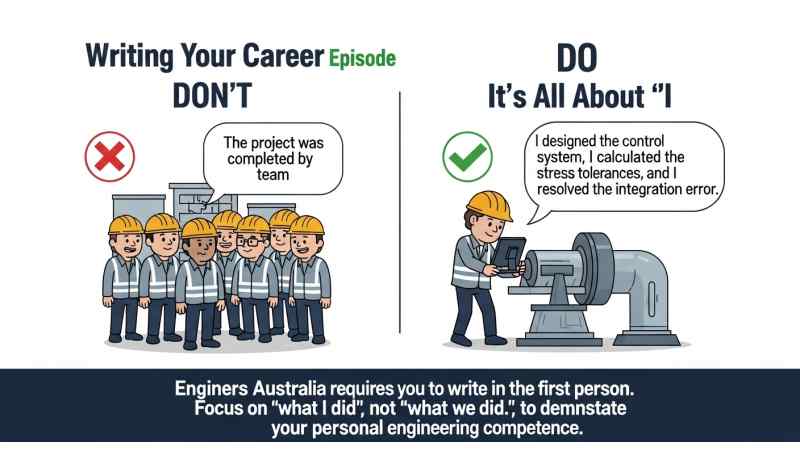
In other words, the CDR must clearly demonstrate your own role in engineering tasks and solutions. For example, each Career Episode should “state what you did and describe how you did it”, emphasizing actions like “I designed”, “I calculated”, or “I implemented” rather than vague group actions. This first-person focus is critical: EA explicitly warns that
“it is not sufficient to describe the activities performed by a team or group – your own role must be clearly identified”.
Why Are CDR Reports Important for Mechanical Engineers?
A well-crafted CDR report is essential if you are an overseas-trained mechanical engineer aiming for skilled migration or professional recognition in Australia. Engineers Australia uses the CDR to verify that you have met the stage 1 competency standards (professional competency) for your field.
Simply having a degree is not enough if it’s from a non-accredited program; the CDR provides evidence of your practical engineering abilities.
Passing the EA migration skills assessment through a CDR is often a prerequisite for obtaining a skilled visa or Permanent Residency in Australia. In practical terms a thorough CDR report shows EA that you can solve engineering problems design mechanical systems and apply best practices according to Australian engineering standards.
It allows them to “assess the competency of an engineer on the basis of engineering skills and knowledge management communication and leadership”. In effect a strong CDR report boosts your chances of a positive assessment outcome.
By contrast a poorly written CDR can lead to outright rejection. Common pitfalls include failing to address the required competency elements or lacking technical detail. As one CDR guidance site notes EA often rejects CDRs that do not cover all 16 competency elements outlined in the Migration Skills Assessment booklet. Other fatal errors include plagiarism
excessive teamwork descriptions (rather than individual contributions) insufficient engineering calculations and diagrams and even simple language or formatting mistakes.
Engineers Australia’s code of ethics is strict:
“having your Career Episodes written by another person…constitutes unethical behaviour” and can lead to immediate rejection and even a ban from future applications.
Therefore, understanding and adhering to the CDR guidelines is crucial for a successful application.
Components of a Mechanical Engineer’s CDR Report
A mechanical engineer’s CDR report is structured into several key sections. Each part serves a specific purpose in demonstrating your professional competency. The main components are:
Curriculum Vitae (CV) / Resume:
A concise but comprehensive document (typically 2–4 pages) that lists your educational background and detailed work experience. It should highlight your mechanical engineering roles and responsibilities. EA advises including an updated CV with your CDR submission. Your CV should chronologically list all relevant engineering jobs, project titles, duties, and dates.
Continuing Professional Development (CPD) List:
A short table or list summarizing any professional development activities you have undertaken. This may include courses certifications conferences seminars workshops research or self-study relevant to mechanical engineering. According to Engineers Australia CPD “is the means by which you keep up-to-date with developments in your field of engineering after you have gained your undergraduate qualification”.
All relevant CPD should be included.
In practice, list activities like technical training courses, certification programs, industry conferences, or even relevant reading. (EA expects this to be brief—often just ½ to 1 page in table format with columns for title, date, duration, venue, and organizer.)
Three Career Episodes:
These are the heart of your CDR. Each Career Episode is an essay that describes in detail one engineering project or significant professional experience. You must submit exactly three episodes, each focusing on a different project or aspect of your work.
(If you have limited work experience, you can use a university project or final-year thesis as one episode, though actual job projects are preferred.) Together, the episodes should cover a range of engineering skills and problems. Engineers Australia requires each episode to be focused on your personal engineering contribution and written in English, your own words.
Each episode must demonstrate how you applied mechanical engineering knowledge (theories, calculations, design methods) and general competencies (communication, teamwork, ethics, etc.) during that project.
Summary Statement:
This is a competency matrix that links your Career Episodes to EA’s competency elements. After drafting the episodes you identify which paragraphs demonstrate each required competency (according to your nominated occupation e.g. Mechanical Engineer). The Summary Statement cross-references EA’s competency elements with specific episode paragraphs. EA provides summary statement templates on its website
but you must ensure you address all relevant elements.
Essentially, the Summary Statement shows the assessor exactly where and how each competency is evidenced in your episodes. Only one Summary Statement is needed for all three episodes.
Below we discuss the key sections (CPD, Career Episodes, Summary) in more detail.
Continuing Professional Development (CPD)
Your CPD list is a short statement of how you stay current in mechanical engineering. Engineers Australia expects you to include “all relevant CPD” activities since graduation. Typical entries might include:
-
Technical courses or certifications (e.g. a course in advanced thermodynamics, CAD software training, or a certification in pressure vessel design).
-
Workshops, seminars or conferences (e.g. a materials engineering conference, a seminar on renewable energy systems, or industry training).
-
In-house training or self-study (e.g. online courses, reading engineering journals, independent research).
Engineers Australia advises formatting your CPD in a table with columns for Activity / Course Name, Date, Duration (hours), Venue, and Organizer. Include only activities relevant to mechanical engineering. Keep this section concise (often just ½–1 page). The goal is to show you actively maintained and improved your engineering knowledge and skills.
Career Episodes
Career Episodes form the core of your CDR. Each episode is structured as follows, per EA guidelines:
-
Introduction (about 150 words): Briefly state the title of the project, dates (month/year started and ended), location, name of the organization, and your job title or role.
-
Background (200–500 words): Set the scene for the project. Describe the overall objectives of the project, the nature of the engineering problem, the technical environment, and where your project fit into it. Include details like the team structure, your position in the organization, and any problems or challenges the project aimed to address.
-
Personal Engineering Activity (600–1500 words): This is the detailed narrative of your role. You must explain in detail the work you personally performed in the project. Use first person (“I”) and be very specific. Engineers Australia explicitly states: “state what you did and then describe how you did it… your own role must be clearly identified.
Remember it is your own personal engineering competencies that are being assessed.” In this section include:
-
How you applied mechanical engineering knowledge and theory.
-
The engineering tasks you were assigned and how you accomplished them.
-
Any design or calculations you performed (include summary of calculations or refer to attached diagrams).
-
Technical problems or challenges you faced and how you solved them (showing problem-solving techniques or creative solutions).
-
Tools, methods, or software you used (e.g. finite element analysis, CAD, MATLAB, etc.).
-
Your contributions to team efforts and leadership, if relevant, but always with emphasis on your actions (“I designed the component”, not just “we designed…”).
-
-
Summary (50–150 words): Conclude the episode by reflecting on the project outcome and your role. For example: state how the project met its goals, any performance improvements achieved, and summarize your key contributions and what you learned. This section ties your narrative back to its significance.
Each episode should be written as an essay, not in bullet or table format. Keep the narrative focused on engineering. Number the paragraphs (1.1, 1.2, etc.) for use in the Summary Statement cross-referencing.
Picking Strong Project Examples
When selecting your Career Episodes, ensure they are relevant to the Mechanical Engineering ANZSCO description (ANZSCO 233512 for Mechanical Engineer). Your episodes should collectively cover a breadth of competencies. The excerpt below lists sample projects that align well with mechanical engineering practice:
-
Designing and installing HVAC (heating, ventilation, air-conditioning) systems, including sizing of components like chillers, air handlers, diffusers, and ductwork.
-
Developing material handling or process layouts, such as conveyor belt systems or automated storage/retrieval systems.
-
Engineering thermal systems (e.g. chiller water systems, heat exchangers, refrigeration equipment) and improving energy efficiency.
-
Creating electromechanical devices (e.g. robotic arms, grippers, car park automation systems) and controlling mechanisms.
-
Designing fluid machinery and power systems (e.g. hydraulic pump networks, centrifugal pumps, compressors, valves).
-
Any research or development project where you solved an engineering problem (e.g. analyzing stresses in a new machine part, optimizing an engine performance using simulation).
Common Mistakes to Avoid
Engineers Australia is strict about CDR format and originality. Here are pitfalls to avoid:
-
Plagiarism: Do not copy text from any source (books, websites, existing CDRs, or templates). The EA manual warns that using others’ words or having someone else write for you is considered plagiarism. They explicitly state it violates ethics and can lead to a ban on your application.
-
Overly Focusing on Teamwork: Your CDR must highlight your individual contributions. Do not simply describe group activities. Use first-person statements like “I calculated”, “I designed”, “I managed” instead of “we did”.
-
Too Little Technical Detail: Omitting detailed technical work makes episodes weak. Include engineering calculations, design steps, material specifications, software used, etc.
-
Ignoring EA’s Format: Follow the word counts and section guidelines exactly. Do not alter the structure.
-
Poor Language and Presentation: Write clearly and professionally. Check spelling and grammar. EA notes that reports should be written in clear, businesslike English.
-
Exceeding Episode Count: Submit only three Career Episodes. Sending more is not allowed.
-
Neglecting the Summary Statement: Failing to prepare a thorough Summary Statement can lead to rejection. Meticulously check that all required competency elements are covered.
-
False or Misleading Content: All information must be truthful. Do not exaggerate your role or outcomes.
Conclusion
For a mechanical engineer pursuing migration to Australia, the CDR report is a critical step. A strong CDR Reference Report for Mechanical Engineers will convincingly showcase your engineering skills, problem-solving, and professionalism.
To achieve this:
-
Plan carefully: choose three diverse projects that highlight your mechanical engineering capabilities.
-
Follow the precise EA format: include a CV, CPD list, three well-written Career Episodes, and a linked Summary Statement.
-
Focus on your contributions: write in first person, give engineering details, and link everything to the competency standards.
-
Be original and accurate: avoid plagiarism, check language, and double-check the format against EA’s requirements.
Taking these steps will maximize your chances of a positive skills assessment outcome and bring you closer to working as an engineer in Australia.
Frequently Asked Questions (FAQs)
How long should each Career Episode be? Engineers Australia recommends each Career Episode narrative be between 1,000 and 2,500 words. This typically breaks down to about 5–8 pages per episode.
Can I use college projects for my CDR? Yes. If you do not have much professional experience, you may use significant university projects or your final-year capstone project as one of the Career Episodes. However, professional work projects tend to carry more weight.
How do I ensure my CDR report has no copied text? Only use your own words. After writing, run the text through plagiarism-checking software to catch accidental copying.
Can I submit more than three Career Episodes? No. Engineers Australia requires exactly three Career Episodes. Submitting more does not improve your chances and is against the rules.
How long does it take for Engineers Australia to assess a CDR? Processing times can vary. EA notes that, on average, it takes about 15 weeks to allocate an assessor to a submitted application. Receiving the final outcome often takes a few more weeks. Plan accordingly and check your EA online portal for status updates.
CDR reference reports for mechanical engineers checklist for Engineers Australia
A strong application should make the assessor’s job easy. Keep the discussion specific to your nominated occupation, explain your personal engineering contribution, and connect each claim with evidence from your projects, employment documents, CPD records, and career episodes.
- Use the same occupation wording consistently across the CV, CDR, career episodes, and summary statement.
- Explain what you personally designed, calculated, tested, supervised, improved, or solved.
- Support technical claims with project context, tools, standards, constraints, and measurable outcomes.
- Check that the final report follows Engineers Australia guidance before submission.
For related support, see our CDR writing services, sample CDRs for Engineers Australia, and Engineers Australia Skill Assessment guide.
FAQs about CDR reference reports for mechanical engineers
Why does CDR reference reports for mechanical engineers matter for a CDR?
It helps align your report with the occupation and assessment pathway you are presenting to Engineers Australia. Clear alignment can reduce confusion and make your competency evidence easier to review.
What should I prepare before writing?
Prepare your CV, academic records, employment evidence, CPD list, project notes, calculations, drawings, and any documents that prove your personal engineering role.
Can I use a sample before writing?
Yes. A sample can help you understand structure and tone, but your final report should be written around your own work, decisions, and engineering responsibility.
CDR Reference Reports for Mechanical Engineers supporting resources

CDR Reference Reports for Mechanical Engineers review checklist for 2026
CDR Reference Reports for Mechanical Engineers should be checked against the latest Engineers Australia assessment expectations. A practical CDR Reference Reports for Mechanical Engineers review confirms that the applicant has used real engineering evidence. The final CDR Reference Reports for Mechanical Engineers draft should explain personal responsibility, technical decisions, and project outcomes. Applicants preparing CDR Reference Reports for Mechanical Engineers should avoid vague claims and keep the report evidence based. A clear CDR Reference Reports for Mechanical Engineers structure helps the assessor follow the project from problem to result.
Before upload, CDR Reference Reports for Mechanical Engineers should be reviewed for grammar, formatting, originality, and consistency. Strong CDR Reference Reports for Mechanical Engineers preparation connects project evidence with the nominated engineering occupation. Professional CDR Reference Reports for Mechanical Engineers support should improve clarity without changing the applicant’s facts. Every CDR Reference Reports for Mechanical Engineers section should support the migration skills assessment pathway clearly. A complete CDR Reference Reports for Mechanical Engineers review can reduce delays caused by missing or unclear information.
CDR Reference Reports for Mechanical Engineers should be checked against the latest Engineers Australia assessment expectations. A practical CDR Reference Reports for Mechanical Engineers review confirms that the applicant has used real engineering evidence. The final CDR Reference Reports for Mechanical Engineers draft should explain personal responsibility, technical decisions, and project outcomes. Applicants preparing CDR Reference Reports for Mechanical Engineers should avoid vague claims and keep the report evidence based. A clear CDR Reference Reports for Mechanical Engineers structure helps the assessor follow the project from problem to result.
Before upload, CDR Reference Reports for Mechanical Engineers should be reviewed for grammar, formatting, originality, and consistency. Strong CDR Reference Reports for Mechanical Engineers preparation connects project evidence with the nominated engineering occupation. Professional CDR Reference Reports for Mechanical Engineers support should improve clarity without changing the applicant’s facts. Every CDR Reference Reports for Mechanical Engineers section should support the migration skills assessment pathway clearly. A complete CDR Reference Reports for Mechanical Engineers review can reduce delays caused by missing or unclear information.
CDR Reference Reports for Mechanical Engineers should be checked against the latest Engineers Australia assessment expectations. A practical CDR Reference Reports for Mechanical Engineers review confirms that the applicant has used real engineering evidence. The final CDR Reference Reports for Mechanical Engineers draft should explain personal responsibility, technical decisions, and project outcomes. Applicants preparing CDR Reference Reports for Mechanical Engineers should avoid vague claims and keep the report evidence based. A clear CDR Reference Reports for Mechanical Engineers structure helps the assessor follow the project from problem to result.
Before upload, CDR Reference Reports for Mechanical Engineers should be reviewed for grammar, formatting, originality, and consistency. Strong CDR Reference Reports for Mechanical Engineers preparation connects project evidence with the nominated engineering occupation. Professional CDR Reference Reports for Mechanical Engineers support should improve clarity without changing the applicant’s facts. Every CDR Reference Reports for Mechanical Engineers section should support the migration skills assessment pathway clearly. A complete CDR Reference Reports for Mechanical Engineers review can reduce delays caused by missing or unclear information.
CDR Reference Reports for Mechanical Engineers should be checked against the latest Engineers Australia assessment expectations.
Related reading
- Start with a worked career episode sample and what makes it pass.
- See also how to choose the right projects for your career episodes.
- Related: a mechanical engineering CDR example.
- Background: the complete Engineers Australia CDR guide.
- Next step: get a free quote for your discipline.
- Also useful: CDR samples by engineering discipline.
- Also useful: the 2026 Australia PR points calculator.